Cross Exam
Built at AIE Code Summit 2026 Hackathon · Nov 7, 2026 · San Francisco, CA
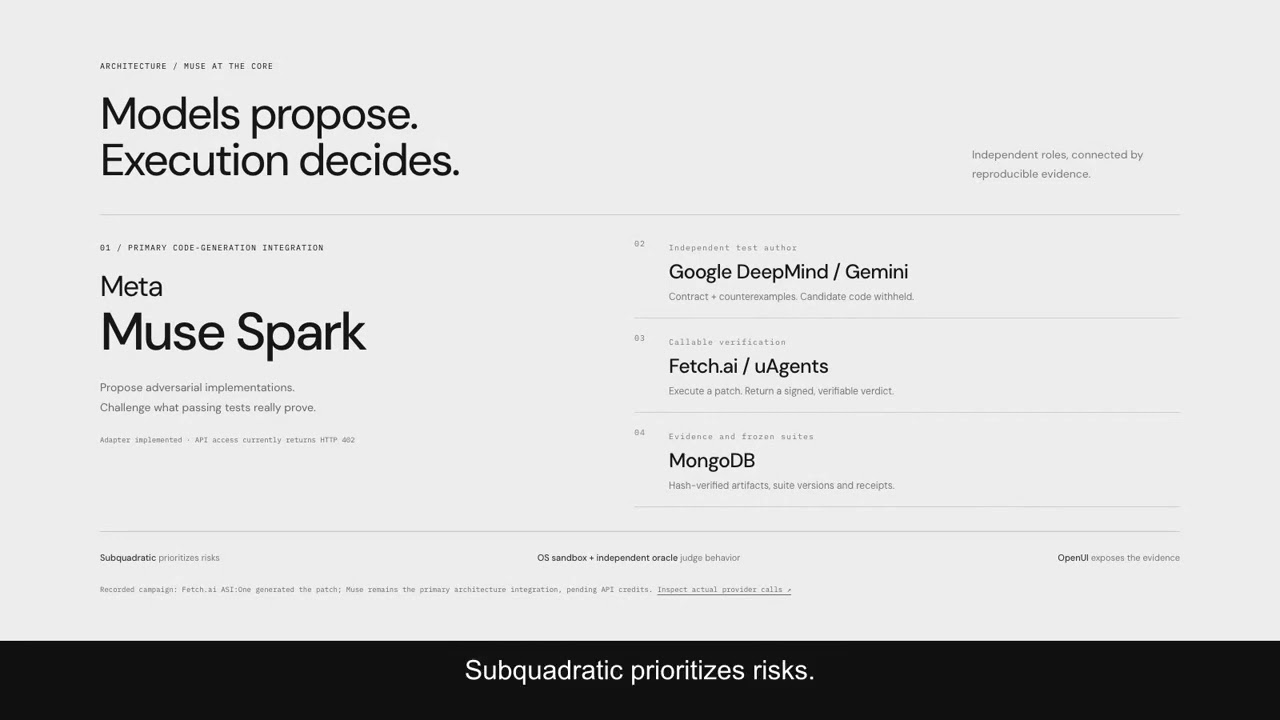
Your coding agent says the patch is ready. Every test is green. What did those tests miss? CrossExam challenges the tests themselves. Its architecture centers on Meta’s Muse Spark as the primary code-generation integration, with Subquadratic prioritizing contract risks and Google DeepMind’s Gemini independently proposing stronger tests. The test author never sees the candidate implementation. An independent specification oracle and OS sandbox determine whether a failure is real. CrossExam turns demonstrated failures into short, reproducible counterexamples. Proposed tests earn promotion only when they catch additional faulty implementations, preserve existing coverage, and accept every correct control. After learning stops, a separate final audit measures the accepted suite. Fetch.ai makes the resulting evaluation callable by other coding agents. A Fetch uAgents verifier retrieves the frozen suite from MongoDB, executes a submitted patch, and returns a cryptographically signed verdict tied to the exact code and tests. OpenUI lets reviewers inspect the evidence, while MongoDB preserves campaign artifacts and receipts with verifiable hashes. The current recorded campaign uses Fetch.ai’s ASI:One for code generation while Muse API credit access is pending. It catches 8/8 synthetic audit faults with zero correct implementations rejected. The benchmark is now being expanded to 30 validation faults and 30 separate audit faults; those results are still being measured. Built for Trust but Verify, CrossExam gives coding agents an executable challenge before their work is trusted.