Strata
Built at Meta Global AI Developer Hackathon · Oct 26, 2026 · Remote
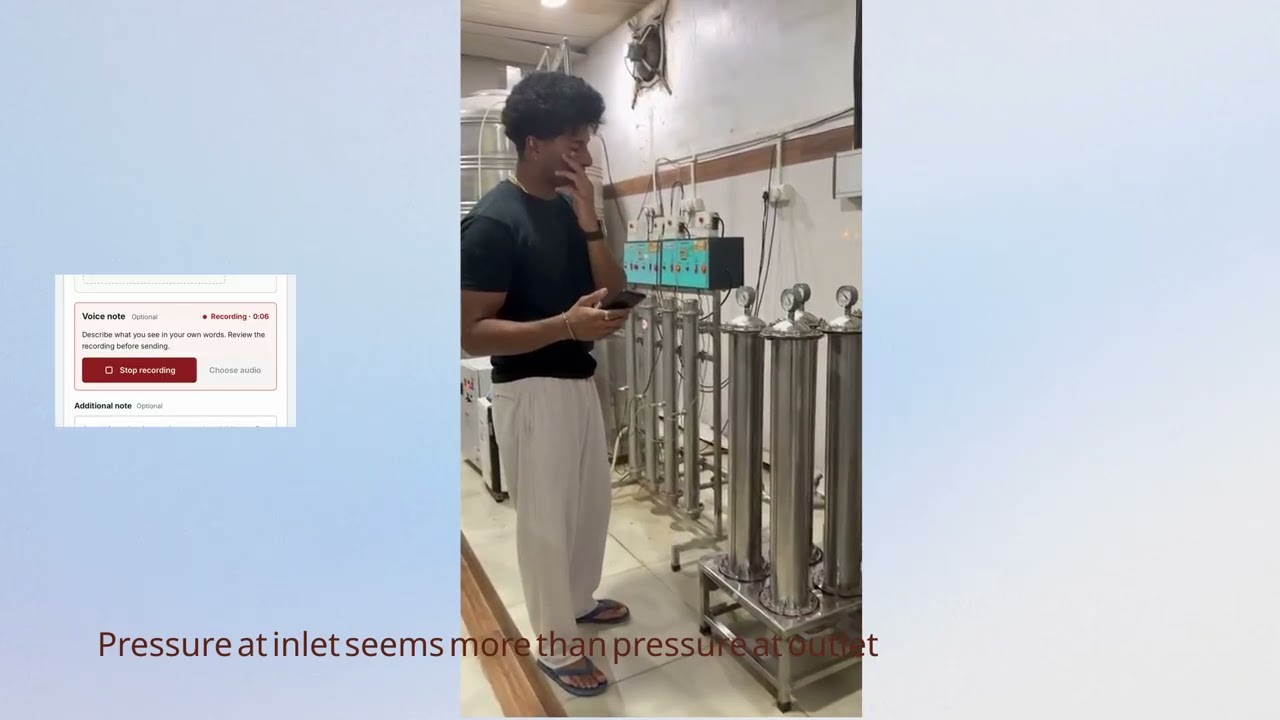
FAULTGLASS is a closed-loop fault investigator for brownfield process plants, where digital telemetry and manual equipment coexist and the one measurement that decides the diagnosis is the one nobody wired. THE PROBLEM: THE UNINSTRUMENTED LAST METER Main pumps and flowmeters stream to the PLC; the chokepoints that settle root cause (filter-bank inlet and outlet Bourdon gauges, local ΔP, manual valves) do not. When a cartridge bank loads, permeate falls from ~2,000 to ~1,500 L/h, suction pressure and motor current sag, TDS creeps up, and every PLC fault bit stays NORMAL. From the control room, a loaded cartridge, a feed-supply problem, a failing high-pressure pump and a membrane fault look alike, and they cost very differently: guess wrong and you pull a healthy pump or replace membranes that were fine. So diagnosis dominates downtime: readings radioed in, P&IDs from memory, valves turned by hand with no record of how, closure by judgement. Anomaly detectors and manual copilots stop at this boundary. They flag the symptom; they cannot observe the cause or prove the fix. THE SOLUTION FAULTGLASS carries the investigation across that boundary, with the field operator as the agent's sensing and actuation extension: 1. Perceive: a read-only Modbus edge feeds an open-weight watcher that screens 30 s statistical cards every 10 s for coordinated drift no single alarm catches. 2. Reason: a long-horizon agent runs a differential diagnosis over plant topology, SOPs and prior incidents, holding feed, pump, membrane and cartridge hypotheses as open, rejected, supported or confirmed on telemetry evidence. 3. Reach: field-only tags are unreadable by construction, so the agent stops instead of hallucinating and dispatches a targeted task. The phone Field Companion locates the gauges in a 3D digital twin, and the investigation checkpoints until the physical world answers. 4. Measure: SAM 3.1 isolates each dial from phone-photo clutter, Wonder reads the psi scale, and code computes inlet-minus-outlet ΔP against a 12 psi restriction gate. The operator's Marathi/English voice note is structured and tolerance-checked against the photos. 5. Actuate safely: the V-113 backwash is proposed only when ΔP is restricted and runs only after Commander approval. The lever video is tracked to prove the SOP's staged close: two hand-driven moves separated by a still hold of at least 2 s. 6. Verify: an independent verifier closes the incident only on sustained recovery in fresh telemetry. RESULT Piloted on a mineral-water bottling plant in Maharashtra, India: gauge photos, valve clips and operator voice captured on site, process telemetry from a physics-based simulator behind a Modbus PLC emulator. The loop runs end to end, from silent drift to verified recovery at ~92% of baseline (~350 L/h restored), with cartridge replacement kept open as the follow-up. No PLC writes, no retrofit, every link auditable.