Billcast
Built at Meta Global AI Developer Hackathon · Oct 26, 2026 · Remote
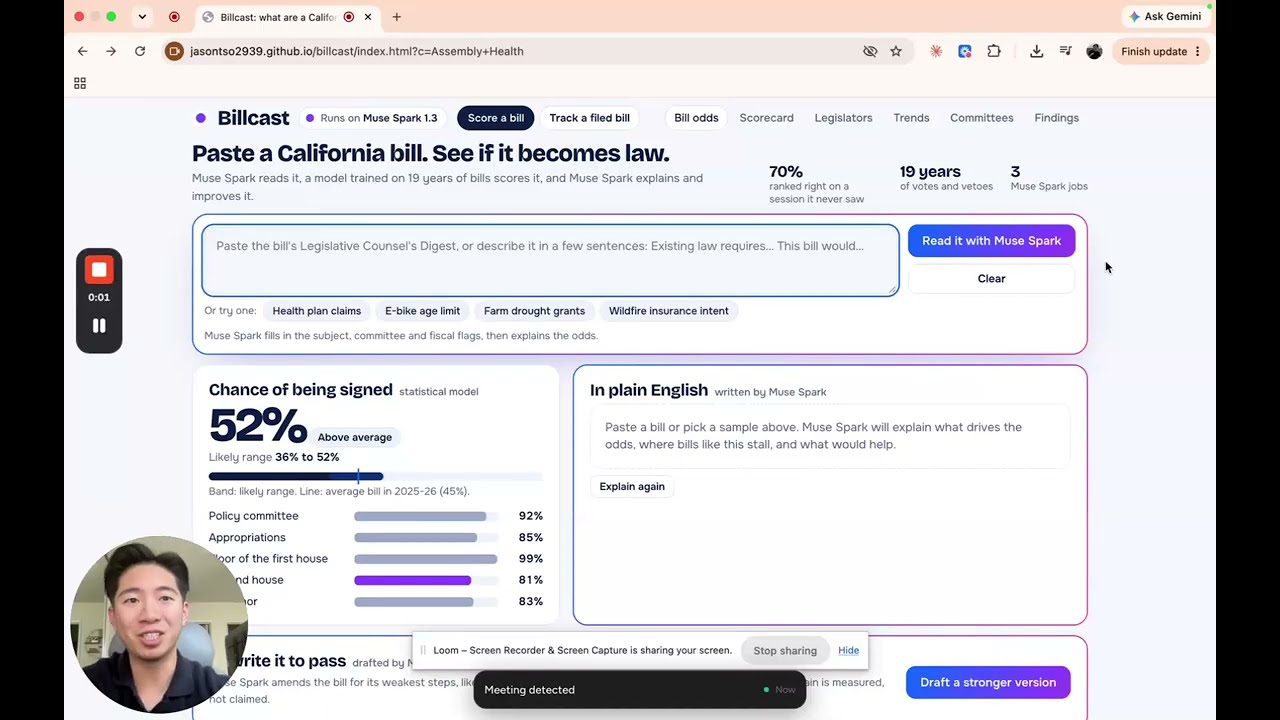
Billcast tells you a California bill's chance of becoming law, step by step, and explains why in plain English. I work in the California State Assembly. Every year about 4,000 bills are introduced and well under half are signed. Staff, advocates and reporters guess which ones will survive from experience. I wanted a clear, honest number instead. Billcast is trained on every bill since the 2007-08 session (19 years of the Legislature's own bulk data). One logistic regression per step (policy committee, Appropriations, floor, second house, Governor) gives the chance of clearing each one, with a likely range from bootstrap refits. Tested on 2025-26, a session it never saw, it ranks bills with AUC 0.70 at introduction and 0.81 by 90 days in. What I built this week with Muse Spark: Paste a bill's Legislative Counsel's Digest and Muse Spark fills in the model's inputs: subject line, first policy committee and the fiscal flags, quoting the phrase it relied on for each. After the odds run, Muse Spark reads the bill and the numbers and writes a plain-English read: why the bill scores where it does, where bills like it stall, what would raise the odds, and what the model can't see. Rewrite it to pass: Muse Spark drafts an amended version aimed at the bill's weakest steps, the way a staffer would before a hearing. The statistical model re-scores the draft in the browser and shows the change at every step side by side, so the gain is measured, not claimed. The statistical model sets the number. Muse Spark reads and explains. Everything runs in the browser except the Muse Spark calls, which go through a small server function so the API key stays private. Live: https://jasontso2939.github.io/billcast/