TrajectoryGPT
Built at Meta Global AI Developer Hackathon · Oct 26, 2026 · Remote
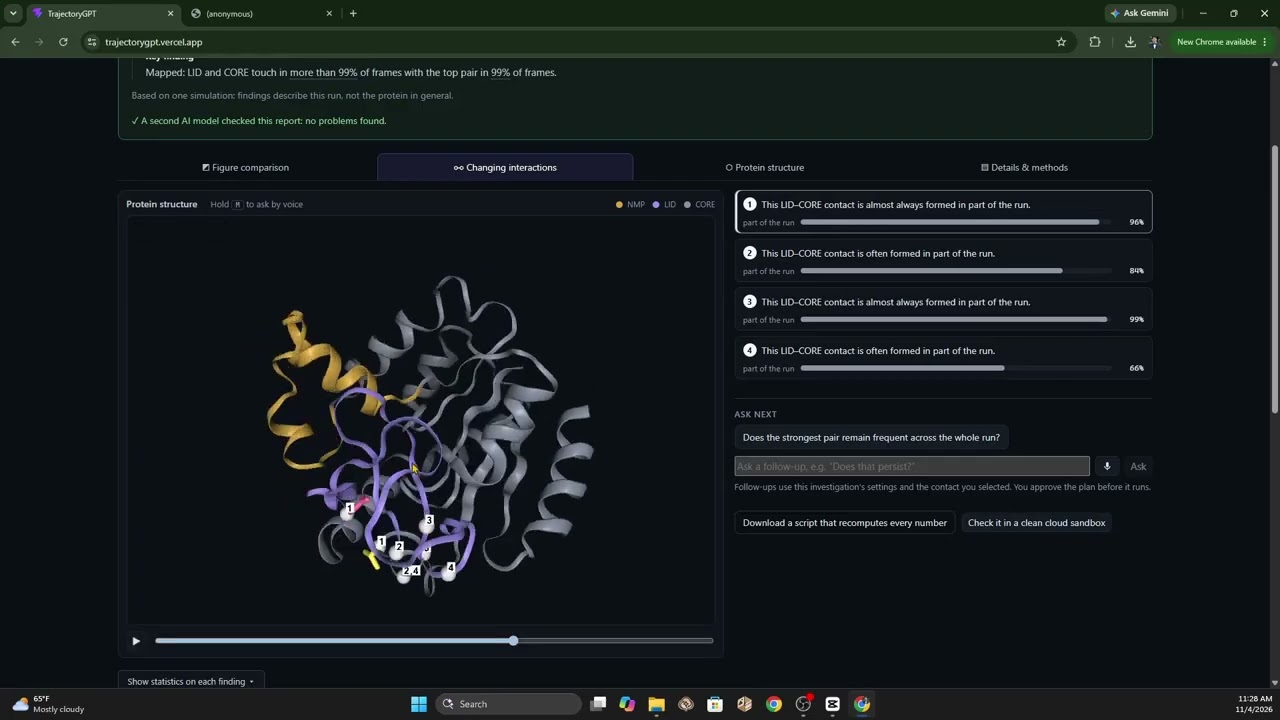
TrajectoryGPT is an AI-powered research agent I built to help scientists reproduce published results and analyze molecular dynamics simulations. Reproducing a figure from a research paper can take a surprising amount of work. Even when the simulation data is available, it's not always clear how the authors arrived at their results. Researchers often end up spending hours trying to reconstruct the original analysis before they can even start investigating their own data. That's the problem I wanted to solve with TrajectoryGPT. A researcher can upload a figure from a paper or simply ask a question about a simulation. The agent works out what the researcher is trying to measure and how to approach it. If the figure doesn't provide enough information, it asks the user to confirm the missing details rather than making assumptions. Once the analysis is configured, TrajectoryGPT runs it using scientific Python libraries like MDAnalysis and NumPy. The results are displayed through interactive visualizations, which include a 3D protein viewer. Researchers can also inspect the underlying calculations and see exactly how the results were obtained. I also built in a verification process because getting a convincing-looking graph isn't the same as getting a scientifically correct result. Muse Wonder independently checks Muse Spark's analysis and flags potential issues that deserve a closer look. The main idea behind TrajectoryGPT is that the AI should figure out how to perform the analysis rather than inventing the results. The actual measurements come from scientific code running on a FastAPI backend deployed through Modal, with a React frontend for interacting with the results. I built this because I wanted to make computational research easier to reproduce without sacrificing the ability to inspect and verify the science behind it.