Victor
Built at Meta Global AI Developer Hackathon · Oct 26, 2026 · Remote
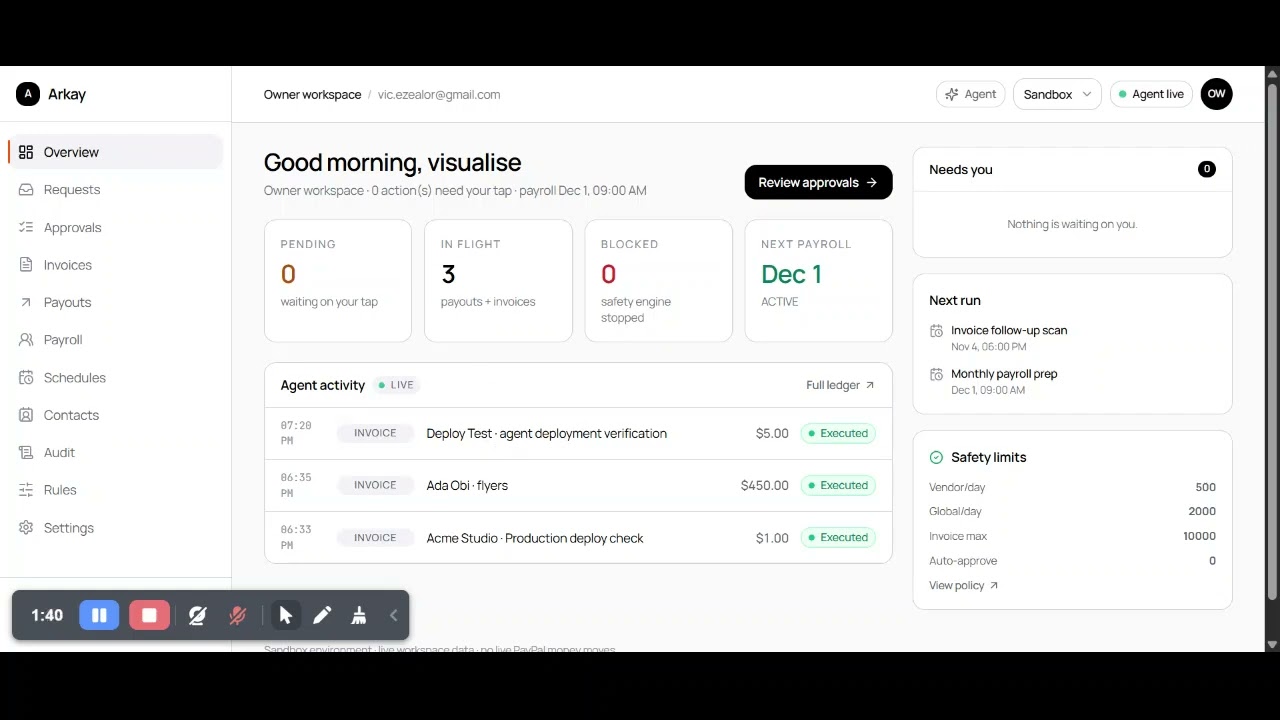
ArkPay is a payments agent that can't steal your money. Freelancers and micro-businesses drown in money-request chaos: a client emails an invoice request, a teammate asks for their cut in Telegram, a receipt photo lands in the group chat — and the founder is the human middleware who copies amounts into PayPal, chases approvals, and keeps the spreadsheet. AI agents that act on your behalf sound great right up until you realize one hallucinated tool call can move real money to the wrong person. ArkPay closes that loop with an approval-first architecture: 1. INGEST — money requests arrive from Gmail, Telegram chat, voice notes, and receipt photos. Meta's Muse Spark 1.3 (via the Meta Model API) extracts payee, amount, currency, purpose, and deadline into a structured draft. 2. DECIDE — every action passes a Payment Safety Engine before anything touches the money: per-transaction and daily caps, vendor allow/block rules, new- payee and amount-anomaly risk flags, and an approval card that expires. One tap on Telegram or in the web app approves it — or it dies unused. 3. ACT — on approval, ArkPay executes against the PayPal API: creates and sends a real invoice, or drafts a batch payout. Every call is idempotency-keyed, every outcome (including PayPal's webhook receipts) lands in an append-only audit trail you can trace end to end. Why it's trustworthy, not just convenient: - The LLM never moves money. It only drafts; the policy engine + human approval gate execution. A prompt-injected email cannot approve itself. - Multi-tenant from day one: workspace-scoped queries everywhere, verified with cross-tenant isolation tests. - PayPal credentials are AES-256-GCM encrypted at rest per workspace; scopes are probed and displayed, and missing scopes are surfaced in the UI. - We chose the Meta Model API Standard tier deliberately: financial data must never train models. That governance property is a feature, not a footnote. Stack: NestJS API + React (Vite) SPA, PostgreSQL (Prisma), PayPal Invoicing / Payouts / Transaction Search APIs + Agent Toolkit, Gmail + Telegram ingestion, Docker/Caddy on a VPS — all live in production. Everything was built Oct 27 – Nov 4, 2026 (verifiable in the public git history). The brain of the whole system is Meta, through the Meta Model API's OpenAI-compatible endpoint, which we swapped in at the config layer: Muse Spark 1.3 runs structured extraction and receipt vision, Muse Wonder 1.0 runs the agent tool-calling loop, and Muse Voice Transcribe handles voice notes. Verified on deadline day: 20/20 extraction fixtures and 6/6 agent-chat scenarios on the Meta models (Spark had fixed the one residual flake our previous provider showed).