Corey Von Allmen. Individual
Built at Meta Global AI Developer Hackathon · Oct 26, 2026 · Remote
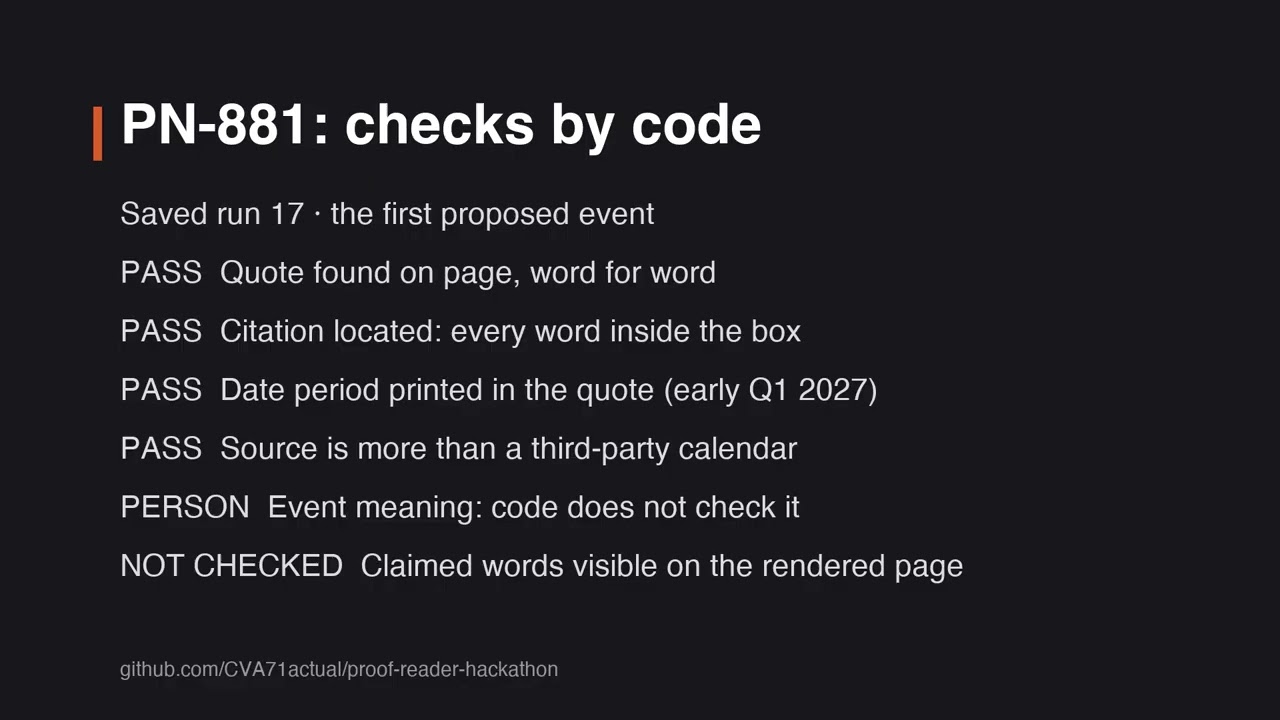
I research investment catalysts for biotech companies: trial readouts, regulatory decisions, launches and investor events for the next six months. I do this with several AI models and review claims against their cited sources, keeping an audit record and a list of unresolved questions. In this hackathon I tried to automate that workflow with Meta's models. Proof Reader is the result, and this submission is an honest report of what worked and what did not. How it works: Muse Spark (Meta Model API) researches one company as an agent. It searches, captures pages and proposes each event with an exact quote from a captured page. Code then checks each proposal (quote on the page, citation located, date printed in the quote, source rule) and records pass, fail or not checked. Muse Spark Open, Meta's open-weight model on Baseten, reviews the rows; Muse Wonder proposes resolutions for disagreements; LettuceDetect may flag wording. A person reviews every row with a failed check or a reviewer finding and keeps, fixes or removes it, by click or by voice (Muse Voice Transcribe). Clean rows are placed automatically and labelled "not reviewed by you". The calendar and the PDF and Word reports are built from the saved run, and the exact instructions sent to the models are saved with each run. What helped: the mechanical parts and saved records - exact quotes on captured pages, recorded checks, spending and turn limits, honest stage labels - which made failures investigable, plus explicit instructions. What remained unreliable: research coverage and judgment. On 15 candidate items in an exploratory comparison, runs found roughly 3 to 11 (not a validated recall score). Live runs taught four lessons: models did not reliably follow instructions; they spent effort unevenly (in run 17, 31 of 98 searches went to one question); results varied between runs; and 3,000+ passing tests did not reveal what live runs exposed. Demo: run 17 (207 turns, 27 sources, 9 rows, review complete with 3 findings, $4.19) and run 18 (109 turns, 8 rows, 4 findings, $2.79), both downloadable from the repo's release. Conclusion: the workflow is demonstrated. Research quality, repeatability and practical value remain to be evaluated. Models explore, code checks what can be checked, and a person judges. Proof Reader is one part of a larger AI research project of mine and was a valuable R&D effort.