bami-codes
Built at Meta Global AI Developer Hackathon · Oct 26, 2026 · Remote
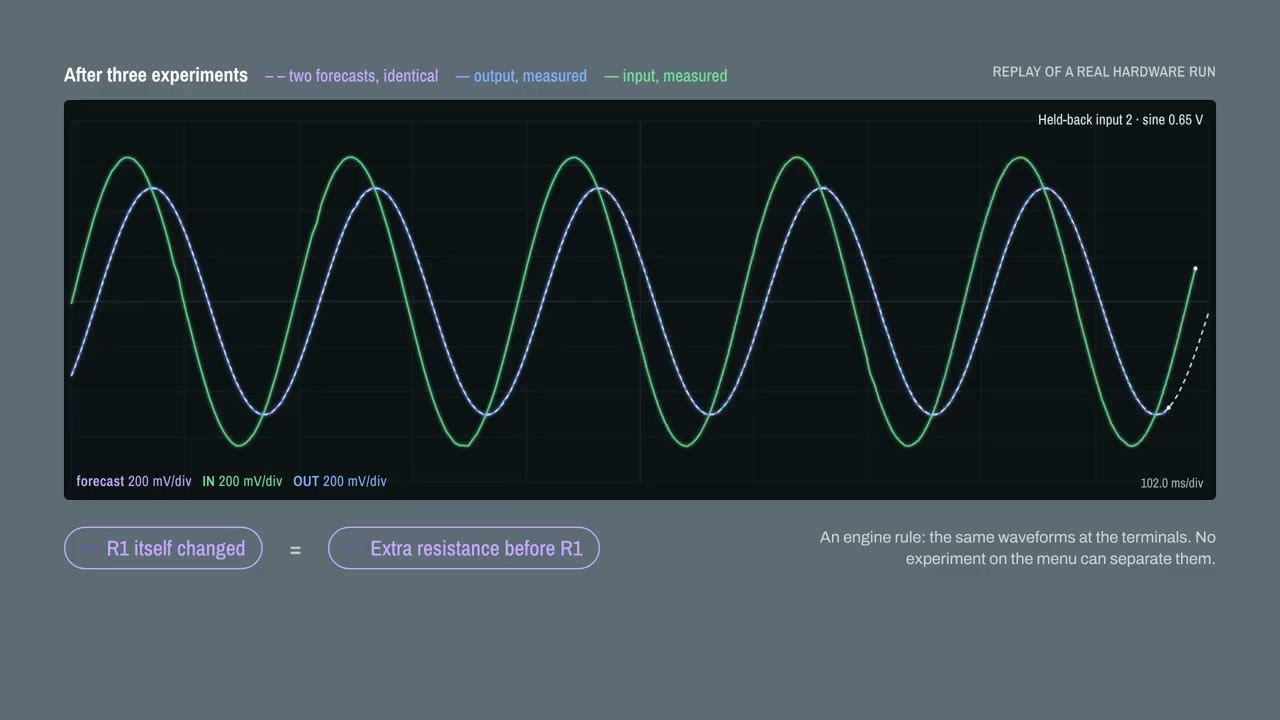
The drawing is right. The board looks right. The output is wrong. What should you measure next? BenchMate gives Meta's Muse Spark a real $40 Arduino bench to investigate that question. It is built for engineers and students debugging circuits: Spark chooses experiments, proposes explanations, and asks for the measurement that can tell competing explanations apart. Spark reads the schematic and chooses tests from a fixed menu. Before each measurement, a circuit simulator records what the current explanations predict. The engine fits those explanations to the measurements collected so far and rejects those that cannot fit within the test allowance. If changing component values cannot explain the board, Spark can propose a component absent from the drawing. If the waveforms cannot decide, it can request a specific multimeter reading. A person moves the wires and takes that reading. Two examples show what this enables. In Case 04, Spark proposed a diode absent from the drawing. After the engine fitted this model, it was locked and published before two new inputs were measured. Both checks passed the 9 mV error allowance. Opening the sealed assembly record revealed a diode in the direction Spark proposed. In Case 01, two explanations produced the same waveforms. Spark requested one resistance reading: 4.71 kΩ showed that R1 was correct and the extra resistance lay before it. We rebuilt five problems reported on engineering forums as small circuits with deliberately planted faults hidden from Spark. Each case ended with a repaired board and a fresh run reporting no mismatch in the tests Spark chose. Across all 15 diagnostic runs, 10 reached a verdict (five fault diagnoses and five repaired reruns), two abstained and three stopped; every attempt remains public. The forecasts are recorded before measurement, final circuit models and reading ranges are published before their checks, and the planted fault is documented before the first measurement and revealed only after the verdict. Judges can replay the runs, click through to the underlying events, and verify record integrity offline with Python and no extra packages. Built solo in nine days, BenchMate demonstrates AI-guided experiments on physical hardware: an unexplained output becomes a concrete next check. Live demo: https://bami-codes.github.io/BenchMate/