TheAptician team_id=1727827281800765
Built at Meta Global AI Developer Hackathon · Oct 26, 2026 · Remote
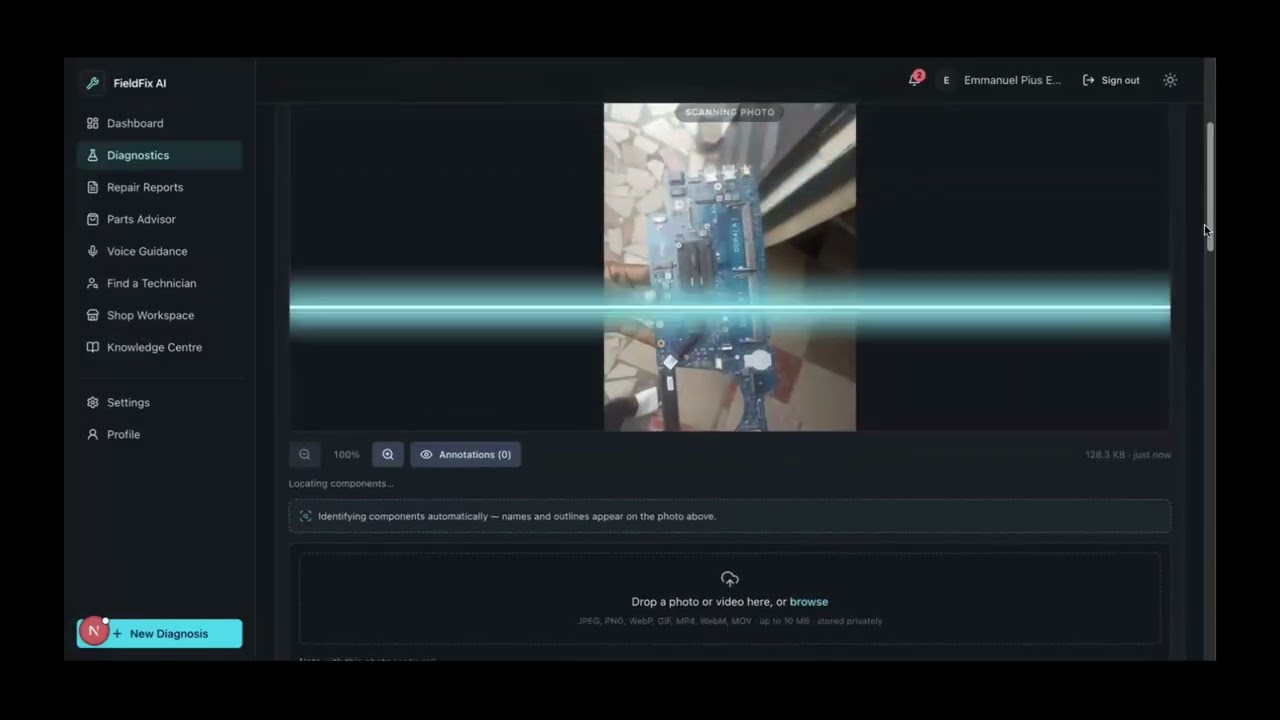
FieldFix AI — Stop guessing. Start proving. Every day, millions of people troubleshoot broken laptops, desktops, and phones the worst way possible: blind forum guesses, no evidence trail, no provenance — and no safety guardrails when the fault is a swollen battery that could catch fire. Repair shops aren't much better: scattered notes, verbal estimates, zero audit trail. FieldFix AI replaces guesswork with an evidence-driven diagnostic loop. Users describe symptoms and upload photos or videos. The platform analyzes the evidence with Meta's AI models, proposes ranked fault hypotheses, guides the user through safe distinguishing tests, cites real technical documents verbatim, enforces a deterministic safety policy — and compiles everything into a shareable repair report where every claim carries a provenance label: observed, inferred, user-reported, or technician-verified. What makes it stand out: • Three Meta models, live in one loop — Muse Spark reasons over diagnoses, safety screening, and visual identification; SAM 3.1 localizes components on evidence photos with boxes and masks; Muse Voice Transcribe powers hands-free, voice-guided diagnostics. • Safety is deterministic, not suggested — a rules-based safety controller escalates hazard language automatically and hard-blocks the loop on critical danger. The AI can raise suspicion but can never clear it. • Zero-hallucination citations — every technical citation must resolve verbatim to a real ingested document passage; fabrications are refused, not rendered. • A complete repair product, not a demo — parts advisor with live supplier feeds, a repair-shop workspace (kanban jobs, estimates, inventory), technician discovery with map view, accounts with RBAC + MFA, and PDF report export. Under the hood: Next.js + Express + PostgreSQL (48 tables), with shared Zod contracts as the executable source of truth validated by both ends at runtime.