Recursive Harness Scientist
Built at The Harness Engineering & Model Wrangling #SFTechWeek Hackathon · Oct 11, 2026 · San Francisco, CA
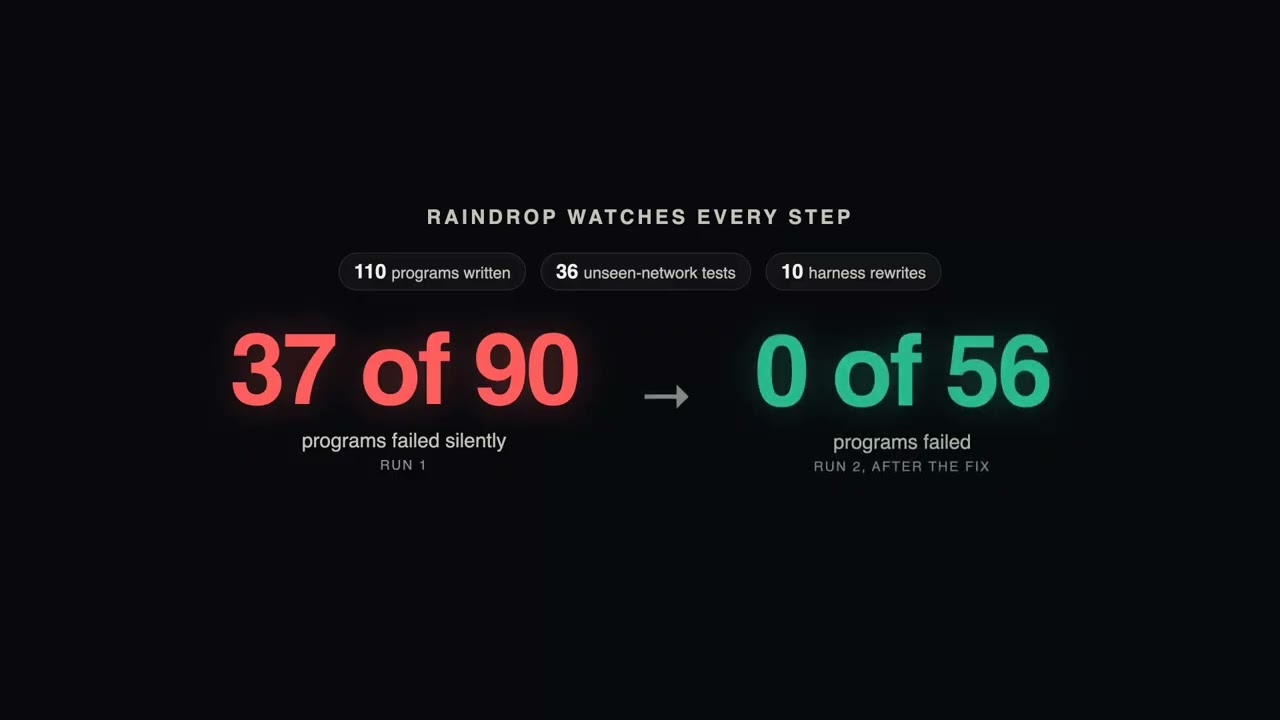
Recursive Harness Scientist: an AI scientist that improves its own scientific method, and must replicate every gain on data it has never seen. Why it matters. Science runs on incomplete maps: we know only 2–11% of how human proteins interact. Predicting the missing links decides what gets tested next. A biomedical knowledge graph flagged baricitinib for COVID-19 in about three days, and the FDA approved it in 2022. But every success needed experts to hand-pick the method for one field, and the wrong method does no better than chance. A harness built for science. Every part of the harness is a part of the scientific method: Hypothesis: the AI scientist (Claude Sonnet 5) proposes how links form, such as shared neighbours or paths of length 3, and encodes the idea as an algorithm. Experiment: the algorithm runs in a sandbox on real data and is scored by average precision, not by an LLM judge. Lab notebook: every hypothesis, result and “what I changed and why” goes into MongoDB Atlas. Literature: the best past findings are read back as lessons. Instruments: a network-statistics tool measures each dataset. Peer review and replication: every new method must hold up on 7 unseen real networks, and every run is repeated. Lab safety: guardrails can only get stricter. A meta-scientist (Claude Opus 4.8) reviews the notebook and rewrites the method itself, including the rules it uses to rewrite it. Results, in one day: The evolved method beat the human-written baseline: +7% on the training networks and +5% on 7 unseen networks spanning proteins, metabolism, ecosystems, power grids and the Internet. It found missing links 10× better than chance in networks it had never seen. Peer review worked. In run 1 the gains failed to replicate. We traced the main cause to silently truncated replies and cut failed experiments from 37 to 0. The winning method chose to read 4 lessons from its literature (MongoDB) every round. 12 methods, 146 experiments and 11 real networks from 8 fields, all in Atlas, monitored in Raindrop and shown live in a WebGL console.