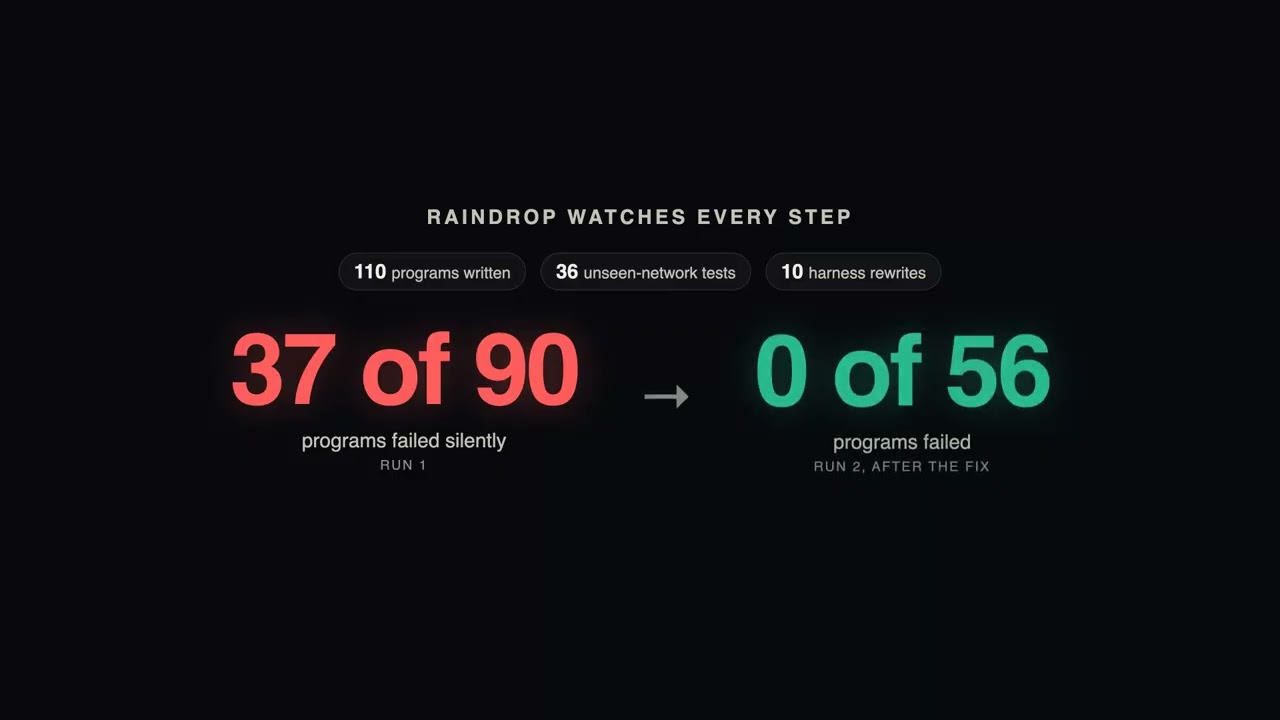
HELIXA is a research studio for changing an agent’s scientific workflow without trusting a model to invent biology. Genomic pipelines can report success while the reference build, allele, or metadata is wrong. A language model can propose a DNA edit, but it cannot reliably decide the exact sequence change that would produce an arbitrary body feature. HELIXA separates those problems. A precise substitution is drafted only when the request names a coordinate and a base the loaded reference can check. A trait wish, such as greater ultraviolet tolerance, becomes an inspectable research proposal. No allele is invented, and nothing is saved until a validated edit is confirmed. The body model does not change shape just because a base changed. The hard part is recursive harness improvement. When a scientific check fails, HELIXA treats that as a gap in the agent’s policy, not as a reason to retry the same broken run. It proposes a bounded, typed change to the harness, evaluates the candidate against the parent on the original incident, negative controls, and sealed held-out cases, and promotes it only if an immutable policy envelope allows the change. The decision is stored as a cryptographic evidence receipt. A candidate cannot rewrite the evaluator, widen its own permissions, or inflate false positives. Worker leases use fencing tokens so a stalled worker cannot overwrite a newer result. MongoDB holds the durable record of that process: runs, monotonic events, checkpoints, harness versions, and evidence receipts. Raindrop is the observability path for why a harness run failed and whether a later policy was better. ElevenLabs turns a verified receipt into a spoken briefing, with on-screen captions when speech is not configured. The four tabs are the application of that mechanism: a Genome Editor, Genome and Harness Evolution, an Earth Evolution Sandbox, and a Harness Library. The Earth view plays back a stored population-genetic model. A horizon of up to two million years is a model parameter, not a reconstruction of Earth, and a genotype is not claimed to guarantee a phenotype. Research use only. HELIXA does not diagnose, treat, or design a clinical sequence.
Team