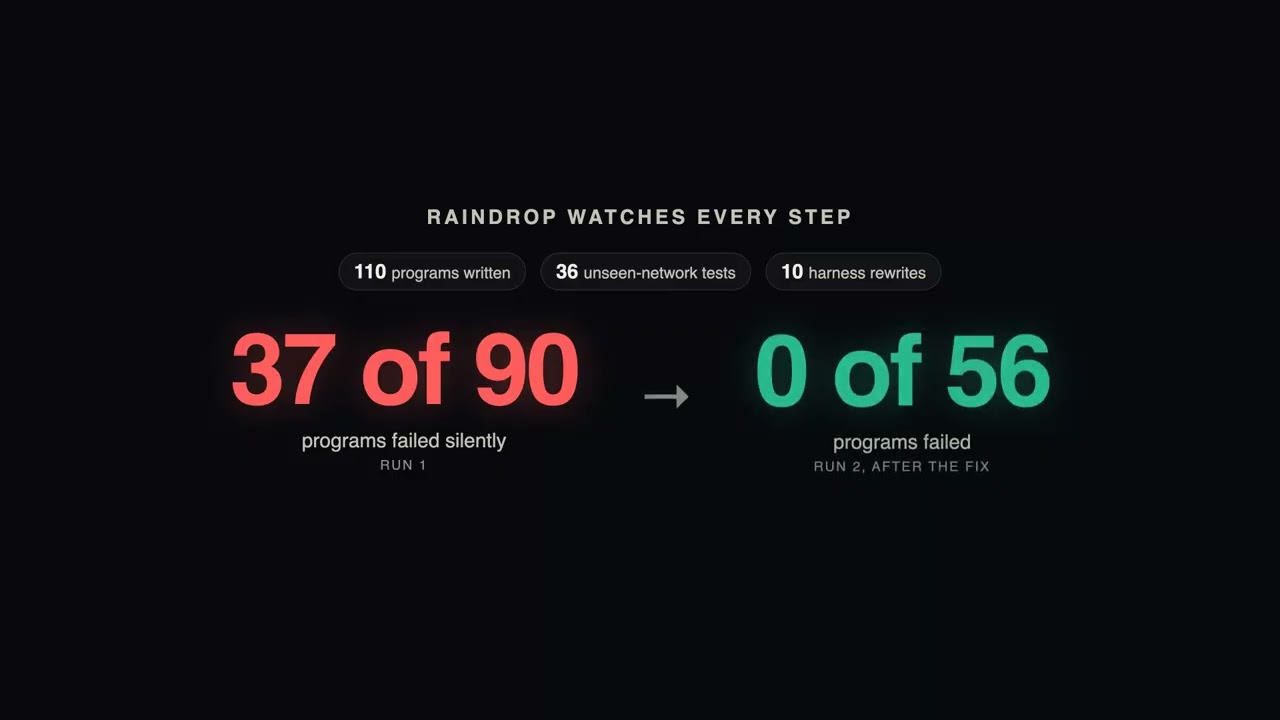
# RED QUEEN 2.0 — The Evolution Chamber **Every fix must survive its own attack.** **What if an AI agent could test its own solutions, learn from failures, and improve until its fix actually works?** That's the idea behind RED QUEEN 2.0. RED QUEEN is a self-improving testing harness that automatically evaluates, challenges, and refines operational policies. Instead of trusting a proposed fix, it deliberately attacks it, identifies weaknesses, generates a better candidate, and verifies the results before allowing promotion. ### The Problem Imagine a customer making an online payment. The payment succeeds, but the confirmation message gets lost. The system thinks the payment failed and retries. **The customer gets charged twice.** This is exactly the kind of failure RED QUEEN is designed to detect and prevent. ### How It Works RED QUEEN runs each candidate policy through **54 different fault scenarios**, including lost confirmations, delayed responses, and stale ledger reads. The system evolves through three generations: - **Generation 1 — Blind Retry:** 20 scenarios fail. Rejected. - **Generation 2 — Ledger Reconciliation:** 10 scenarios fail. Rejected. - **Generation 3 — Stable Idempotency:** 54 out of 54 scenarios pass. Promoted. Each failure produces a counterexample that guides the next deterministic policy improvement. An independent verifier checks every candidate before promotion. ### The Live Proof RED QUEEN doesn't just display simulated success metrics. It executes the same payment fault against two different policies: **Baseline policy: 2 charges. Failure.** **Evolved policy: 1 charge. Success.** Same payment. Same fault. Different outcome. ### Technologies **MongoDB Atlas** serves as the system's persistent memory, storing execution events, counterexamples, verification results, and policy evolution history. Runs can be recovered after refreshing the application. **Raindrop** provides live observability, capturing policy evaluation events, rejected candidates, and verification outcomes. The integration is operational in production. The current candidate-generation mechanism is deterministic rather than LLM-generated. RED QUEEN demonstrates the underlying recursive harness architecture: adversarial testing, evidence-driven improvement, independent verification, and persistent memory. ### Why It Matters As autonomous systems take on more responsibility, generating solutions is only half the challenge. **We also need systems capable of testing those solutions, detecting failures, and verifying improvements before deployment.** RED QUEEN demonstrates how that process can work. **Don't just generate a fix. Make it survive its own attack.** **Live Demo:** https://red-queen-ten.vercel.app **GitHub:** https://github.com/vincentleg/red-queen
Team