Precedent - the Harness for Evolving Memory
Built at The Harness Engineering & Model Wrangling Hackathon · Sep 26, 2026 · New York, NY
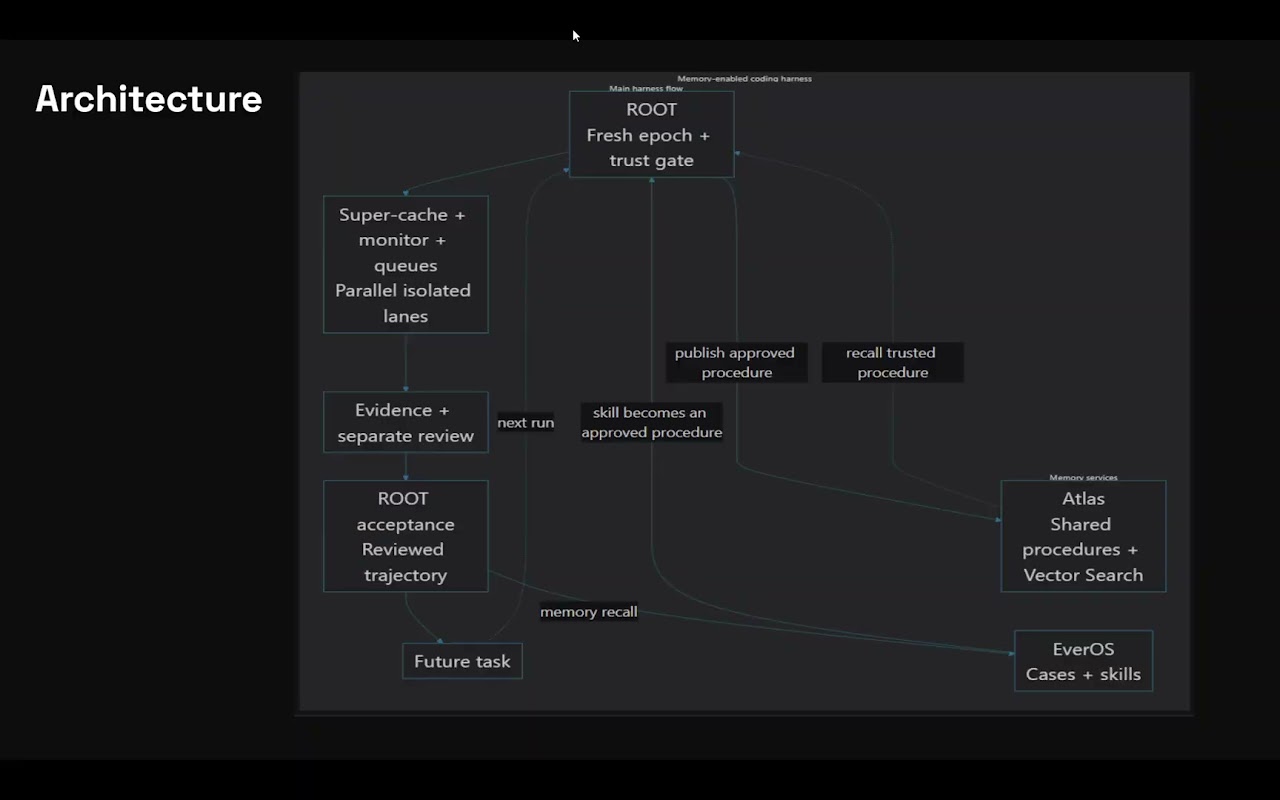
We built a complete orchestration and memory system for teams of coding agents. At the foundation is our custom Orchestrator Harness. Every campaign begins with a fresh epoch, and ROOT divides the work into > parallel lanes. Each lane gets its own Git branch, isolated worktree, task card, and provider session, preventing workers from interfering with one another. The super-cache stages the standard tools, hooks, skills, > and provider configuration that every worker needs. A persistent monitor watches processes, results, leases, and lane health. Workers can send progress reports or request help through queue notifications, and ROOT > can respond without restarting their sessions. > > The harness also controls the complete result lifecycle. A worker must produce evidence tied to its exact lane and run. A separate reviewer decides whether the result passed, failed, or was blocked, and ROOT > separately accepts or rejects it. The harness can resume stopped lanes, correct invalid results, retire completed work, and clean up resources using exact identities. > > On top of this, we built a memory feedback loop built on top of the open source EverOS (not ours) and MongoDB-langchain Atlas (not ours). After work is reviewed, we record a trajectory describing the task, what was attempted, the result, and the review decision. EverOS turns reviewed experience into > historical cases and reusable skills. Our custom trust system verifies where those skills came from. An approved skill can become a trusted procedure with an immutable version, permissions, applicability rules, > current-version status, and revocation support. > > Trusted procedures can be published to MongoDB Atlas and found using real Vector Search. When a new task starts, the system searches EverOS for relevant local experience and Atlas for shared procedures. It > validates every result before use, builds a safe task-specific plan and worker context, and then launches a real coding worker. The reviewed outcome feeds back into memory for future tasks. > > The result is a coding-agent harness that can safely learn from reviewed work, reuse proven lessons, coordinate parallel agents, and improve across tasks while still working normally when every optional memory > feature is disabled. On SWE-Marathon v1.1 ZSTD, our harness scored 47.3% above the official high average and 7.3% above the official xhigh average while xhigh used 91% fewer uncached tokens—11.14× lower—although our runs took longer, due to the agent no longer doing early termination.