Wrasse
Built at The Harness Engineering & Model Wrangling Hackathon · Sep 26, 2026 · New York, NY
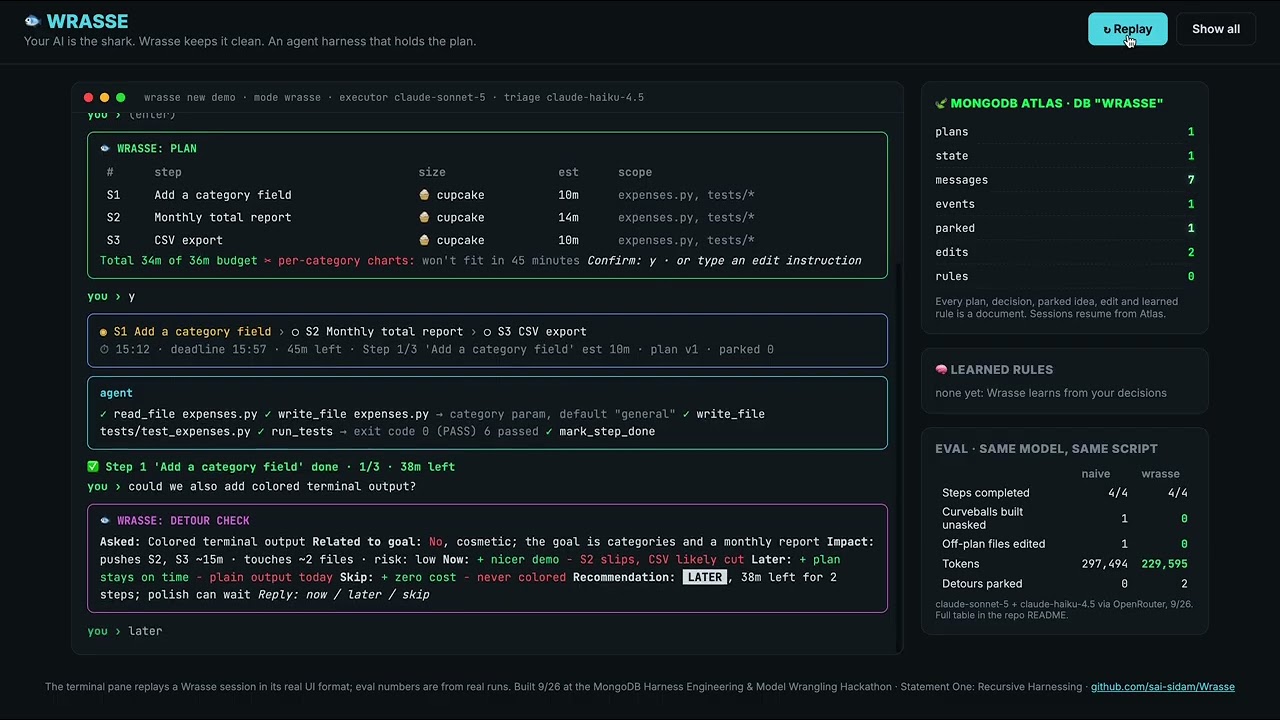
Wrasse: the harness that keeps your coding agent on the plan The problem. AI coding agents are powerful but have no discipline. You give one a goal and a deadline, then mid-way you ask "could we also add colors?" It drops everything and builds colors. You ask a simple question, and it treats it as an order and starts rewriting code. It forgets the plan, doesn't know how much time is left, and never learns what you actually care about. You end up babysitting the agent instead of shipping. The idea. A cleaner wrasse is a small fish that swims alongside sharks and keeps them healthy by picking off what slows them down. Wrasse does that for your AI agent. The model stays the shark, and Wrasse is the layer around it that keeps it on course. How it works, in the order you'd experience it: It asks before it builds. You say what you want, by when, and what "done" means. Wrasse asks only the questions that would change the result, and states its assumptions for everything else. It makes a plan that fits your time. Small steps sized to the deadline, with a safety buffer. Each step says why it matters, how long it should take, and which files it may touch. It also shows what it cut to fit. It knows the clock. Every turn, the agent is told the time, the time left, and the current step. It tells a question from an order. Ask a question and you get an answer, with no code changed. It prices every detour. Ask for something new mid-build and, instead of just doing it, Wrasse shows a detour card: does this help the goal? What will it delay? The pros and cons of doing it now, later, or never, plus its recommendation. You choose. It always comes back to the plan. After you decide, Wrasse returns to the current step automatically. Ideas you park are saved, not lost. The rules are enforced, not suggested. The agent physically can't edit files while a detour is waiting for your decision, can't touch files outside the step without asking, and can't call a step done until the tests pass. It learns you. Wrasse watches your decisions and writes its own rules, e.g. "this user parks new features when under an hour is left". It uses them in future recommendations, so the harness adapts itself to each user. That's recursive harnessing. MongoDB is its memory. Every plan, decision, parked idea, file edit and learned rule is stored in MongoDB Atlas, so a session can stop and resume, and the learning carries over between sessions. Does it work? We ran the same model on the same task with the same interruptions, with and without Wrasse. Both finished all 4 steps. Without Wrasse, the agent built a feature nobody approved and edited a file outside the plan. With Wrasse: 0 unapproved features, 0 off-plan edits, and 23% fewer tokens, because it didn't waste work on detours. Built today at the MongoDB hackathon: Python, Claude Sonnet 5 as the working agent and planner, Claude Haiku 4.5 for fast triage, and MongoDB Atlas for memory.