PradeepTeam
Built at Meta Global AI Developer Hackathon · Oct 26, 2026 · Remote
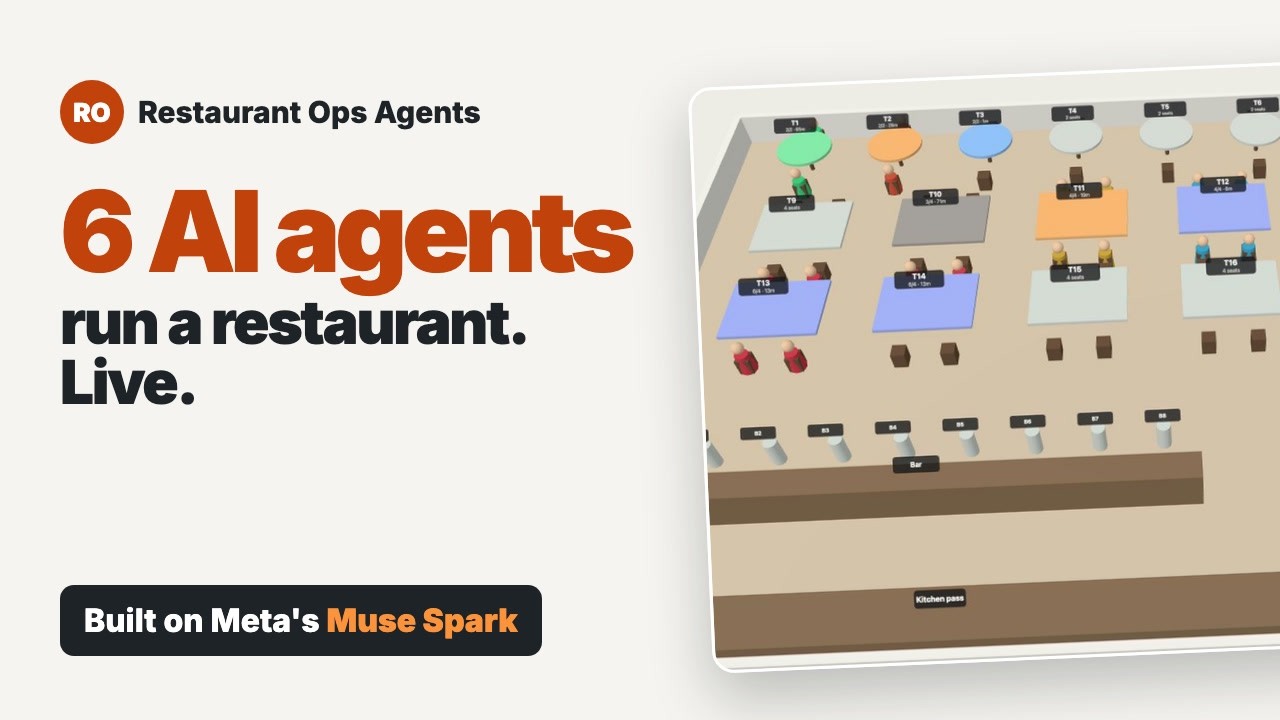
Restaurant Ops Agents is a real-time, multi-agent operating system for an 80-seat bistro. A simulated dining floor (3D and 2D) and an online-order page generate orders. Six agents react to every order on one event bus: | Agent | What it does during service | | --- | --- | | **Order** | Parses mods and allergies, allergen-checks every item, routes it to a kitchen station and fires courses; asks to throttle online orders when the kitchen is slammed | | **Inventory** | Depletes stock lot by lot (first-expiring first, FEFO), flags low stock against tonight's forecast and lots near expiry, quarantines on a cooler failure | | **Forecasting** | Revises tonight's covers every 15 service minutes from what is actually seated; forecasts tomorrow with P10/P50/P90 bands (LightGBM quantile models) | | **Procurement** | Compares supplier quotes, drafts purchase orders (MILP optimizer), negotiates with supplier vendor agents, learns supplier reliability, re-plans after a rejection | | **Menu** | "86 salmon after 4 more", specials that use at-risk stock (margin and allergens checked), menu engineering and price suggestions | | **Prep & staffing** | Prep list from the forecast, mise en place burn-down, calls a cook in when a station stays behind | **Design principle: numbers come from models and rules; judgment comes from agents.** Agents call deterministic tools for every number (forecasts, quotes, stock, margins). A LangGraph coordinator runs every proposal through a constraint checker (shelf life, minimum order, budget, station capacity, allergens) and resolves cross-agent conflicts, for example blocking a salmon special while salmon is short. Anything above a threshold goes to the manager as an approval interrupt with a safe default on timeout. The manager sees every decision and its reason live, and approves, edits or rejects with one click. The hot path never waits on a model: an order is parsed, allergen-checked and routed in under a millisecond. Around the agents sits the rest of a real restaurant: - **Front of house:** bookings and a waitlist. - **Payments:** checks, splits, tips, gift cards and loyalty, delivery by zone, and Stripe-ready card payments. - **Guests:** profiles with persistent allergies. - **Food safety:** HACCP checklist, temperature log and food donations. - **Kitchen:** kitchen display and printed station chits. - **Purchasing:** POs sent to suppliers as PDF by e-mail. - **Back office:** day close with a double-entry journal, backups with a restore drill, crash recovery from snapshots or the event log, role-based sign-in with an audit log, an admin Setup screen and a POS history importer. **Disruptions you can trigger live:** - **Party of 12:** the grill wait jumps and online ready-time quotes stretch. - **Salmon short:** an 86, a replacement special and a fallback PO that re-plans after a rejection. - **Cooler failure:** dairy quarantined and the affected dishes 86'd. - **Heatwave:** the dish mix shifts toward cold dishes. - **Forecast miss:** tonight is revised and tomorrow's order adjusted. **Measured, not claimed.** KPIs include order-to-station latency, quote accuracy, ticket times, 86s caught before a guest ordered, waste, food cost, and auto-executed vs approved decisions. A batch simulator compares the agents with a fixed-par baseline over a week. Every service can be replayed from its event log. 138 backend tests pass. **Stack:** - **Backend:** Python, FastAPI, LangGraph and LangChain, LightGBM, a MILP optimizer, SQLite, and optional Redis Streams. - **Frontend:** React (Vite) with a Three.js floor. - **Meta:** the Meta Model API (Muse Spark).