alamazing
Built at Meta Global AI Developer Hackathon · Oct 26, 2026 · Remote
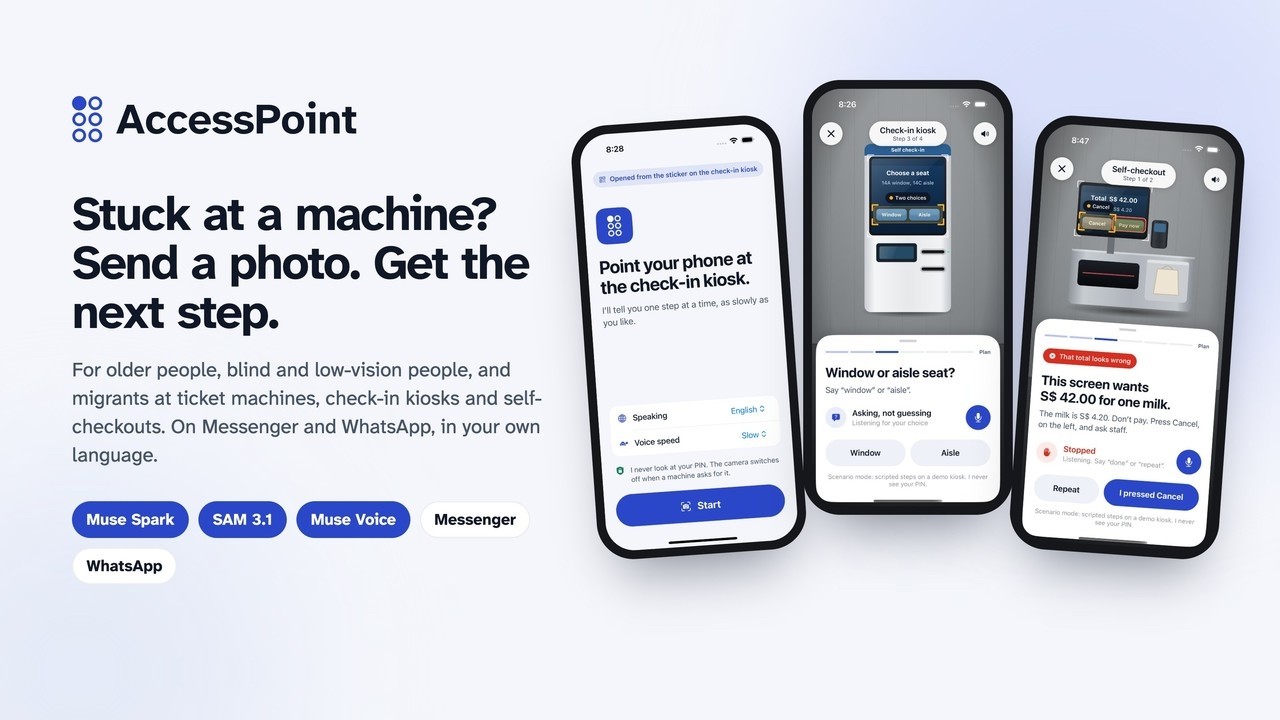
AccessPoint helps people who struggle with self-service machines (ticket machines, airport and clinic check-in kiosks, self-checkouts, food kiosks) get through them safely: older people, blind and low-vision people, and migrants and tourists who can't read the screen's language. You send a photo of the screen on a chat app and get the next step, in your own language, as text and a spoken voice note. Nothing to install. The problem. Counters were replaced by touchscreens just as the world got older: 1.4 billion people will be over 60 by 2030, 2.2 billion live with a vision impairment, and 281 million live outside the country they were born in, and millions more travel every year (WHO, IOM). Machines that handle money and identity assume you can see, read the language and react quickly. Today the only help is a stranger, who might watch your PIN, or a general chatbot, which might say "press Pay" on a wrong total or guess at a button it can't read. What it does. - Recognises the machine and reads what the screen is asking ("This looks like an airport check-in kiosk"). - Gives one step at a time, and says where the button is ("Window 14A is in the middle, on the left"), with the person's own photo and the button outlined. - Asks instead of choosing when the screen offers a choice. - Stops the person when the screen wants something they didn't ask for: a total that doesn't match (S$42.00 for one S$4.20 item), a transfer, a scam screen. - Never asks for a PIN; PIN-screen photos are deleted at once. - Understands voice notes in 25 languages and speaks every reply back. How. Muse Spark reads the photo and returns one step as schema-constrained JSON. SAM 3.1 outlines every button precisely, and code points only where SAM's outline and Muse Spark's reading agree. Muse Voice Transcribe hears spoken answers. Deterministic code, not the model, makes every safety decision, and every safety message is fixed text. Guardrails. Six principles: the person presses every button and AccessPoint only speaks; it fails closed (no step or pointer when anything is uncertain); code decides and models only propose; two independent models must agree before it points; dangerous moments (stop, PIN, unreadable) use fixed human-written text in 6 languages; and it keeps almost nothing. Six layers check every photo: signed and rate-limited input, a strict schema with screen text treated as data, scrubbing of card numbers and PIN codes, a deterministic decide() with safety checks first, Spark and SAM agreement, and the person's own press. A red team on the real models (prompt injection, a fake helpline, a hidden transfer, a wrong amount, a blurred photo) ended 5/5 in a safe verdict. Where it runs. A Cloudflare Worker serves Messenger, WhatsApp, Telegram and a web page (/try) from the same conversation code. Telegram and /try are live today. Messenger and WhatsApp are code complete and tested end to end, and go live after Meta's app review. An iPhone app (Expo) shows the full camera experience in a scripted scenario mode across 8 scenarios. Results on the real models (3 Nov 2026). Muse Spark gave the expected answer on 7/7 test screens. Muse Spark plus SAM 3.1 pointed at the right button 5/5 times; SAM 3.1 alone picked the wrong one of two look-alike buttons, which is why code requires the two models to agree. Muse Voice understood 3/3 spoken answers in English, Tagalog and Indonesian. A red team of 5 screens built to trick the model all ended in a safe verdict. 22/22 bot tests and 11/11 app flows pass. All code was written during the event (27 Oct to 4 Nov 2026). Only open-source tooling (Expo template, fonts under the SIL Open Font License) pre-existed.