fixAM
Built at Meta Global AI Developer Hackathon · Oct 26, 2026 · Remote
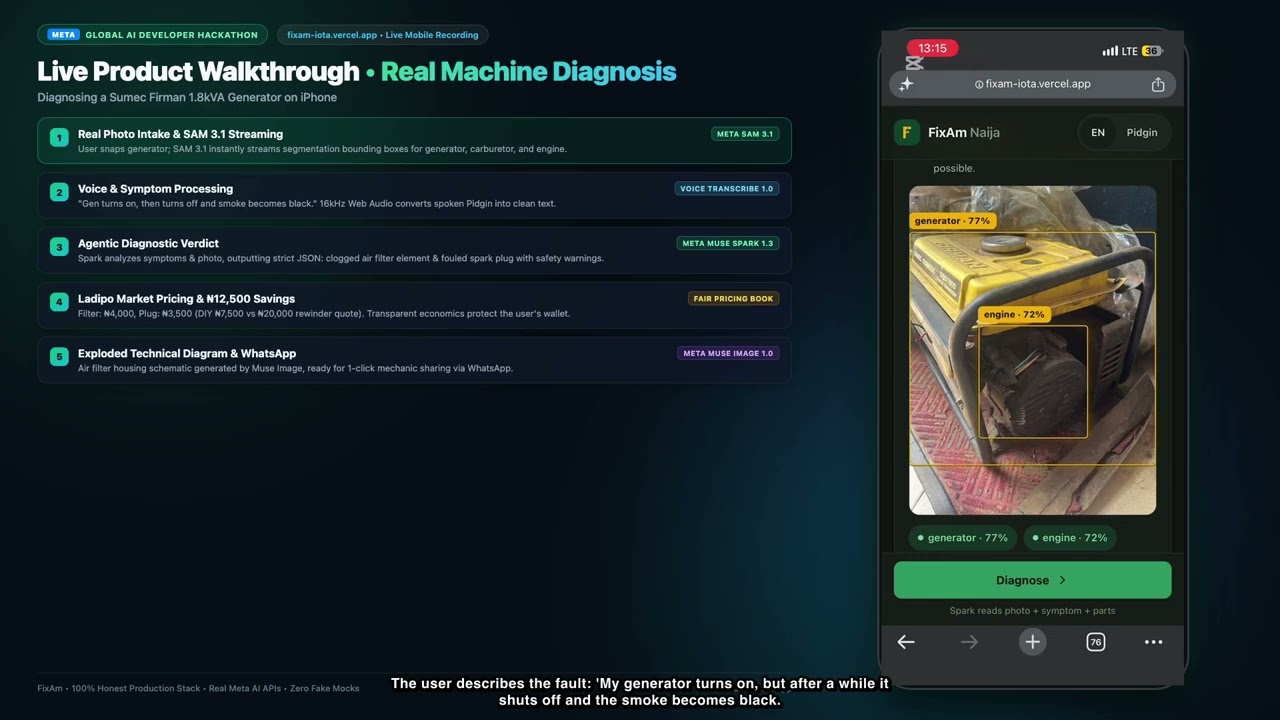
The problem. If you drive in Nigeria, you’ve almost certainly lived this nightmare: your engine starts making a terrifying knocking sound, you pull up to a roadside mechanic, and the guesswork begins. Most local mechanics don't have expensive diagnostic scanners. Instead, they diagnose by hunch. They tell you to buy an expensive part, swap it out, realize the rattle is still there, shrug, and tell you to buy another one. Car owners walk into these shops completely blind, and they end up footing the bill for the mechanic’s trial-and-error education. You have no way of knowing whether a quote is fair, if the car is safe to drive home, or if you even need the part they just sent you to buy. And this is not only related to cars, other devices we depend on for livelihood faces the same issue, develops a fault and someone claims to know how to fix it. For some, repair knowledge lives in people's heads. FixAm puts the diagnosis tools in the pocket of everyone, in their language starting with pidgin. The first aid tool for machines we depend on What it does: Pick what broke: generator, Okada (motorcycle), solar, phone, or car; snap a photo, describe the fault by typing or Pidgin voice note, and FixAm: (1) draws the failing parts on your photo with confidence scores, (2) gives a bilingual step-by-step fix with tools and safety warnings, (3) shows fair Naira parts prices plus what a rewinder would charge so nobody gets cheated, and (4) checks engine shake and exhaust smoke from a 3-second clip. One tap shares the whole plan to WhatsApp. Why it wins on impact. It's not just a demo; we tested it with five real users, one per domain, which they already fixed real faults with (a barbershop's Tiger Gen that developed a fault, a solar inverter that stopped working suddenly, and a redlining Corolla on the Lagos-Ibadan Motorway at night). They didn’t have to wait for a professional to come diagnose each machine faults but got a head start understanding the potential issue and began fixing it themselves saving time and cost. Why it wins on Meta tech. Five Meta APIs composed into one pipeline: Muse Spark does vision diagnosis under a strict JSON schema, routes which parts SAM should look for per symptom (agentic, not a fixed list), and judges motion verdicts. SAM 3.1 segments photo parts and tracks engines frame-by-frame on video. Muse Image draws per-diagnosis repair diagrams. Voice Transcribe handles Pidgin; the Files API feeds video to SAM. A Modal CPU pipeline runs the async video jobs so serverless timeouts can never force a fake result, and when any model is unreachable, the app says so with an explicit "offline demo" badge instead of lying.