Naian
Built at Meta Global AI Developer Hackathon · Oct 26, 2026 · Remote
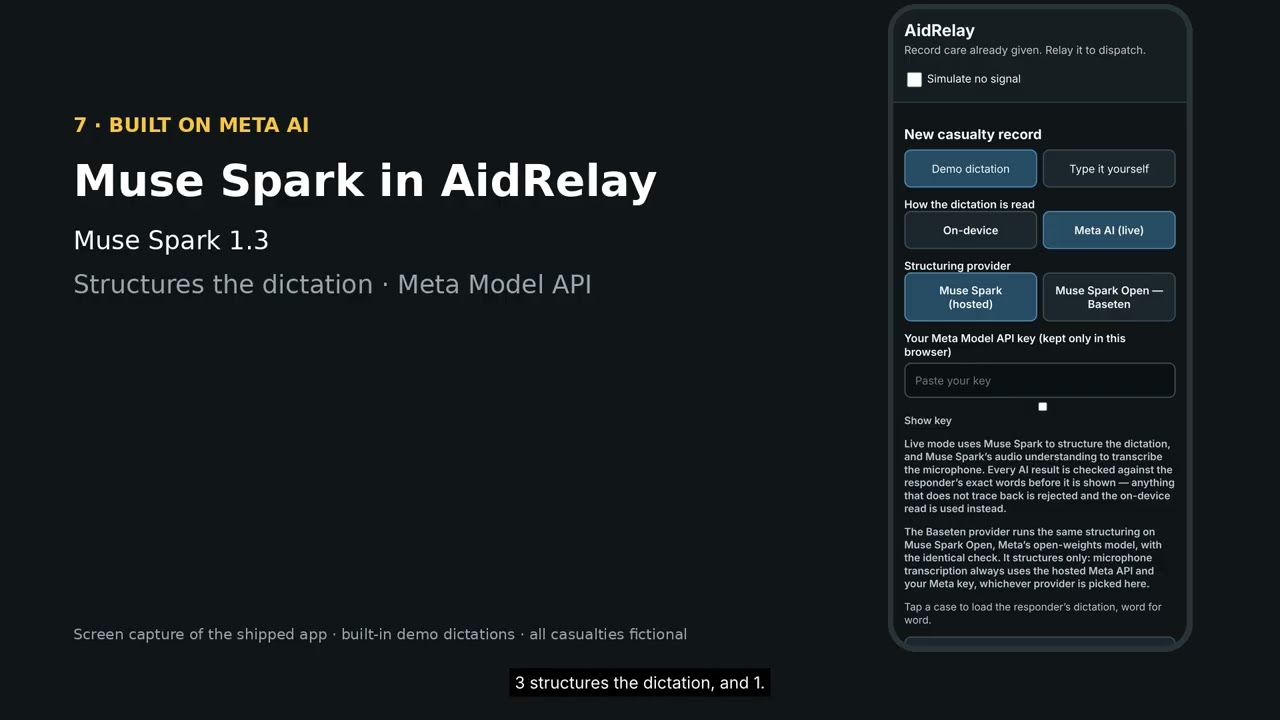
AidRelay is a voice-first casualty record relay for civilian disaster and mass-casualty response — volunteer and rural crews working a storm-damaged fairground, a wildland fire, a flood. A responder dictates what was already done for each casualty; the app structures it into a fixed record, reads it back for confirmation, stores it encrypted on the phone, queues it when there is no signal, and relays it to a dispatch board sorted by who needs transport first. This app gives no medical advice, diagnosis, or treatment recommendations. It is used by responders, dispatch coordinators, and the receiving facility. It only records care trained responders already gave. How it works: - Capture: the responder states the casualty's tag, the START category they assigned, the location, and the care already given from a fixed 17-item list of completed actions (tourniquet applied, wound packed, IV started, CPR in progress…). No real names. - AI structuring: Muse Spark 1.3 turns the dictation transcript into a draft record in the fixed schema; Muse Spark 1.2 transcribes recorded audio. The app runs on the end user's own Meta Model API key, entered in the app and stored only in their browser. - The validation gate: every AI-produced fact must trace back to the responder's own words, checked against a deterministic on-device parse. A draft that adds anything unstated is rejected whole and the app falls back to the on-device read. In live testing this gate caught Spark inventing a care item — and it fired again on camera during the demo shoot. - Confirmation: nothing is saved until the responder confirms it. Medications are only recorded through a verbatim read-back plus an explicit yes; anything merely mentioned second-hand appears as "mentioned, but not confirmed" and can never reach the record, the board, or the handoff. - Offline-first: records are encrypted on the device (WebCrypto AES-GCM) and queued with no signal; they relay automatically when connectivity returns, with deduplication at the board. - Dispatch board: all records in one list, sorted red first, then yellow, green, black, each with location and elapsed time. One tap builds a plain-language handoff for the receiving facility — confirmed facts only. What was built during the hackathon (Oct 26 – Nov 4): Everything in the repo. AidRelay was designed and built from scratch starting October 30, 2026, after a Cerebral Valley eligibility ruling confirmed the concept fits the event rules. No part of the submitted product predates the hackathon window. Live demo (key-free demo cases): https://mherick.github.io/aidrelay/