Folkstyle arena
Built at Meta Global AI Developer Hackathon · Oct 26, 2026 · Remote
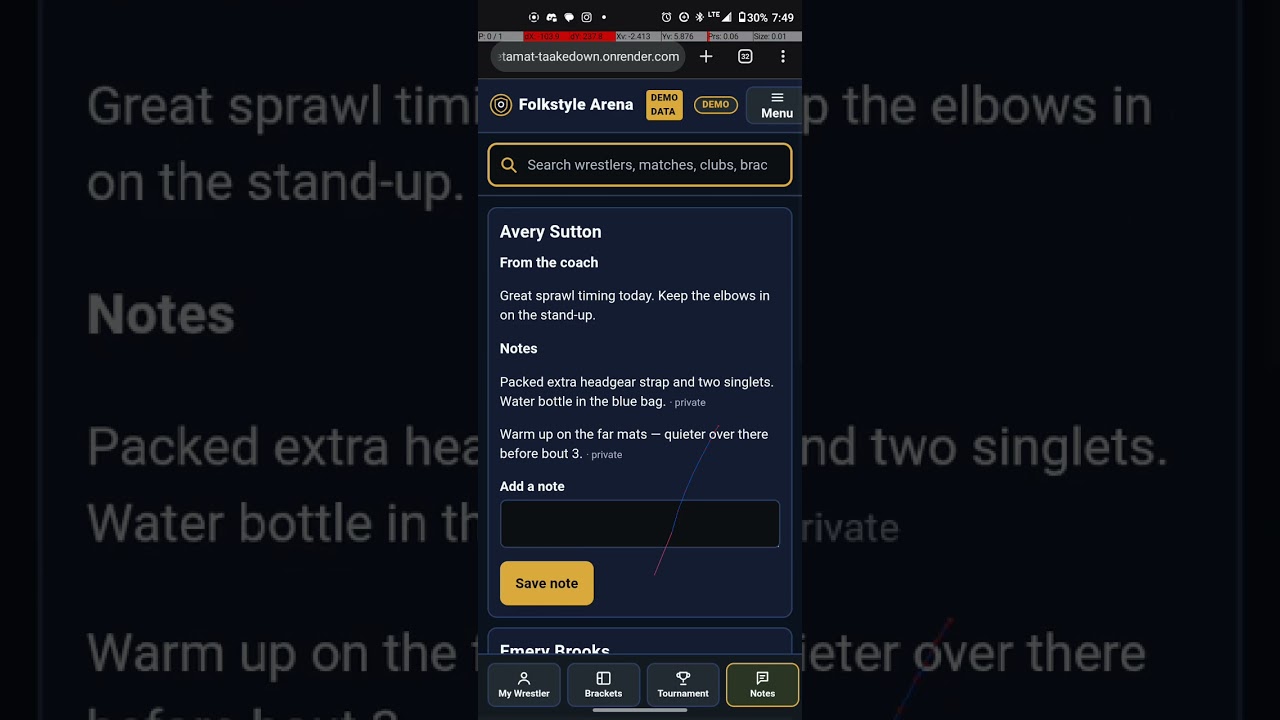
Folkstyle Arena is a folkstyle wrestling tournament management platform built from nine years of coaching youth wrestling. Tournament software has always been hard to use in practice: disorganized, messy systems that don't make sense from a user's perspective. I've spent years thinking about what this software actually needs, what's important, what people really care about, and how to do it differently. This is that idea, built out. It's not a polished, tournament-ready final product yet. In its current state, it's already a far better way to run a tournament: set up a tournament in plain language, publish visual brackets, score bouts from a phone at the table with big +1/+2/+3 buttons and an undo that names the play, enforce rest time between matches with the reason shown on screen, and show parents their wrestler's mat and next bout without needing an account. Organizers, table workers, guardians, and spectators each get their own view, and a QR code on a printed bracket lets family follow a wrestler's bracket through the day. Tournament stats — matches, pins, mats, time wrestled, schools — are tracked in one place. Every wrestler also gets a trading card, like a baseball or football card, generated with Meta models. A wrestler can choose from styles like Attack, Brick-Wall Defense, Fire, and Ice, and personalize a card they can proudly display. The card is a persistent identifier tied to that wrestler, with an album of variants kept across the season. The design also includes milestone editions, designed to unlock new card art when a wrestler reaches milestones like wrestling a first match or winning a match, and a photo path where a photo can be cut out with SAM and placed on a generated background. The illustrated style generations are live in the demo; the photo cut-out path is still being finished, so it isn't shown as working here. All demo data in the video and live product is synthetic: invented wrestlers, schools, and results for testing, not real children or a real tournament.