Kenosis Interactive
Built at Meta Global AI Developer Hackathon · Oct 26, 2026 · Remote
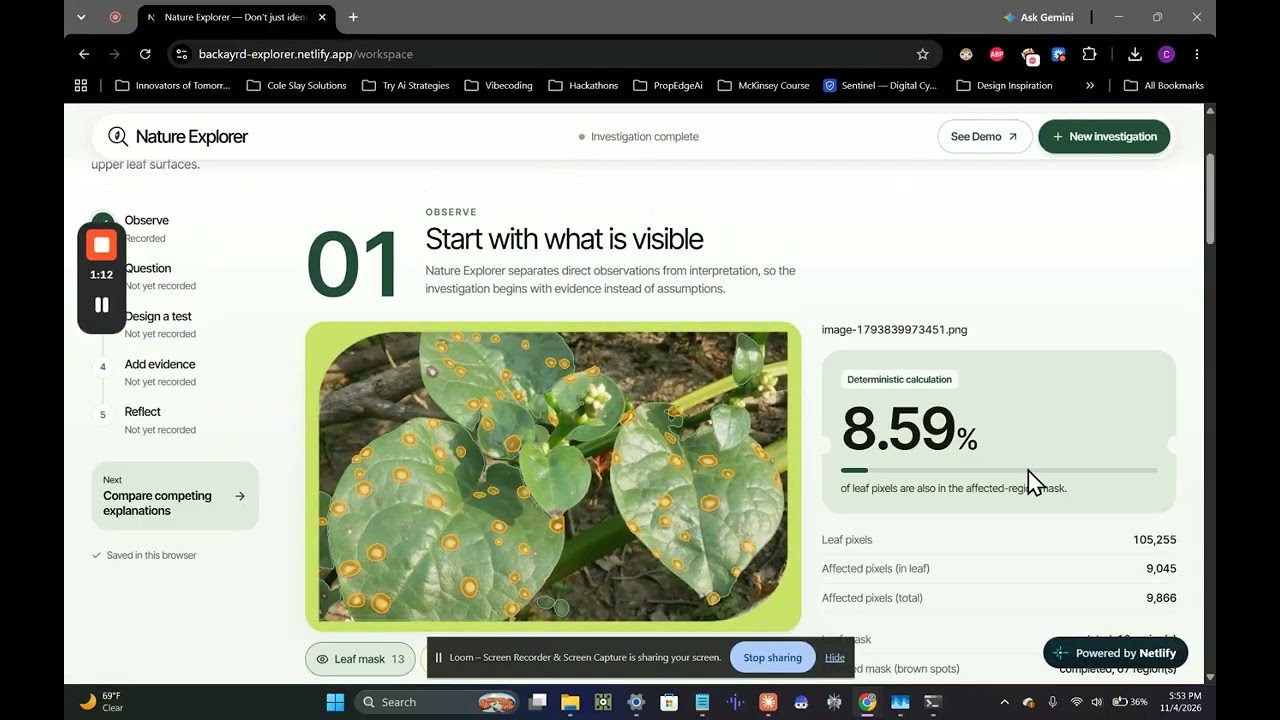
Nature Explorer: Don’t just identify it. Investigate it. Most plant apps stop at a name, and sometimes a guess at what’s wrong. But one confident answer from one photo doesn’t tell you much when you’re looking at a spotted leaf and wondering what’s going on. Nature Explorer turns a plant photograph into a structured scientific investigation, so you can work out what the evidence supports and what to check next. How it works: Observe: Upload a photo. The app suggests a likely identification with alternatives, records what is directly visible, and keeps those observations separate from interpretation. Measure: SAM 3.1 outlines the leaves and the visibly changed areas, and the masks are drawn over your photo. Deterministic code, not an AI model, then calculates what percentage of leaf pixels are affected. Question: Instead of jumping to one diagnosis, Muse Spark generates competing hypotheses. Each one shows the evidence that supports it, the evidence that weakens it, what’s missing, and a prediction that could prove it wrong. Test: The app designs a practical, low-risk test that helps tell the hypotheses apart, with a safety check that screens out hazardous steps such as chemicals or deliberately infecting a plant. Update: Add a follow-up photo, an observation, or a test result. Follow-up photos are measured against the same region as the original, and the hypotheses are revisited rather than defended. Reflect: A final report summarizes what the evidence currently supports, what remains uncertain, and what to do next, alongside a timeline of the whole investigation. Built to be trustworthy: Each system has one job: Muse reasons, SAM segments, and code measures. Every hypothesis must cite evidence the server has already recorded, and references to unknown evidence are rejected. Results are labeled by source, so you can see what came from a model and what was calculated. Pl@ntNet adds an independent second opinion on the plant’s identity and suggests possible conditions, and the app shows clearly when it agrees or disagrees with Muse Spark. Pl@ntNet’s disease matches are presented as candidates, not diagnoses. Nature Explorer never claims to have proven a cause or diagnosed a plant. When the evidence is too weak, it says so, and if a measurement can’t be made, it shows no number rather than inventing one. Who it’s for: Home gardeners, students, teachers, and anyone curious about the natural world. It needs no scientific background, and a sample investigation lets you explore the full workflow before uploading a photo. Built with: Meta’s Muse Spark and SAM 3.1, Pl@ntNet, Next.js, TypeScript, and Tailwind CSS. Investigations are saved in your browser, so you can come back to them when you have new evidence.