Nautilus - Agentic failure-investigation framework for underwater robots
Built at Meta Global AI Developer Hackathon · Oct 26, 2026 · Remote
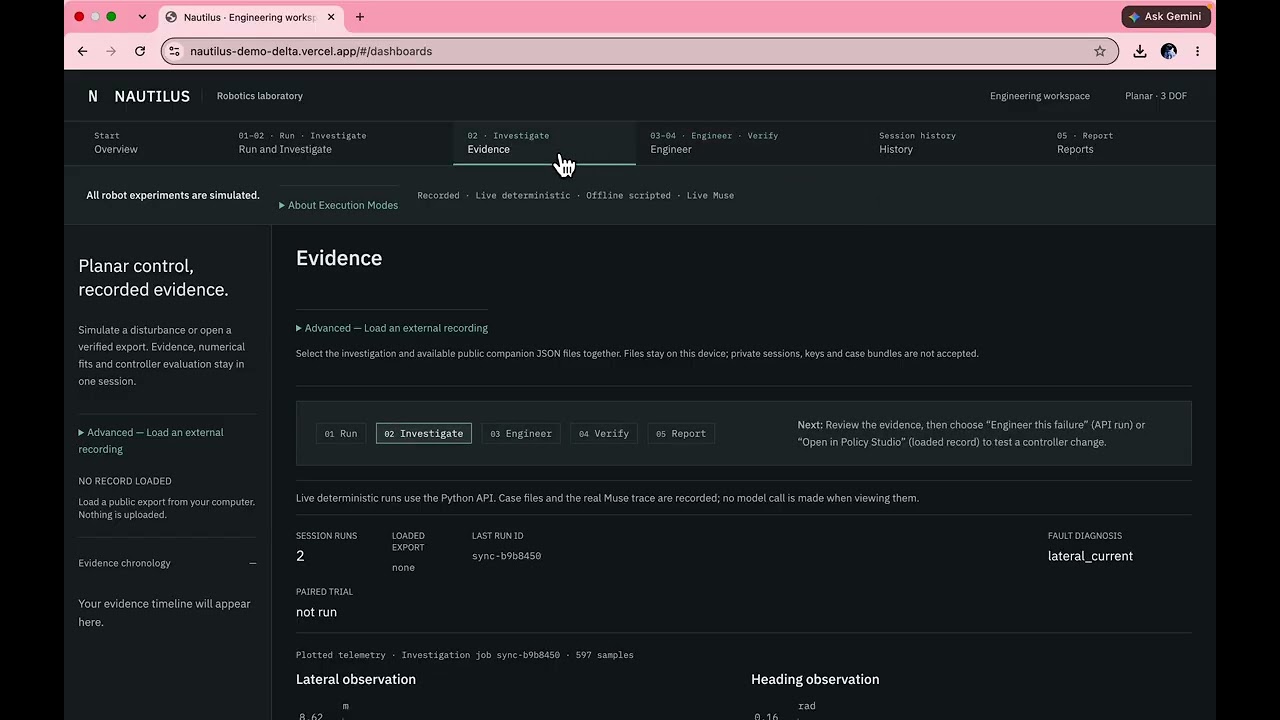
Imagine an autonomous underwater vehicle inspecting an offshore pipeline. Halfway through its mission, it begins drifting off course. Is an ocean current pushing it away? Has a thruster degraded? Or is its heading sensor providing inaccurate measurements? In robotics, different failures can produce nearly identical symptoms. Misdiagnosing the problem can lead engineers to deploy an ineffective controller change, potentially wasting expensive field-testing time or worsening the vehicle's behavior. Nautilus is an agentic robotics failure-investigation and controller engineering platform designed to address this problem. Built around a physics-based planar marine vehicle simulator, Nautilus combines numerical diagnosis, controlled experiments, AI-assisted engineering, and controller evaluation into a unified workflow. Its investigation engine compares competing physical explanations against observed telemetry, explicitly represents uncertainty, and supports experiments that help distinguish plausible causes. Rather than assuming that the best-fitting hypothesis is necessarily correct, the system preserves ambiguity when the available evidence is insufficient. Once an investigation is complete, Nautilus can transfer its observations, hypotheses, and evidence into a controller-engineering workspace. Candidate controller changes undergo structural validation, matched baseline comparisons, predefined acceptance gates, and separate robustness evaluations. Every numerical result is computed by trusted simulation tools rather than accepted from a language model's output. Nautilus also integrates Meta Muse through bounded, structured tool interfaces. In recorded real development sessions, Muse proposed controller-parameter changes and requested numerical evaluations, while the trusted host validated proposals, executed experiments, and determined the final outcomes. The project demonstrates both successful and unsuccessful engineering interventions. One bounded controller revision reduced mean RMS cross-track error from 0.994 meters to 0.410 meters, passing eight predefined development gates and improving on a separate held-out evaluation. Another aggressive controller configuration performed worse than its baseline and was rejected. To support reproducibility, Nautilus preserves controller fingerprints, session identities, evidence references, and hash-linked investigation records. Engineering reports retain canonical serialized evidence so exported results can be checked without changing their original hashes. The current implementation is developed and evaluated entirely in simulation, with marine autonomous vehicles as its initial application. Its broader goal is a reusable framework for robotics engineering in which AI agents can investigate problems and propose interventions, but numerical evidence determines whether those interventions are justified.