R1D1
Built at Meta Global AI Developer Hackathon · Oct 26, 2026 · Remote
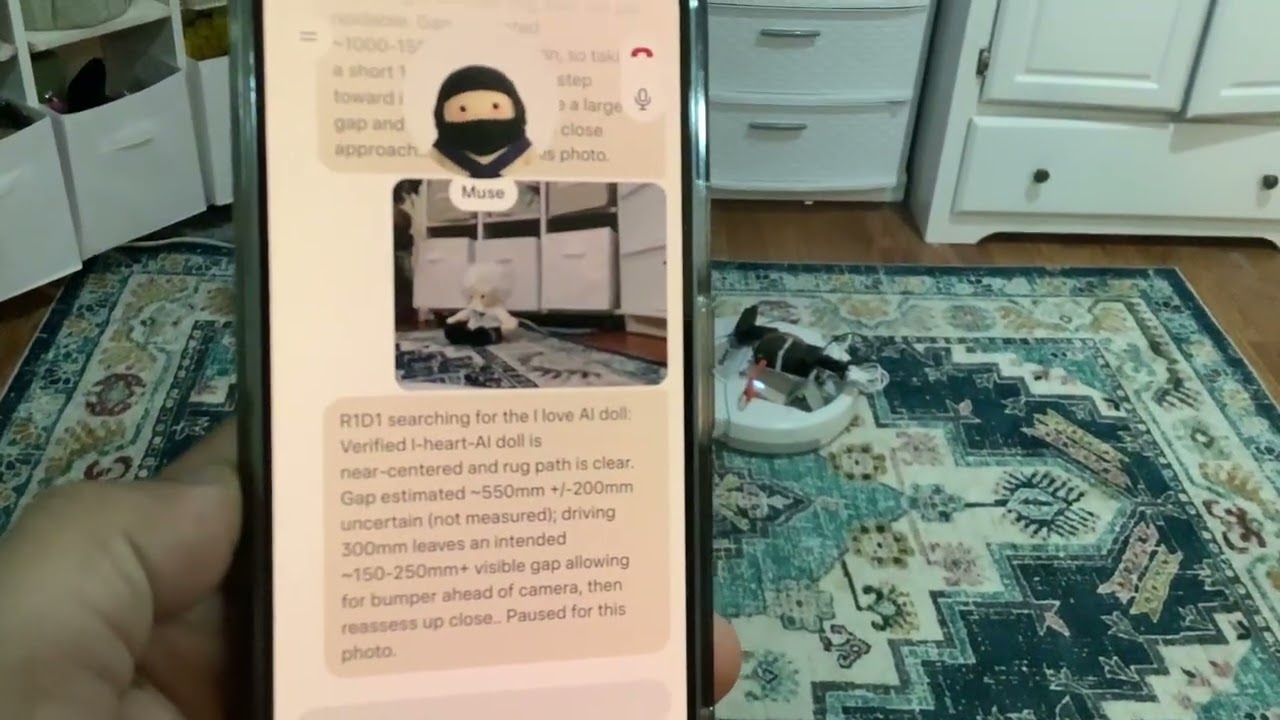
R1D1 asks a simple question: how much can a robot do with wheels, two cameras, and a cloud brain? For anyone who can't easily get up and check a room, aging, mobility, or just the couch, that's the difference between wondering and knowing. Built from an original iRobot Create and a Raspberry Pi, R1D1 has no lidar, depth camera, or map. It combines Meta's models with a local controller to investigate its surroundings through small, supervised movements. Muse Wonder interprets camera observations, proposes bounded actions, and explains its choices. The Muse Gadget SDK connects the device to the owner's Muse app for inspection requests and photo reports. In our demonstrated task, a spoken request sent R1D1 searching for a plush doll wearing an "I love AI" shirt. Wonder scanned the room, spotted a candidate, and, critically, refused to commit until the shirt text was legible, advancing in small inspection steps. Once the shirt read clearly ("I" with a blue heart, "AI"), the controller staged a cautious approach: 250mm, reassess, 100mm, reassess, stopping with a visible gap and no bump contact. The robot then beeped to confirm the find, and the session closed on the owner's explicit acknowledgment. The same evening, R1D1 completed a two-target mission: it found a black Roomba vacuum, approached and stopped clean, then found the doll, 2/2 targets, both verified, no contact. The local controller enforces movement limits, monitors safety sensors, and stops on invalid proposals or detected hazards. During one trial the hazard layer vetoed a close approach ("motion hazard; stopped without reversing") even with the target in view. The robot reported the miss honestly rather than risk contact. Cloud reasoning proposes actions; local software controls execution. R1D1 also demonstrated visual memory: on a loop-closure test it matched its starting view with 487+ inliers and ~2cm return offset, and correctly identified a moved stuffed toy as "moved object, not a different room." The demo ran fully untethered: USB-C battery bank, phone-hotspot Wi-Fi, with the complete Pi-to-cloud vision chain working remotely. R1D1 is a supervised research prototype. It needs adequate lighting, its odometry drifts, and it has not demonstrated reliable household navigation or unattended patrol. The next question is whether this architecture can support useful remote visual checks: a person asks for an observation, the robot gathers evidence, and the agent reports what it can and cannot establish.