Vigil
Built at Meta Global AI Developer Hackathon · Oct 26, 2026 · Remote
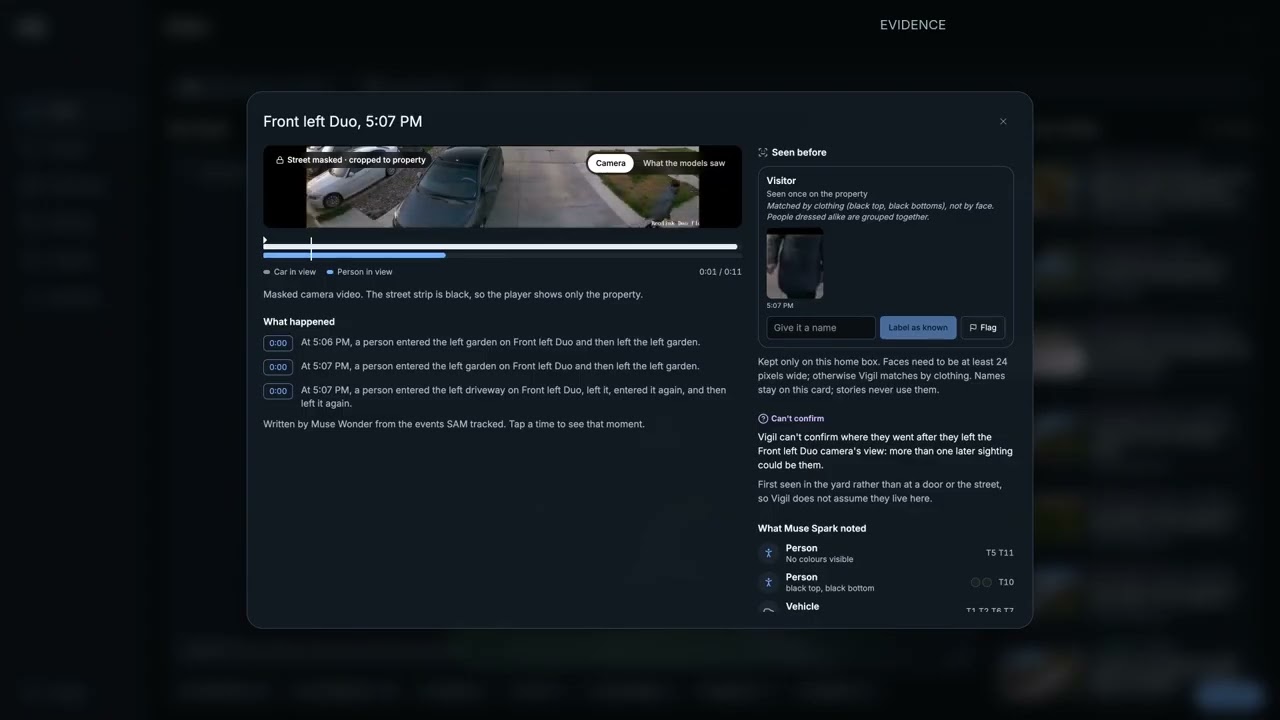
Your cameras capture motion. Vigil helps you understand the visit. Vigil connects home-camera observations into a story you can inspect: what happened, which cameras saw it, what needs attention, and what remains unknown. A spatial dashboard brings the house, camera coverage, recorded clips and visit evidence into one place. The project grew from a practical problem with my own home cameras: reviewing separate alerts means reconstructing the same visit across multiple recordings. Vigil brings that evidence together and gives each story sentence a citation back to the observed events. Meta’s SAM 3.1 provides masks and tracks, Muse Spark supplies structured descriptions and rule drafts, and Muse Wonder writes cited stories from an event ledger. Homeowners can define what matters in plain language and review the resulting rule before confirming it. The core principle is simple: models perceive and describe; code decides. Only deterministic owner rules can raise a “needs attention” verdict. Missing observations remain explicit blind gaps, and unsupported model sentences are rejected or replaced with a deterministic template. Roles come from observed spatial origin and explicit owner context, never face recognition. Vigil includes a React interface, FastAPI backend, privacy masking, cached offline playback and guarded model access with spending limits. The prototype has processed owner-approved real camera clips and passed 1,710 offline Python tests. Broader accuracy, latency and spatial calibration acceptance remain open. The goal is a home-camera experience that makes evidence understandable—and is honest about what it cannot confirm.