H-Meta
Built at Meta Global AI Developer Hackathon · Oct 26, 2026 · Remote
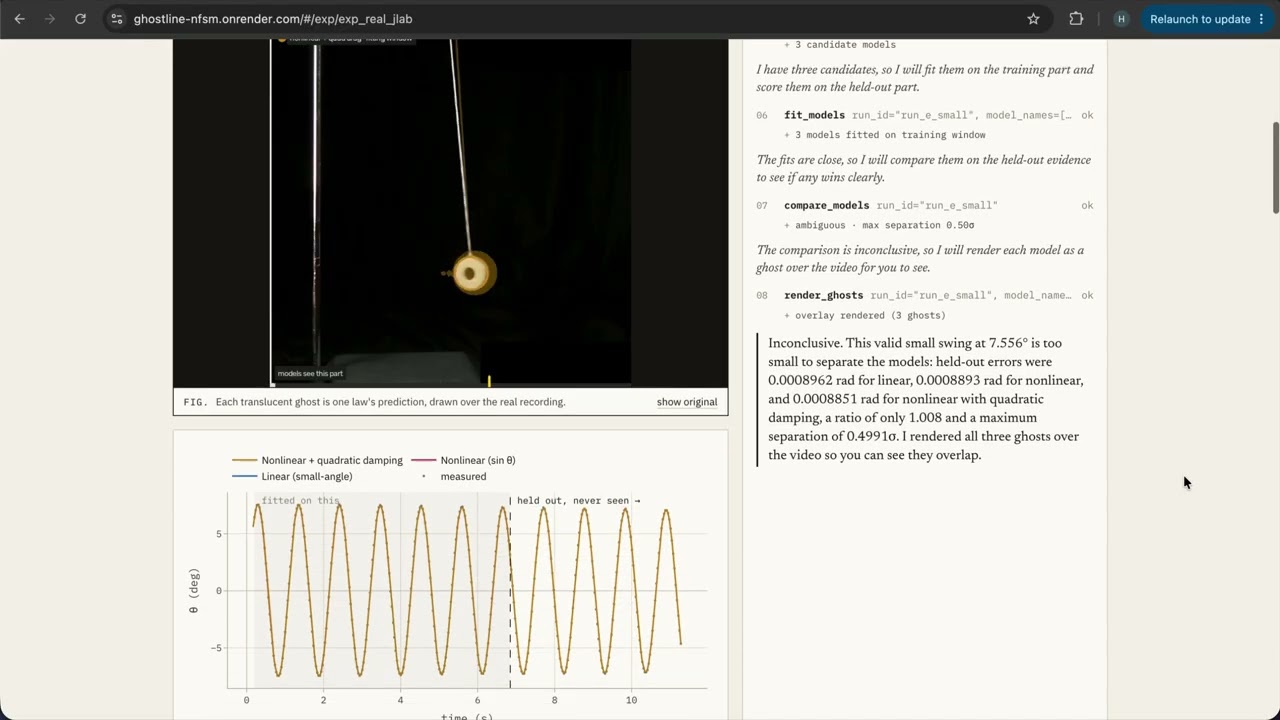
Ghostline is an AI agent that runs the scientific method on a phone video. You film a physical system, such as a pendulum or falling coffee filters. Ghostline tracks it, turns pixels into a calibrated time series, and fits competing physical laws (linear vs nonlinear pendulum, linear vs quadratic drag) on the first 60% of the clip only. Each law must then predict the rest, and its prediction is drawn as a translucent "ghost" over the real video. You can see which law follows reality and which drifts away. The problem: AI tools for science tend to give a confident answer even when the data can't support it. Ghostline is built to be honest about evidence: • If the models differ by less than the measurement noise, it says "Inconclusive" instead of picking one. • It then designs the experiment that will decide: it searches the knob you control (release angle, number of filters) for the setting where the models disagree most. • It freezes every model's predictions into a SHA-256 hash before you film, so the result can't be tuned after the fact. • On the reveal, it verifies the hash and scores the frozen predictions. If the camera was bumped or tracking was lost, it marks the run INVALID instead of scoring it. • If no candidate law fits, it says so and names the likely cause. Numbers come from code, never from the LLM: measurement, fitting, simulation and scoring are deterministic Python. The agent reasons, picks tools and explains. Results: • On real footage of a lab pendulum (Jefferson Lab), Ghostline called a 7.6° swing inconclusive, committed predictions for 25°, and the nonlinear law won with a 0.2% period error. The linear law missed by 1.3%. • On real iPhone footage of a mouse swinging on its cable, it correctly reported that none of the candidate laws fit, because the mouse twists as it swings. • On 15 synthetic clips run through SAM 3.1, every check came out right, with no false INVALIDs.