Controls Bench Muse
Built at Meta Global AI Developer Hackathon · Oct 26, 2026 · Remote
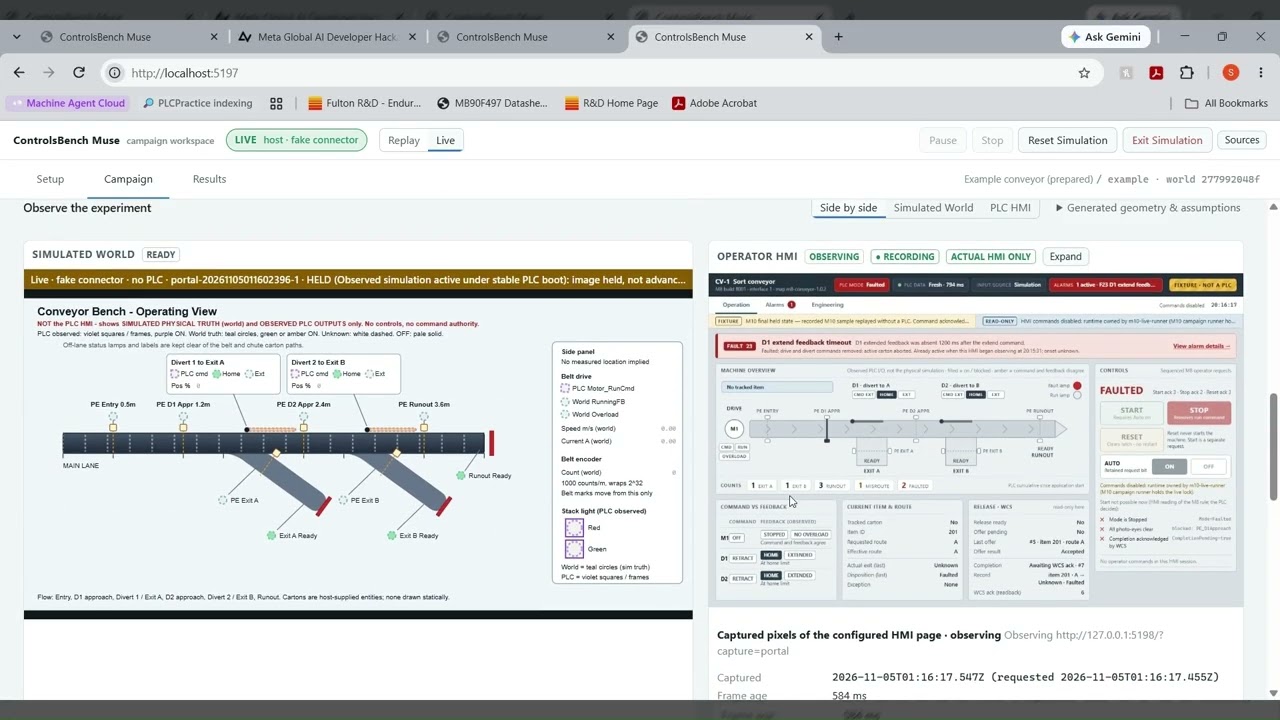
Controls Bench is designed to help controls engineers use AI for the parts of their jobs that tools like Claude Code or Codex can't easily handle. Generating PLC Structured Text is already possible. The harder, more expensive work is testing, troubleshooting, and validating that code against how a real machine behaves. The entire demonstrated system was built during this hackathon, including the simulator, PLC interceptor libraries, Meta integration, automated investigations, and HMI testing. Controls Bench tackles that problem by combining a machine specification, a simulated world powered by Meta's Muse Wonder, and a running CODESYS PLC runtime. Wonder uses the spec to build a reactive model of the machine, including its expected behavior and assumptions. The Controls Bench engine streams simulated sensor and equipment data to the PLC and reads the PLC's responses, allowing the control code to be tested without having the physical machine available. The connection is made through spec-driven interceptor libraries inside the PLC program. They route simulated data into the PLC's I/O signals and return observations to Controls Bench. The approach is designed to be PLC- and protocol-agnostic: the demo uses CODESYS over OPC UA, but the libraries could be implemented on other platforms, including by asking a Meta model to generate the corresponding Structured Text, and connected through other communication protocols. Testing is not just a fixed script. During live PLC testing, Muse Wonder can choose experiments through structured tool calls, inspect the results, and decide what to investigate next. The demo includes a fault experiment selected in response to earlier observations. This creates a closed testing loop: Wonder uses actual PLC and HMI results to drive its next investigation rather than following a predetermined script. Wonder can also operate the live HMI through browser controls—starting, stopping, and resetting the system—then inspect screenshots to evaluate whether the interface and machine respond correctly. Findings retain assumptions, supporting evidence, and untested areas so engineers can review the conclusions. Industrial controls testing can take hours, weeks, or months depending on complexity. Controls Bench aims to reduce that burden by letting AI set up, run, and document a meaningful portion of the bench-testing process. The same architecture also provides a path to future capabilities such as PID tuning and signal processing. With access to simulated behavior and live PLC I/O, Controls Bench could iteratively tune a control loop or evaluate filters such as low-pass, moving-average, and Kalman filters rather than just suggesting parameters in chat. These are planned features, not part of the current demo. At its core, Controls Bench is about connecting Meta's models to executing PLC logic so AI can do more than write code: it can test how that code behaves.