Hardware Engineer
Built at Meta Global AI Developer Hackathon · Oct 26, 2026 · Remote
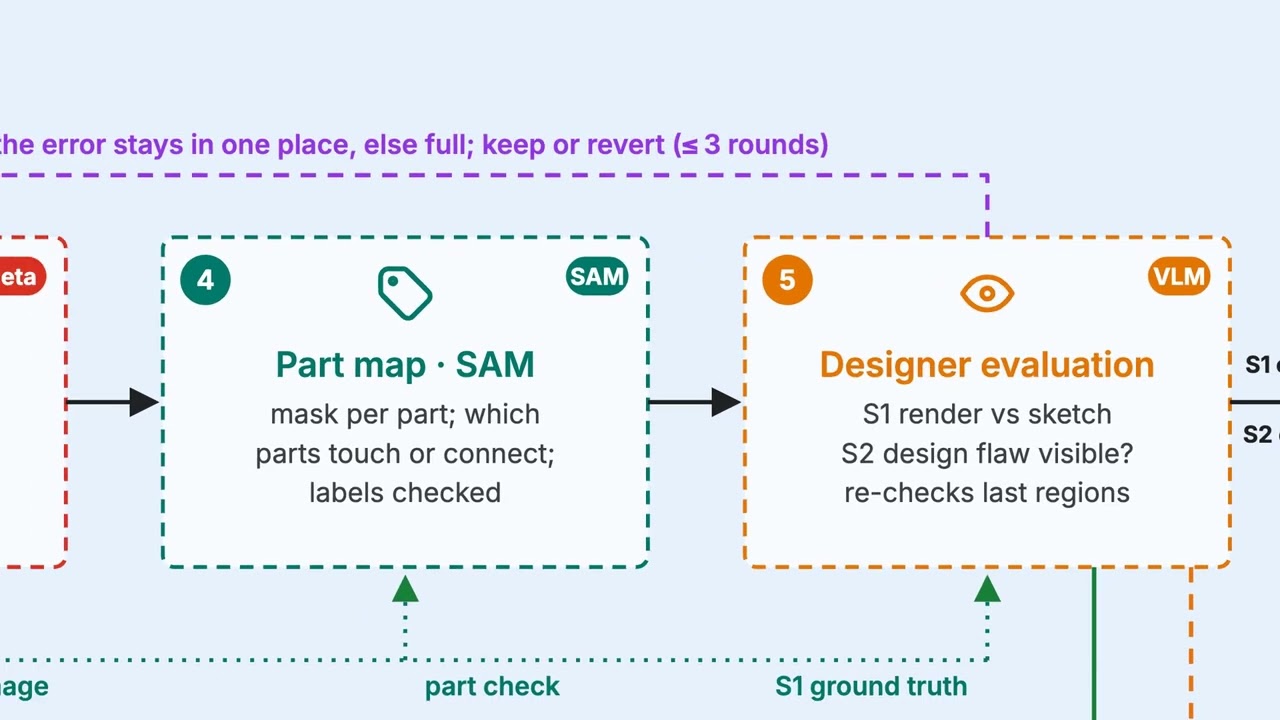
Hardware Engineer (HE) is a self-improving agent inspired by recent AI advancements TextGrad, built only on Meta models, that turns one paragraph into subfinctions, then a hardware concept that works and rewrites its own instructions from written critique. Hardware design starts with a concept, and the best feedback on a concept is often a picture. When one asks a frontier model directly an engineering problem, the picture looks catchy but does not work. Engineers then give feedback to the model; it fixes one thing but breaks another. Hours go by. HE runs that feedback round itself. Give it a paragraph, not even a specification, and it returns an engineered concept: a labelled photoreal figure you can trust working principles, with engineering calculations behind it, a plan for how to make it, and the whole whiteboard discussions among agents that led there, used to improve future attempts. How it works: four domain experts and a chief designer argue on one shared whiteboard; they search the literature, calculate, simulate and sketch. An Evaluator reviews the result like a senior engineer: it checks the worst case of every limit and confirms the design agrees with itself. On a rejection the Manager turns the written critique into a textual gradient, inspired by TextGrad: first what in the design must change, then which instruction let the fault through. It rewrites only those lines of the team’s prompt; the meeting continues on the same board, and the same issues are checked first. Every loop closes: keep or revert. When the design prompt is set, the picture loop begins: a code sketch fixes the geometry and Muse Image renders it. Such renders often come with mistakes, and feedback to specific locations in the image often affect other valid components. To fix that, SAM 3.1 determines parts and their relative integration in the output image, used to provide localized feedback that together we can call “ImageGrad” to the image prompt or the overall design prompt. A multimodal critic compares the picture with the sketch and the design text. A wrong picture becomes a gradient on the image prompt and is fixed locally, kept only if nothing else gets worse; a wrong design goes back to the team and into the master prompt. It learns your practice: lessons, skills and tools from every design are read by the next team, and you can add your own sources to its knowledge base. I’ve also built HE on open weights (Muse Spark Open on Baseten, SAM3 on Modal) for cheap and secure tool for future users. Six problems (lunar excavator, robot fingertip, wind-tunnel turbine, stair-climbing hand truck, solar cold room, footbridge damper), were evaluated two blind judges (Claude) to compare HE on the Meta API and HE on open weights; only 2% difference in performance of outputs was measured. Try it: clone the public repo, paste your Meta API key, run one problem from the terminal (about 30 minutes, about $1.7) & six example designs with reports, whiteboards and figures.