Second Source
Built at Meta Global AI Developer Hackathon · Oct 26, 2026 · Remote
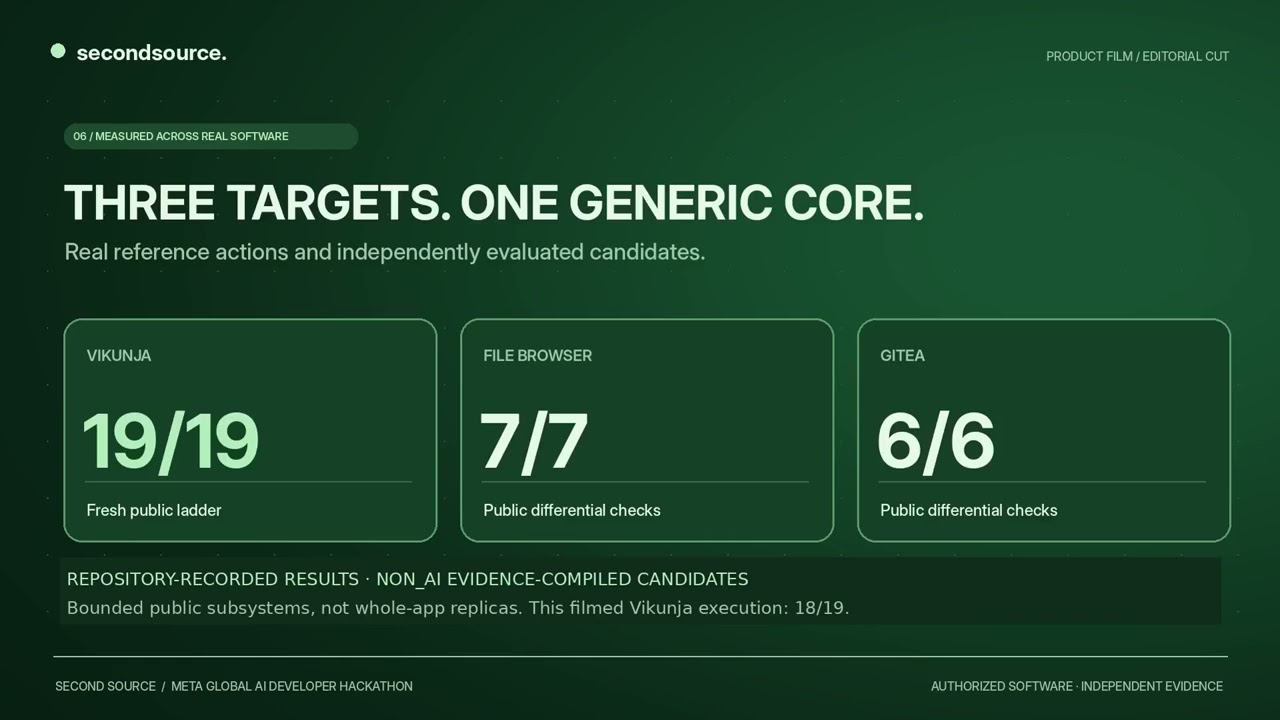
What if AI could rebuild software it has never seen the source code for—and prove that the replacement actually works? Second Source is an AI-powered system for understanding and reconstructing existing software from its observable behavior. The long-term vision is simple: provide a link to software you own or are authorized to investigate, and receive an independent, working replacement with tests, evidence, and a clear account of what matches. Why does this matter? Businesses depend on legacy applications, undocumented APIs, and critical internal tools whose real behavior is nowhere fully written down. Conventional AI builders can generate a convincing interface, but a screenshot cannot reveal hidden permissions, default records, error handling, or state transitions. A replacement that looks right can still fail when it matters most. I built Second Source to approach this problem as an experiment, not a guessing game. Its working local engine investigates supported reference applications within an authorized scope, captures real inputs and outputs, reconstructs an executable behavioral candidate without copying the original source, and runs independent checks against a fresh reference. The result is not just a generated artifact: it is a candidate, an evidence trail, visible mismatches, and a verification report. Meta Muse Spark 1.3 is integrated through the Meta Model API to reason about unexplained behavior and propose bounded improvements. In a recorded Vikunja experiment, Muse identified the hidden default-project behavior involving “Inbox” and “My Open Tasks,” which guided a generalized compiler correction. Crucially, proposed AI changes must survive independent testing: suggestions that introduce regressions are rejected, not quietly accepted. The latest documented runs reached 19/19 public behavioral checks for Vikunja, 7/7 for File Browser, and 6/6 for Gitea; an owned workflow passed 30/30. These are independently measured results on supported, bounded subsystems—not claims of complete application cloning or scores attributed solely to Muse. The merged prototype also includes a Muse-first workspace, PocketBase support, link observation, reports, and an interactive architecture. This is the working foundation, not the finish line. Next are broader authorized-link discovery, visual understanding, ordinary source-code generation, isolated builds, and iterative verification. The ambition is to make software reconstruction trustworthy: software in, working software out—with proof, not guesses.