MagicRayality
Built at Meta Global AI Developer Hackathon · Oct 26, 2026 · Remote
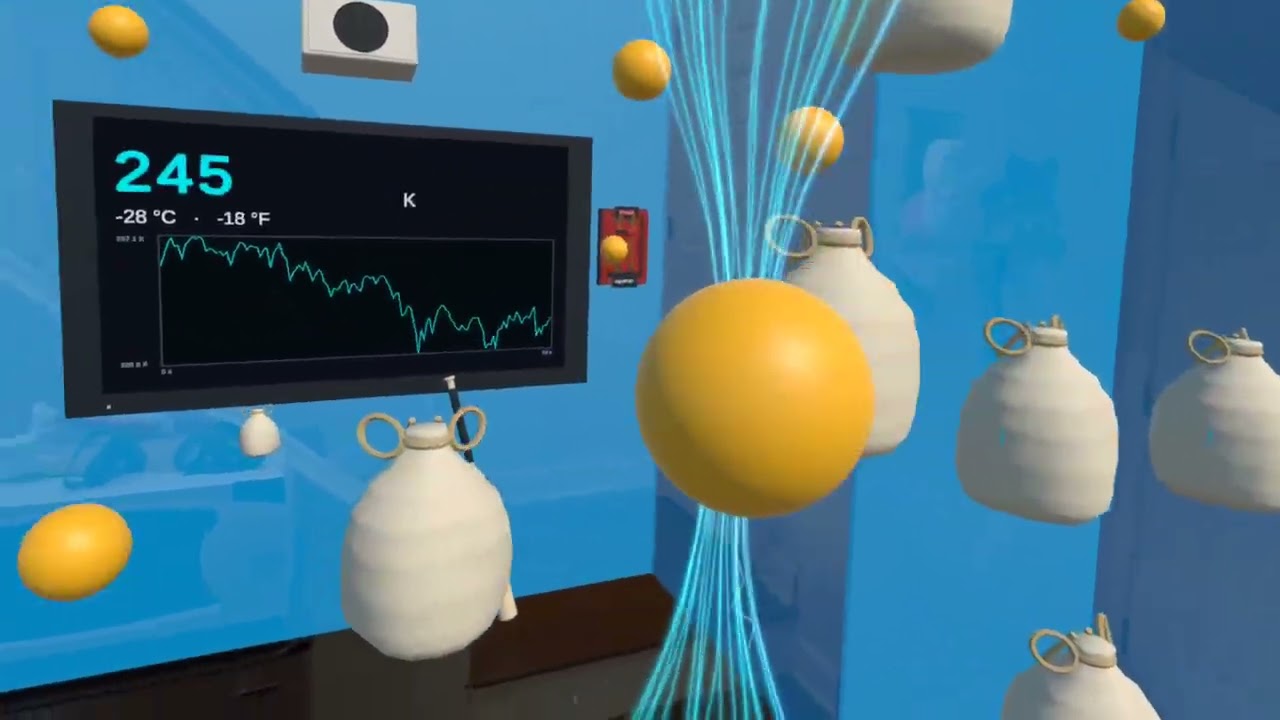
Amiss is a mixed-reality physics lab for Meta Quest. Your room becomes the experiment: the headset scans it, overlays the walls, and fills the space with elastic balls. A wall display shows one number, the temperature of the ball group, and its history. You swing a bat, you put work into the balls, and the number moves. The problem is that almost everyone meets thermodynamics as a formula and never sees that temperature is a property of motion. Textbooks and videos show the result. They do not let you break the claim and watch it recover, in the room you are standing in, with your own body. That is the gap Amiss closes: an abstract quantity becomes something you can push, heat, cool and re-test in ten minutes. Episode one asks a single question: what determines the temperature of a group of balls? There is no explanation-first tutorial. You get a bat, a temperature reading and a contradiction. The instructor, a Meta model, reads what you actually did and changes the next trial: heat the group, cool it, follow one ball, watch the whole group, repeat a trial with one variable changed. What we built during the event: - A Unity 6 Quest client with hand tracking, controllers and passthrough, so the experiment sits on your real walls and your real floor. - A deterministic headless simulation kernel, the source of truth for every trial, plus a proposal validator that refuses anything the model asks for outside the allowed tool space. - An instructor policy pack: system instructions, next questions, allowed actions and mistake classification, shipped as versioned, digest-verified data. The device refuses an edited pack instead of guessing. - An in-app provenance trace for every model call: model, request id, prompt and response hashes, live or recorded. - A keyless recorded-fixture path so the instructor loop can be run and verified with no API key. The design rule is that the model proposes and the simulation decides. Physics is never generated by a language model, so the experiment cannot hallucinate a result; the model chooses which honest experiment to run next and what to say about the evidence. What existed before kickoff: a rough idea and nothing else. No code, no repository, no design, no assets, no prototype. Everything above was built during the event, in four days of design and architecture, two days laying the foundations, and four days validating and fine-tuning on device. One person built it end to end, design through device validation, with Muse Wonder Full and Muse Code covering the work a larger team would have split. Who it is for: people who are curious about physics but have no training in it. The success condition is not reciting a definition. It is that a person, before hearing the name of the concept, can say in their own words what the anomaly was and what changed their mind.