Team CaféPilot
Built at Meta Global AI Developer Hackathon · Oct 26, 2026 · Remote
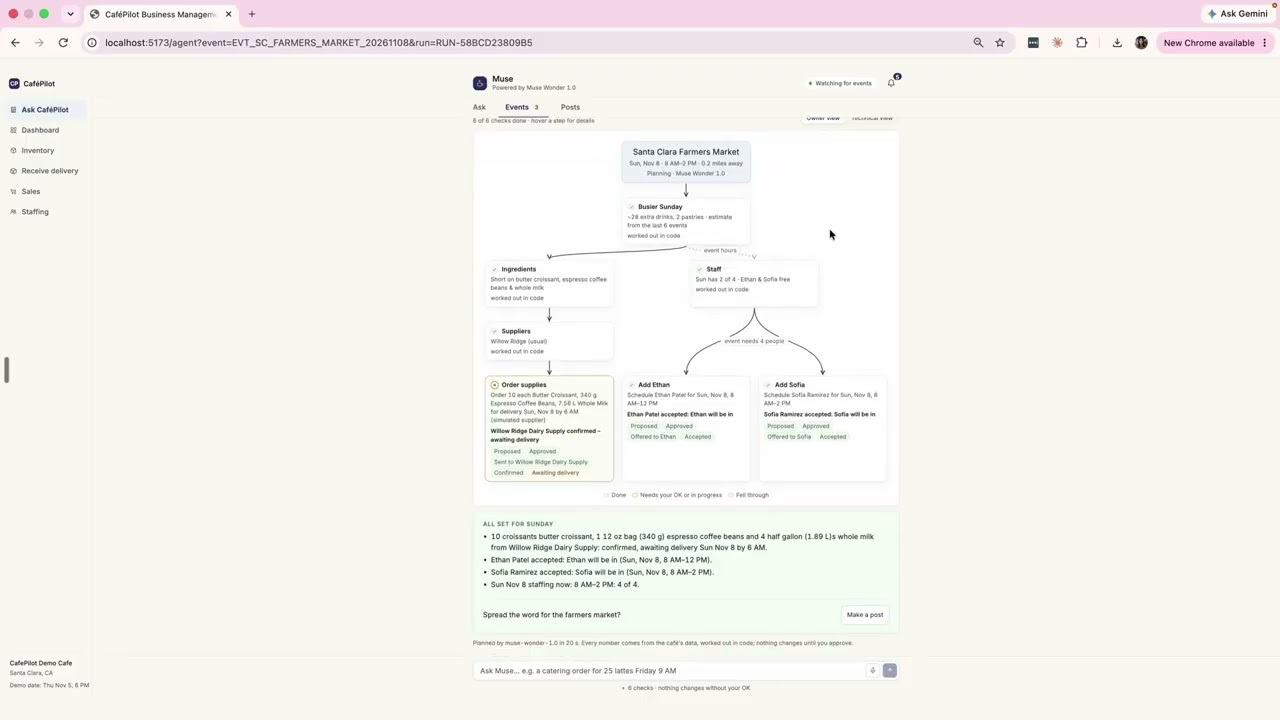
CaféPilot is an AI operations assistant for small businesses, built on Meta's Muse models and Meta glasses. The example business is an independent café. The problem: café owners juggle separate apps for sales, staff schedules, supplier orders and inventory, plus a clipboard and their own memory. Stock is counted by hand, local events cause surprise rushes, order math happens in their head, deliveries are checked by eye at 6 AM, and nobody tracks which orders or shifts were actually confirmed. CaféPilot puts inventory, sales, staffing, purchasing and receiving in one system with one assistant, Muse: • Plans ahead: Muse takes an upcoming event (e.g., a Sunday farmers market; discovery is scripted in the demo) and builds a live plan graph. It estimates extra demand, converts drinks to ingredients using recipes, rounds to supplier case sizes, finds staffing gaps, and drafts orders, shifts and an event post for approval. • Forecasts from history: demand is the average of comparable past days (for the market, its last 6 editions), computed in code and shown with its source. It is a transparent estimate, not a trained forecasting model. • Recovers: if a supplier rejects an order or a barista declines a shift, Muse replans with another supplier or qualified employee (built and tested). In the demo, a short delivery triggers a reorder. • Checks deliveries hands-free: the owner wears Meta glasses. Our "Barista" Swift iOS app uses the Meta Wearables Device Access Toolkit (https://wearables.developer.meta.com/docs/getting-started-toolkit) to start a glasses session, show the camera preview and capture photos. It uploads the slip and delivery photos to CaféPilot's photo receiver, which opens the receiving screen for that purchase order. Muse Spark reads the slip, SAM 3.1 and Muse Spark count the items, and code matches them against the order. Uncertain counts become "please count it", not a false shortage. • Answers questions: a chat that answers from live café data. • Keeps the owner in control: every change is an Approve / Change / Decline card (Proposed → Approved → Sent → Confirmed / Rejected). Core design: the model proposes, the code checks, the owner decides. Muse chooses from 23 typed actions. A validator rejects unknown IDs, broken steps and quantities that didn't come from code. The executor waits for approval before every write and can't create duplicates on retry. All numbers are computed in code. Stack: FastAPI, PostgreSQL, React/TypeScript, a Swift iOS glasses app, and over 580 automated tests. Demo data is synthetic; suppliers and staff replies are simulated. Instagram posts are drafts only, never posted. The same pattern works for bakeries, restaurants and any small shop that runs on stock and shifts.