Smart Campus Connect
Built at Meta Global AI Developer Hackathon · Oct 26, 2026 · Remote
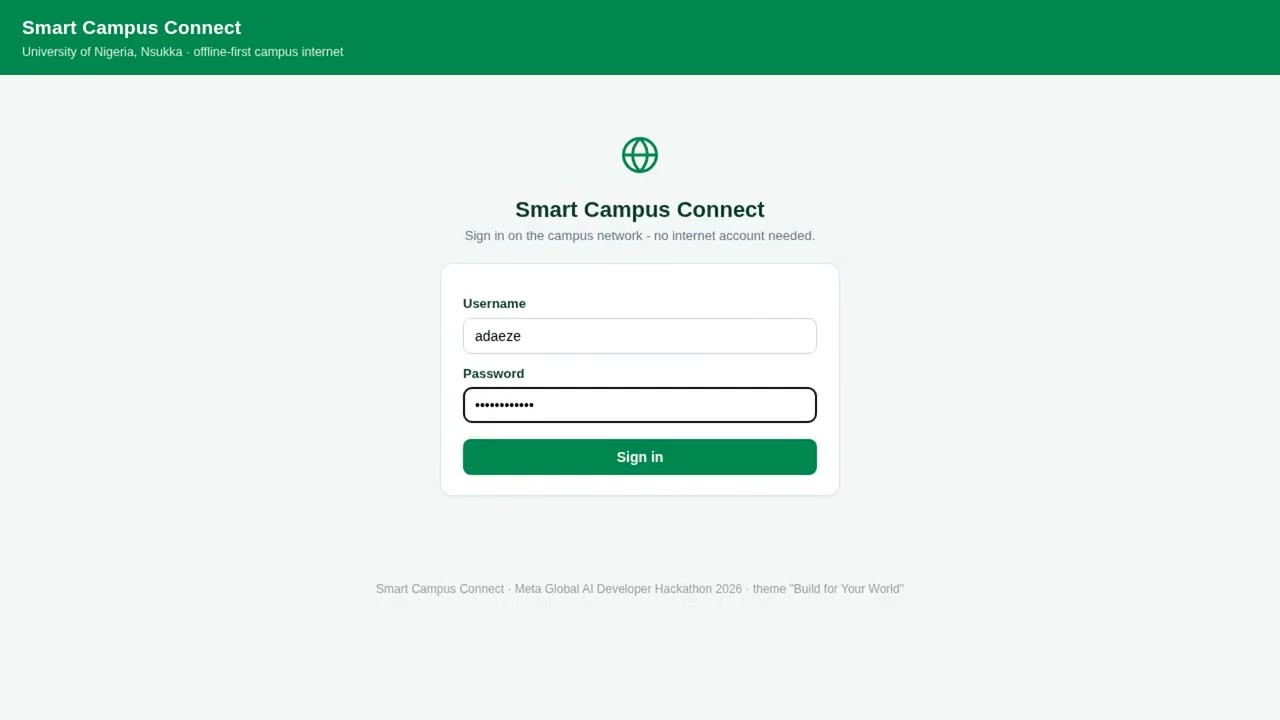
At the University of Nigeria, Nsukka (UNN), internet access is scarce and expensive. This prototype explores transparent allocation and locally reusable study materials for unreliable connectivity. It has not been deployed or measured on campus. Smart Campus Connect is an offline-first campus system that: 1. Allocates internet hours fairly and transparently: a weekly floor for every student when the pool is sufficient, with the remainder weighted by exam urgency and documented need. Every allocation carries a human-readable rationale. 2. Lets students log usage against their allocation, so they can see self-reported usage and remaining allocation. It does not enforce network access. 3. Provides AI study tools built for unreliable connectivity: exam summaries, revision quizzes, and condensation of pasted text. Requests made while offline queue on the campus server and need an explicit retry once connectivity returns; successful results are cached (repeat requests need no external model call or external bandwidth), and lecturers publish materials to a library students can open over the campus network without internet. When no model endpoint is reachable, a clearly-labeled non-AI extractive fallback keeps the tools usable; the interface never presents it as AI. 4. Targets study materials by explicit course/exam IDs: students carry registered exam IDs (e.g. CSC101), published materials carry course tags (e.g. CSC101-W3), and each student's dashboard surfaces exactly the materials matching their upcoming exams. 5. Measures itself: the admin panel counts what the database records - library reads, distinct readers, cache hits, successful model jobs, labeled fallback servings, and text bytes in and out. The one estimate (downloads avoided) is labeled with its comparison scenario, and a same-source quality check scores outputs against a fixed key-concept rubric rather than output length. 6. Is designed to run on a local campus server (Flask + SQLite) with local role-based accounts for students, lecturers and administrators, so no external identity provider is needed on an isolated network. This demonstration runs the prototype on a local server; only model generation uses an external provider endpoint, and only when connectivity exists. Administrator actions (pool, allocation, student management) are enforced server-side, separate from the lecturer publishing role.