Snapclaim
Built at Meta Global AI Developer Hackathon · Oct 26, 2026 · Remote
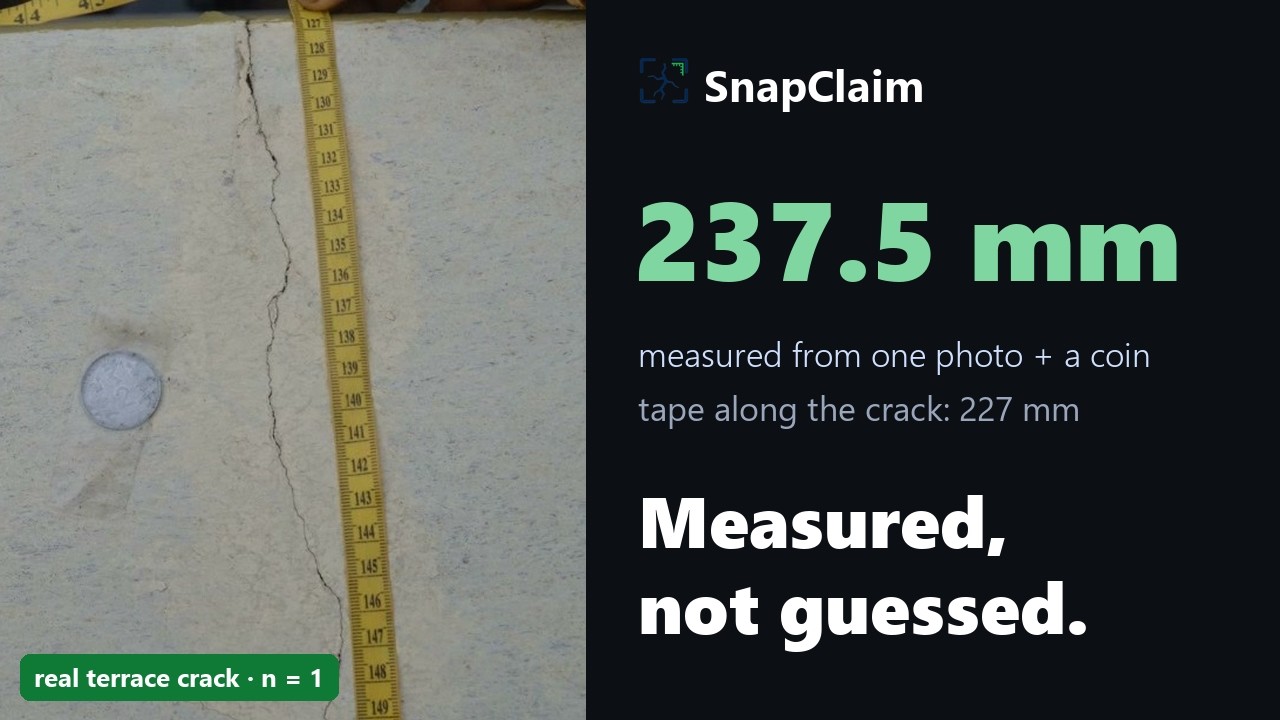
SnapClaim turns a damage photo and one spoken or typed line into a replayable damage report. Measurements come from the pixels, scaled by a coin, ruler, bank card, or other measured diameter, and every number carries a receipt that can be re-run. The AI writes the sentences, but the server refuses to ship any finding whose numbers don't match a receipt. Photos stay on your phone only mask data travels except two explicit taps: Cross-check sends the photo once for masking, and Render attaches it to the report. Evidence so far. One crack has been measured against a steel tape: a terrace-slab crack, tape span 227 mm (range 225–230). SnapClaim measured the same photo twice, same 25 mm coin, two pipeline runs: 232 mm [R005] in the filed report and 237.5 mm on re-run about 2% apart, i.e. +5 to +10.5 mm (+2 to +4.6%) against the span. This is a single case (n = 1). We haven't measured enough cracks to claim accuracy, and the width has no ground truth, so it's marked unverified. A photo-only AI estimate of the same crack said 315 mm, which is why the measurement path exists. What is real and what is not. Measurement, receipts and the evidence gate run deterministically in the app and the backend. The live AI parts (SAM 3.1 masking, Muse Spark findings and skeptic, voice transcription) use our keys with a $5 default spend cap, and fall back to on-device models where possible. The 54-scene bench tests the maths given a mask, not capture on a phone. This is documentation, not insurance advice, and the measurement is 2D in-plane only. How it was built. SnapClaim was built during the hackathon by a three-person team. The codebase was written mainly with Meta models: Muse Wonder and Muse Spark 1.3 Contributor, plus Muse Spark 1.3 used through opencode and Muse Code. Claude Code (Anthropic) was used for some commits and refactors. Every measurement, test and evidence check was run and verified by the team. The AI tools helped write code; the numbers come from the pipeline and the tape measurements.