Excalibur
Built at Meta Global AI Developer Hackathon · Oct 26, 2026 · Remote
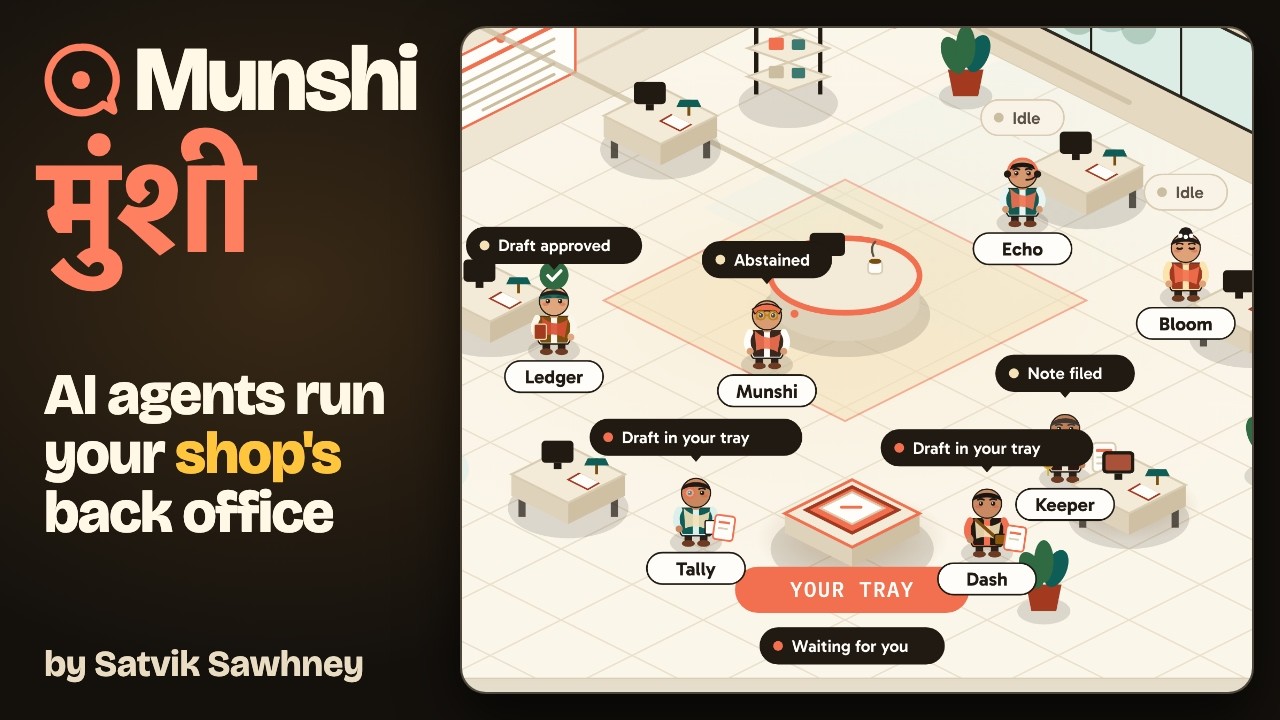
Forty-five packets in the notebook. Eighteen on the shelf. Where did the rest go? India has about 13 million kirana stores, and in each one the owner is the cashier, the buyer, the stock-keeper and the credit desk at once. Money leaks quietly, stock walks off, supplier prices creep up, and credit given on "kal de dunga" (I'll pay tomorrow) never comes back. Accounting apps only record what he types. Chatbots guess numbers, and some act on their own. In a business that runs on trust, one wrong number is enough to lose the owner for good. Munshi is an AI back office for a small shop, built on one guarantee: nothing changes the books without a named person's approval, and every number on screen traces to a row in those books. Seven agents work the shop like staff. Overnight they read the books, find what is leaking, rank it by rupees and draft a fix, then wait. The owner's day: - Morning brief: findings ranked by money, each with a Why? that cites his own ledger. Every figure opens to the row behind it, and Why this number walks it back to the person who approved it. - Shelf count: one photo. Muse Spark names the products, SAM 3.1 finds every pack, and plain code does the counting and compares it with the books. - Supplier bills: photograph a bill. Every line is read, every figure is pinned to the paper, and a price rise is caught. - Ask, in Hindi or English, by voice: every number in the answer is a chip he can tap down to its row. If the books don't know, Munshi says Cannot verify. It never guesses. - Credit: an overdue balance becomes a reminder or a PayPal payment link, drafted by the agent and sent only on his yes. - The agents' office: he can watch who is doing what and open any run, step by step: what it read, what it proposed, which model answered. - The rest of the shop: counter, stock, purchasing, staff roles, campaigns, a storefront that takes bookings and orders, Hindi throughout, and an installable app whose last brief stays readable offline. The guarantee is enforced by the database, not by a prompt. The agents run on a Postgres role with no write grant, a trigger on every book table refuses anything but a person's own command or a draft approved in that same transaction, and row-level security is forced on every tenant table. A model never writes a figure: answers cite stored cells, and a validator rejects any digit that did not come from one. Every guard has a sabotage test that must fail when the guard is removed, more than 1,700 such cases in all. All of it was built from scratch during this hackathon. Two real merchants are already live on Munshi: Elite Unisex Salon & Academy and Prabhave. The public demo runs on synthetic data, with simulated suppliers and a PayPal sandbox.. For the owner, that means something no accounting app or chatbot gives him: agents that do the work of a back office, and books he can still trust, because nothing moves without his yes.