Muse Life Graph
Built at Meta Global AI Developer Hackathon · Oct 26, 2026 · Remote
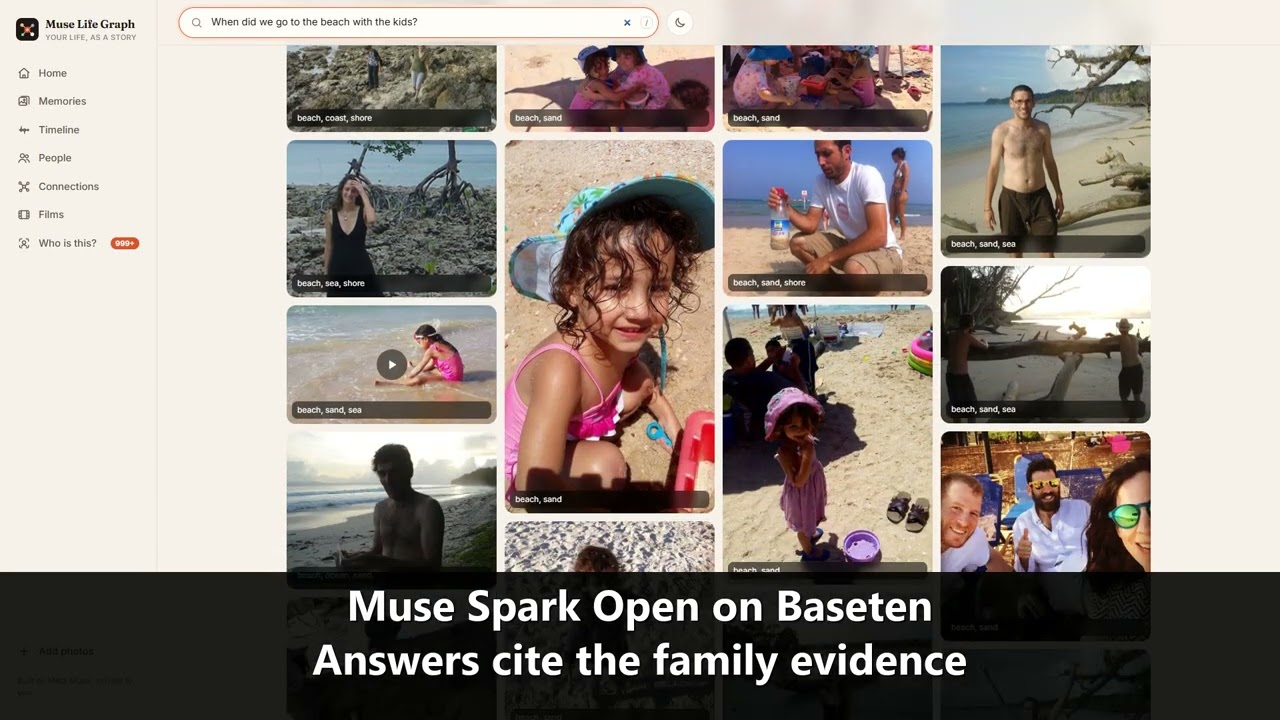
Muse Life Graph: one sentence in, a family film out. A crew of Meta Muse agents writes it, cuts it, watches its own draft and re-cuts it. TRY IT (2 minutes) Live demo: https://agmonporat--muse-life-graph-web.us-east.modal.run · access code: muse-3bydjbr3g2 1. Home plays a film the crew made. 2. Search "when did we go to the beach with the kids?" and see the answer cite the photos it used. 3. Films > "Taya Growing Up": the critic's timestamped notes, first cut vs re-cut, and the blind test. 4. Make your own film (about 7 minutes; the demo pays for 6 new ones). Names are read-only. 5. Connections: you at the centre, circles as bubbles; open one, drag a person to the right circle, set how close you really are. Run it on your own photos: Windows download in the README - fully on your own PC with Meta's open Muse Glimmer, or with Meta's API. THE PROBLEM Families keep thousands of photos and videos nobody looks at, and old faces nobody can name anymore. Turning them into a birthday or wedding film takes days of searching and editing. Today's AI tools either tag pictures or generate once without checking the result. WHAT IT DOES - Understands, not just tags: Muse Spark perceives each photo, video (keyframes and soundtrack together) and voice note into a strict schema with evidence, including when an undated scan was taken and why it thinks so. Copies are found by perceptual fingerprint. - Names people carefully: a name goes on a face only when two independent keys agree (a local face fingerprint and a second witness). Unnamed faces are grouped, so one answer names many. - Builds a life graph: Neo4j holds moments, people, places and evidence; network science (backbone, Louvain circles, bridges) shows the circles of a life forming and fading year by year. - Makes the film with an agent crew: Researcher (queries the graph) > Producer (Muse Spark) > Screenwriter (Muse Wonder) > pauses to ask the owner what only they know > Picture Checker (Muse Spark Open) > Copywriter (Muse Wonder rewrites the narration as one host voice - nostalgic, playful or documentary - and code sends back any line the pictures don't support) > Editor > Sound (MusicGen score, SeamlessM4T narration) > Critic: Muse Wonder watches the rendered draft video and gives timestamped notes > re-cut > blind test. - Search and ask in any language, answered only from the moments found, with citations. RESULTS (real data, docs/EVALS.md) - Blind test over all 8 finished films, in both orders: Muse Wonder preferred the critic's re-cut in 12 of 16 viewings. - Copywriter's host-voice lines vs the screenwriter's, 8 films, blind (Muse Spark judges, both orders): rewritten lines preferred in 16 of 16 viewings, no unsupported facts flagged. - Two-key face links: 93% precision (face fingerprints alone: 80%). - A film takes a median 7 minutes and $3 of model calls. - Measuring exposed a real bug (the Picture Checker's rejections were ignored), now fixed. WHAT'S NEW Everything shown was built from an empty repository during the hackathon (first commit Oct 26; git log shows every step). The demo library is the author's own family photos, shared with consent. The only thing brought in from before is data: names and reference faces from the author's earlier private database. PRIVATE BY DESIGN: THREE WAYS TO RUN The Windows app checks the computer's graphics card on its first screen and suggests one: (1) everything on this computer with Meta's open-weights Muse Glimmer through Ollama / LM Studio - no key, no cost, nothing leaves the PC; (2) pictures here, words in the cloud - every call carrying a photo, frame or sound runs locally, only text goes to Meta's API; (3) Meta's models in the cloud. Calls are routed by their content (mlg/muse/chat.py); a recording is never sent to the cloud as a fallback. Tested end to end on a local vision model on a 16 GB RTX 5070 Ti (full perception schema in 12-24 s a photo, no key); Glimmer itself needs ~24 GB and was not run on our hardware. BONUS CATEGORIES Open weights (Muse Spark Open on Baseten for search, titles, circles and the Picture Checker; Muse Glimmer for the fully local mode; MusicGen and SeamlessM4T on a home GPU) · Agentic (a crew that pauses to ask, critiques and re-cuts) · Creative (a personal film from one sentence).