Anukriti AI
Built at Meta Global AI Developer Hackathon · Oct 26, 2026 · Remote
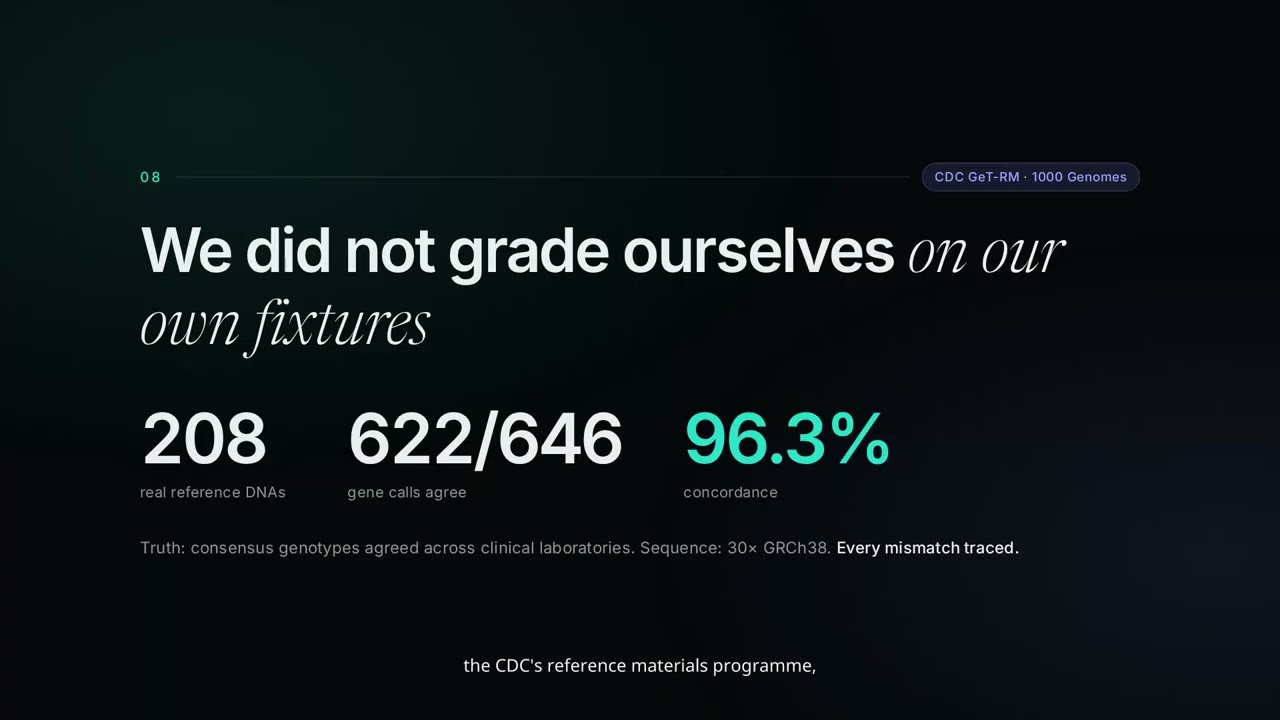
Pathya (പഥ്യം) turns the pharmacogenomic lab reports India already produces into verified, de-identified research data. It is a research tool, not medical advice: it makes no dose, drug or test recommendation and has no patient-facing output. The problem we know firsthand. Labs across India run these tests every day. The results leave as PDFs and WhatsApp photos in a dozen layouts, reach one hospital, and stop. India's DPYD frequency evidence rests on about two studies and 3,600 people, and the variants that matter here are not Europe's: the common Indian decreased-function DPYD variant is HapB3, not the *2A that European-derived panels are built around, and c.85T>C is carried by roughly a quarter of Indians. How it works. Muse Spark 1.3 reads a report - PDF, phone photo, or results read aloud through Muse Voice Transcribe in mixed Malayalam and English - under a strict JSON schema, quoting every gene call from the page rather than paraphrasing it. PharmCAT 3.4, CPIC's reference engine, standardises the allele names. Deterministic rules then record which India-relevant variants the panel never tested, strip every identifier before storage, and a curator verifies each call against its own quote. Records pool into carrier frequencies with Wilson 95% intervals, where a panel that never tested a variant is left out of that variant's denominator instead of being counted as a non-carrier - the page shows both conventions, so the choice is visible rather than buried. The same report can be read again by open-weights Muse Spark Open, so a biobank can run the whole pipeline inside its own network. That is the only version of this that could ever touch a real patient's report. Validated on real data, not our own fixtures. 208 CDC GeT-RM reference DNAs, cross-checked against their 1000 Genomes 30x GRCh38 sequence: 622 of 646 gene calls agree with clinical-laboratory consensus (96.3%), exact on every CYP2C19, CYP2C9 and VKORC1 call, and every one of the 24 mismatches is traced and written up. The hosted and open-weights readers agree within one call across 580 comparisons. The benchmark also produced the project's own argument unprompted: six disagreements were decreased-function SLCO1B1 alleles the consensus panel never looked for, all six in African-ancestry samples - a panel designed elsewhere calling a carrier a non-carrier. Live, open to everyone, no sign-in: https://pathya.anukritiai.com