ViChitra
Built at Meta Global AI Developer Hackathon · Oct 26, 2026 · Remote
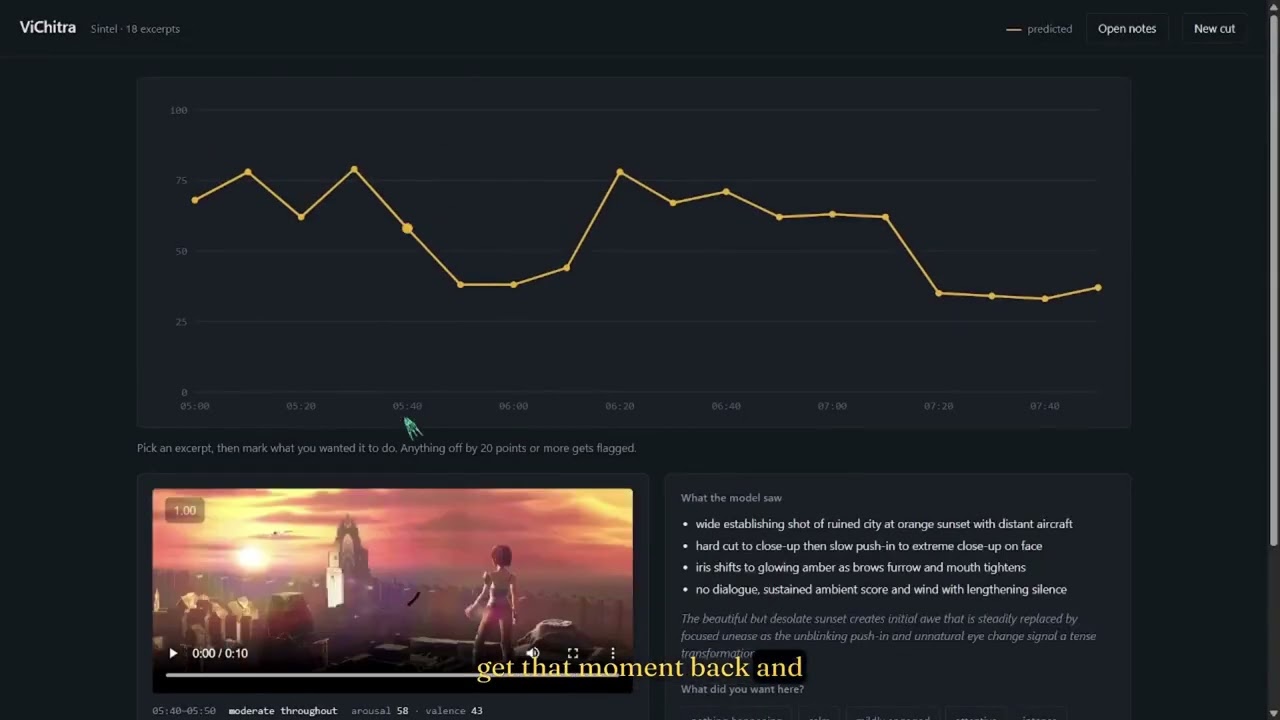
Filmmakers go blind to their own cut. You were there when you shot it, so you see what you meant rather than what's on screen. Studios solve this with test screenings. Independent, regional and student filmmakers can't; India makes more feature films than any country on earth and almost none of them ever get tested. ViChitra slices a cut into short excerpts, sends each one to Muse Spark with its audio, and returns a predicted audience-reaction curve, valence and arousal, plus the craft cues behind every score ("no hard cuts or score stings, sustained hushed ambience"). The director then marks what they INTENDED each stretch to do, and the tool flags where the cut diverges by more than 20 points. That second input is the point. A test audience can tell you how they felt. They can't tell you where the film stopped doing what you meant, because they don't know what you meant. Only the director does. Intent is an input here, which is the one thing a screening room cannot give you. The result exports as a single self-contained HTML file: the director marks at home, emails one file, and the editor opens it in any browser with no install and sees timecodes with reasons. Measured: 2.2 seconds and 0.7 of a US cent per excerpt - a three-minute sequence costs about 12 cents. Scoring the same cut twice reproduces within a few points (+0.88 valence, +0.86 arousal run to run). Validation against human annotation is preliminary - 18 excerpts, one annotator and reported as such in the README rather than overclaimed. It doesn't replace a test screening. It competes with not having one.