CAGE
Built at Meta Global AI Developer Hackathon · Oct 26, 2026 · Remote
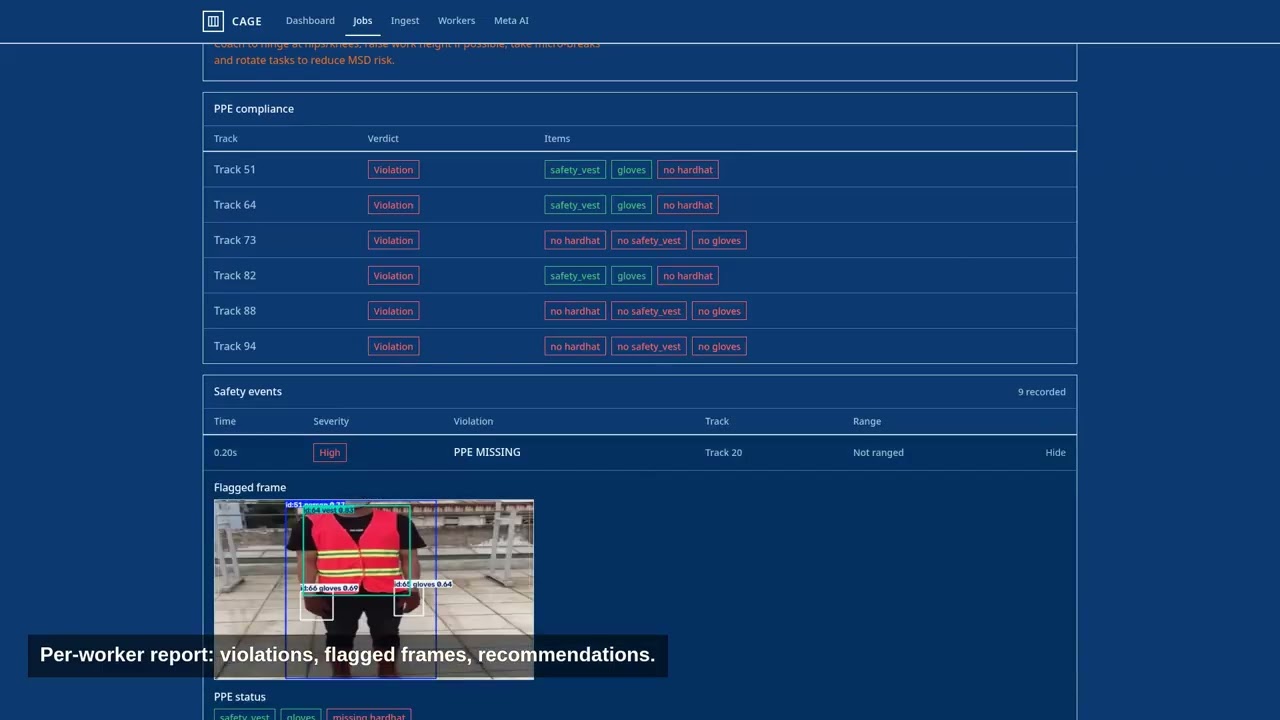
CAGE — Construction Site Safety Intelligence About 1,075 construction workers died on the job in the US in 2023, 9.6 per 100,000 full-time workers, the deadliest industry in the country. Fall protection has been OSHA's most-cited violation for years. Most of these deaths are preventable, and the footage needed to catch them already exists: sites run body-worn and fixed cameras all day. Nobody can watch eight hours of it from six workers at once, so it goes unreviewed. CAGE reads that footage after the shift and writes the safety report. You upload a shift, POV body-cam or wall-cam through the same pipeline, and get per-worker violations, the frames that prove them, an ergonomic risk score, and a plain-language brief. Three stages. A fine-tuned YOLO with a pose model and BoT-SORT tracking finds workers, PPE items, missing PPE, and violation candidates, and keeps one track ID per worker across frames. SAM segments the flagged regions to pixel accuracy, and the pipeline links each PPE item to the worker wearing it by containment and temporal smoothing. A vision model then re-reads the annotated frames and decides whether the finding stands, returning a confidence and an explanation. Locally that check runs as a three-pass adversarial chain of observer, auditor, and reconciler; through the Meta Model API it is one reconciler pass over the same evidence. Findings map to OSHA standards (1926.501/503, 1926.451, 1926.102, 1910.212) and to REBA-inspired ergonomic risk, so a foreman reads "hinge at the hips, raise the work height, rotate tasks" rather than a count of red boxes. Worker names and appearance embeddings stay in the local SQLite database. Only opaque worker codes go to the API.