Epicenter
Built at Meta Global AI Developer Hackathon · Oct 26, 2026 · Remote
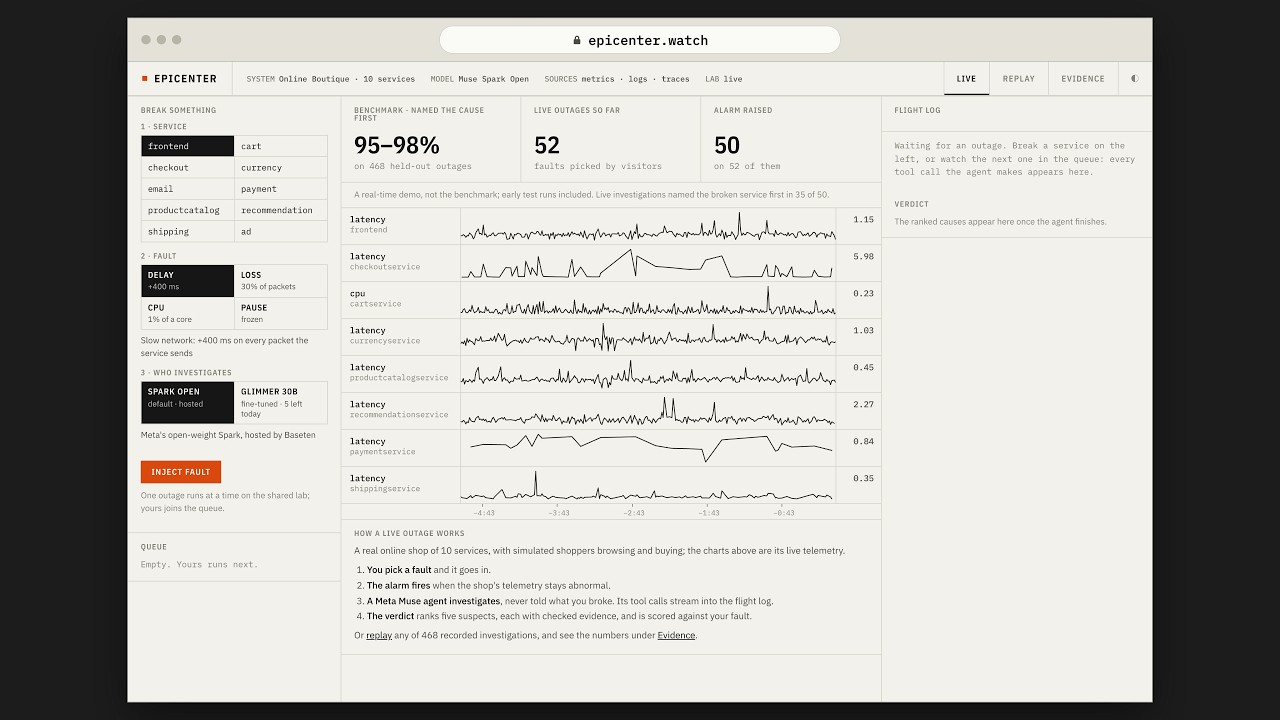
Epicenter is a root-cause analysis system for outages in distributed systems: it detects the outage, finds the service that caused it, proves it with checked evidence, and drafts the customer update. It answers only when it's confident, and escalates when it isn't. When something breaks in a system of connected services, everything downstream raises alarms, and an on-call engineer has to work out which one is the actual cause while customers wait. Here's how it works in practice. A simple detector watches live telemetry and raises the alarm. Then a Meta Muse agent investigates with read-only tools: metrics, logs, traces, and the call graph. It ranks five suspect services, and each one cites the exact tool calls behind it. A verifier throws out any cause whose evidence doesn't hold up, so an answer only goes out when the top cause passes that check with enough confidence. Then it drafts the ticket note and the customer update, with every sentence citing evidence. In the live lab it also proposes rolling back the change on the blamed service, but nothing happens unless a person approves it. You can try it at https://epicenter.watch. Break a service in a running 10-service shop (Online Boutique with OpenTelemetry) and watch the agent find it, or replay any of 468 recorded investigations. Measured on 468 held-out outages from the RCAEval benchmark (pre-registered split, published methods re-run on the same cases): hosted Muse Spark names the broken service first 95.1 to 97.5 percent of the time, against 66.7 to 77.8 percent for N-Sigma, the best published method. With escalation it answers 410 of 468 and is right on 98.5 percent of those. I also fine-tuned Meta's open-weight Muse Glimmer 30B on Spark's verified investigations of separate training outages (on the same held-out test: 0.58 to 0.65, up to 0.82 to 0.94 top-1; unfinished investigations 140 down to 1) and published the adapter on Hugging Face, so a team could run it on their own hardware.