Walk Me There
Built at Meta Global AI Developer Hackathon · Oct 26, 2026 · Remote
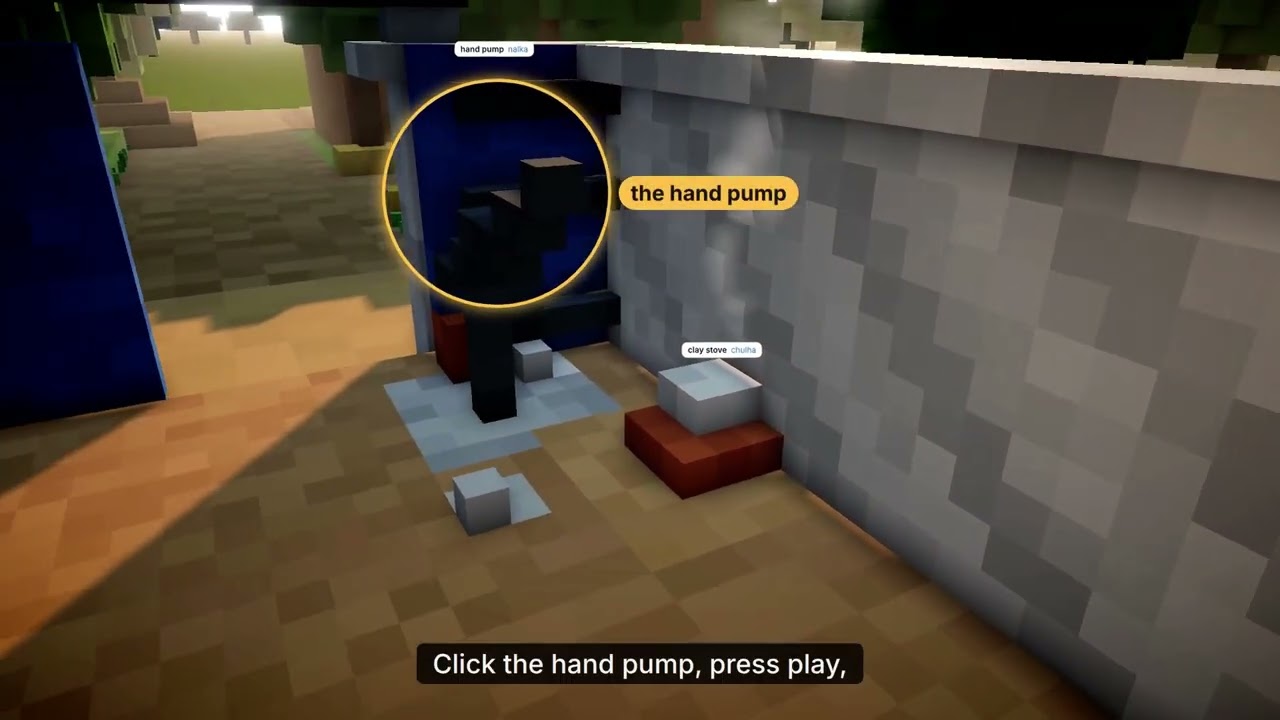
My grandmother's house in Punjab is gone, nobody ever took a photo of it, and only my mother remembers it, in Punjabi. Walk Me There turns a spoken memory like that into a 3D place made of coloured blocks that you walk through in the browser, and clicking a described object shows the words that described it, with a button that plays them. Muse Spark maps the words, and plain code checks every build against that map: on 8 written test homes, this raised stated positions built right from 71.7% (the builder model alone) to 92.7%. Try it at https://34-59-251-94.sslip.io. Muse Voice Transcribe writes the speech down, Muse Spark 1.3 translates it and maps it into rooms and objects, Muse Wonder writes a program that builds it, and Muse Image paints the view. Code then checks five things: everything said exists, sizes are within 35% or 1 m of what was said, positions hold as seen by someone walking in ("the hand pump is next to the big wooden gate with two leaves"), every coloured block in the place itself traces to a sentence, a marked landmark feature or a marked guess, and each described ground-level room is checked for a way in on foot (new builds use a stricter version of that check). A failing check goes back to Wonder with the speaker's words, for up to three repairs. In the saved run, the house passed 30 of 32 checks on the first build: the lower part of the neem tree stood past the courtyard wall, and the ladder stood 0.8 m from the wall it was said to stand against. One repair fixed both, and the whole house cost $0.36 in model calls. The builder's instructions include a worked example with this house's layout, so that first build was not a cold test. Six places were built from recordings in Punjabi, Spanish, Japanese and English: a home in Punjab, a haveli in Lahore, a plaza in Oaxaca, a school in Ibadan, a covered shopping street in Tokyo and a castle game level. Their first builds passed 156 of 170 checks, and automatic repairs brought that to 169 of 170. Nine places were built from written descriptions: eight well-known landmarks, such as the Golden Temple, and an unnamed temple in Nara. On six of them the real place's well-known features were added and marked as not said. The app also exports any place as a data pack for Minecraft: Java Edition. I built all 15 in the real game, and at most 6 of 2,000 randomly sampled blocks per place differed from the file. Those checks come from the app's own map, so I also tested the map against separate answer keys: 8 typed, spoken-style descriptions of homes the system had never seen, each with a key written separately from the code. These are text, not recordings, so the test covers mapping and building. Transcription and translation were not measured, but each described object can play the speaker's own words, so a family can catch an error. Wonder built each home three ways with the same building rules: from Spark's map with checks and repairs, straight from the description, and straight from the description followed by reviewing its own program. All stated facts together (things, sizes and positions): 93.8%, 79.3% and 77.9%. Stated positions alone: 92.7%, 71.7% and 69.4%. Self-review did not help. The checked pipeline got the most facts right on all 8 homes (on positions alone it tied on one), at about four times the cost of Wonder alone ($0.59 against $0.15 a home). This test ran before the building kit used in the demo, so these numbers do not cover that kit; two re-runs of the checked approach alone on the same 8 homes with the kit gave 95.1% of all facts and 93.6% of positions, then 96.9% and 96.3%, though by then those homes were no longer perfectly unseen. Tools that make 3D from photos need photos or a building that still stands, and these homes have neither. An image model paints something convincing, but nothing holds the picture to what was said. Here every coloured block in a home traces to a sentence or is marked as the app's guess, and one toggle hides the guesses. It is for families keeping a home that now lives only in an older relative's voice, in the language they remember it in, and for oral-history projects recording elders. It needs no 3D skills or photos, and the speaker needs no English. The app suggests the next question to ask, such as "Where was the door of Bibi Ji's room?", and a later recording adds the answer to the same place. The six recordings run 23 to 90 seconds and cost $0.30 to $1.16 in model calls, so a family could record an elder describing a home and walk through it the same night. At that address you can walk through the 15 places, or build your own by uploading a recording, typing a description or talking live. A backup copy runs on a separate server at https://35-196-186-212.nip.io. Walking needs a computer with a keyboard and mouse, and building has daily spending limits. A separate upload of the Punjabi recording to the public site finished in about 6 minutes at $0.33, with one repair and every check passing: https://34-59-251-94.sslip.io/h/2026-11-03-2adc7e. All of my code was written during the hackathon, and the first build and every repair on the six recorded places are saved in the app's Builds tab, along with any rebuild from Spark's notes that was kept.