Silk Lab
Built at The Recursive Agents Hackathon · Oct 17, 2026 · San Francisco, CA
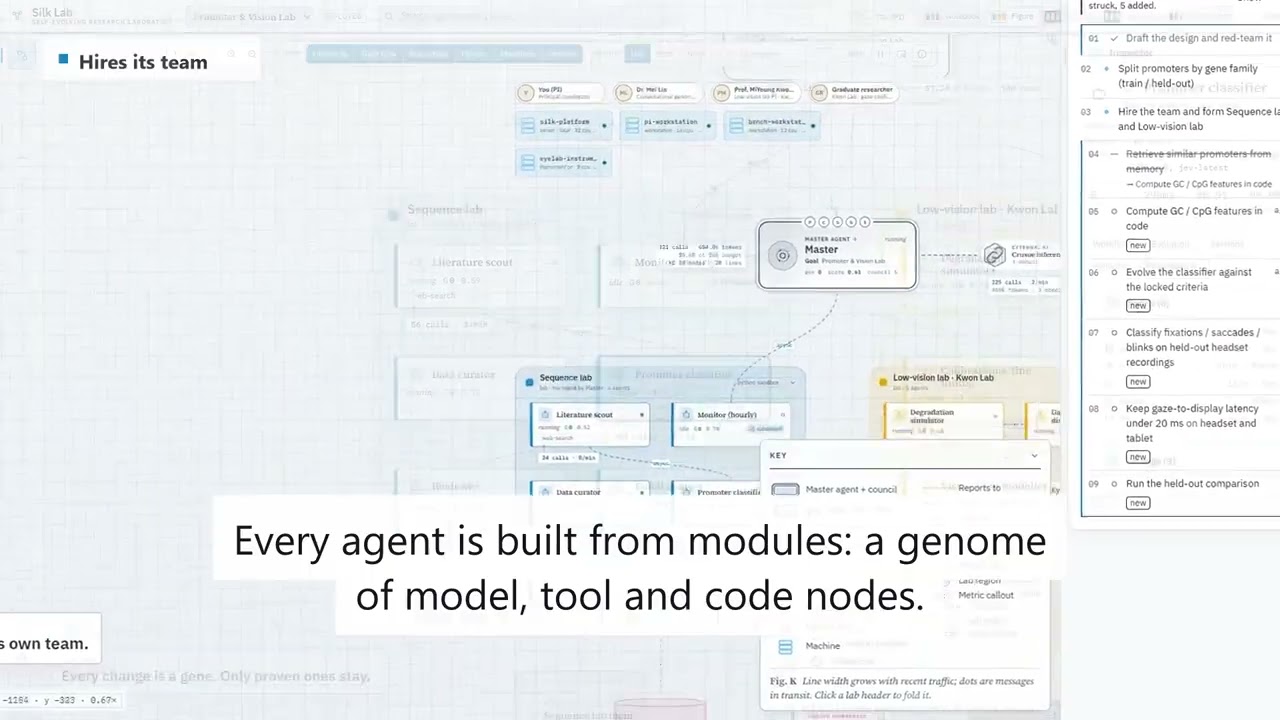
Silk Lab is a self-evolving research lab: a platform where a team of AI agents builds, measures and improves itself on a real research goal. You give it one goal (our applied case is Kwon Lab at Northeastern: moving gaze-contingent training for central vision loss from lab eye trackers to VR headsets and tablets). Hold-to-deploy, and a master agent hires sub-agents, organizes them into labs, and plugs in instruments with your consent. Each agent is a genome, a graph of model, tool and code nodes, and an evolution engine mutates it. A referee locks the success criteria and a held-out set before any change, so every new version must beat its parent on data it never saw, with lineage, an evidence chain and rollback. Teams evolve too: parallel structures compete and the winning one stays. A council inside the master (planner, coordinator, standards committee) votes on big decisions and steers the master's own evolution. A safety officer (hard-coded rules + Jev pre-screen + LLM review) warns on small issues and halts the whole project on critical ones until a human decides. Agents can propose new analysis panels and themes for the UI, through a validated extension API. Every researcher, on every machine, talks to the same lab through a chat module that never interrupts running work. Problem solved: research automation today means one-shot agents that never get measurably better; Silk Lab turns improvement itself into a safe, measured, held-out loop. The demo video uses mock data.