BibimbapKiller
Built at Built with Claude: Life Sciences · Jul 7, 2026 · Remote
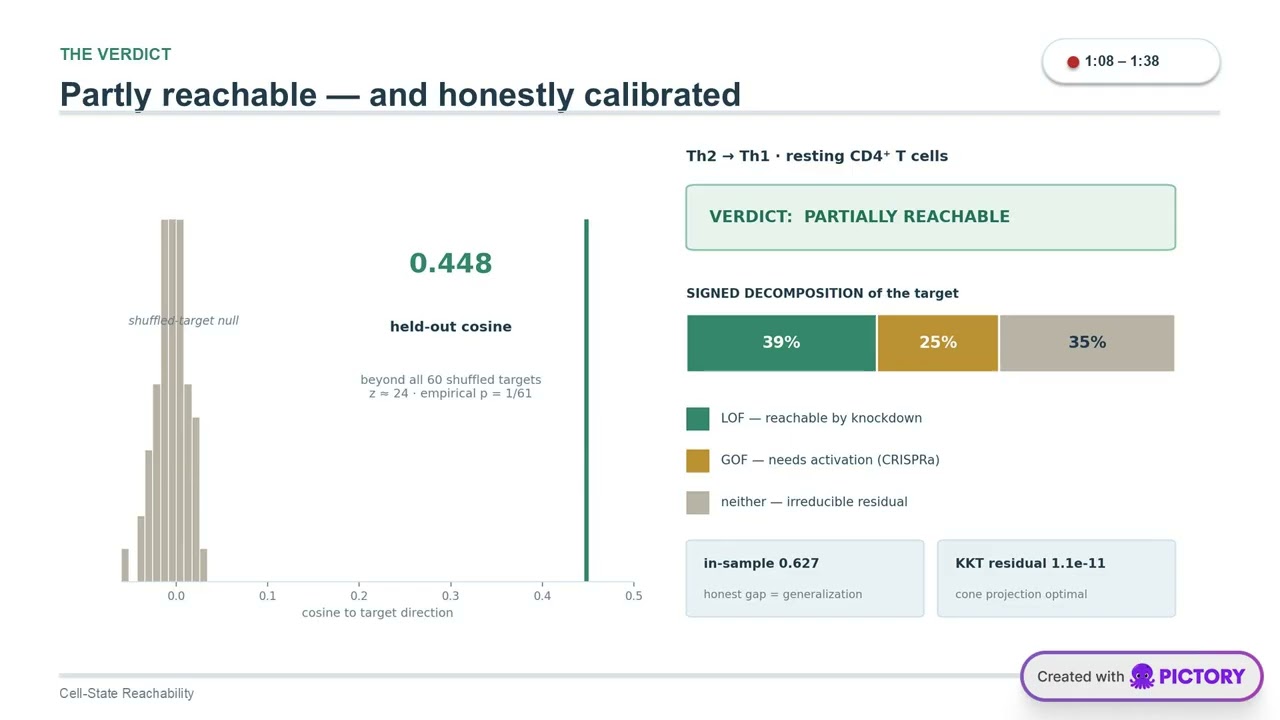
What if a model could say the one word every drug-discovery pipeline needs but no other tool can utter — "unreachable"? Cell-state-reachability reframes perturbation biology around a new question: not "what will this gene knockout do?" but "can we actually steer a cell from state A to state B — and should you believe the answer?" We surveyed 91 perturbation-prediction methods; none return a feasibility verdict. Ours does. Built on public Perturb-seq screens (Replogle K562/RPE1, Norman combinatorial doubles), it produces a map of reachable cell-state space plus the falsification machinery that flags which regions you're allowed to trust: additivity bounds for multi-gene edits, weak-instrument confidence intervals, and negative-control and construct-validity checks. The payoff is targets a supervised ranker structurally can't nominate — like ZAP70: small-molecule-tractable, genetically associated, yet undrugged. The stance is AI-as-instrument, not oracle. The deliverable isn't a gene list; it's understanding of the data's structure earned inside a falsification loop — fitting for a field whose own 2025 benchmark shows deep models don't beat linear baselines.
