Intron
Built at Built with Claude: Life Sciences · Jul 7, 2026 · Remote
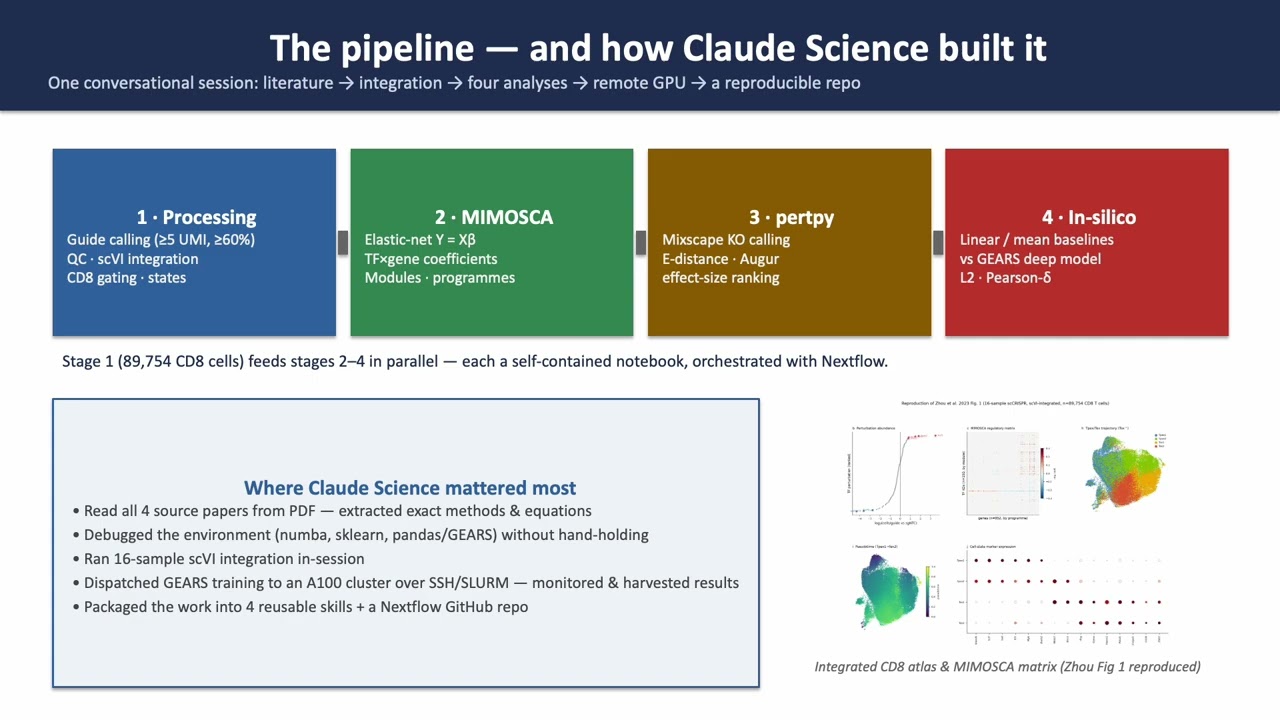
This project analyzed an in-vivo single-cell CRISPR Perturb-seq screen of tumor-infiltrating CD8 T cells (Zhou et al. 2023, GEO GSE216909 — 16 samples, 180 transcription-factor knockouts plus non-targeting controls) to map which TFs steer CD8 differentiation toward or away from exhaustion, and to test whether that regulatory logic can be predicted computationally. Starting from raw 10x matrices, I called single guides per cell, integrated all 16 samples with scVI, gated to 89,754 CD8 T cells, and annotated their differentiation states, then reproduced the paper's regulatory-network analysis (MIMOSCA elastic-net regression yielding a TF×gene coefficient matrix, co-functional modules, and gene programmes) and cross-validated it with the pertpy framework (Mixscape, E-distance, Augur). Finally, I benchmarked in-silico perturbation prediction, comparing simple linear/mean baselines against the GEARS deep model. The analysis identified Ikzf1 as the dominant regulator — its knockout retains cells in the progenitor-exhausted state and has the broadest transcriptional footprint (~900 genes) — while Tcf7, Egr2, and Bhlhe40 knockouts drive terminal exhaustion along the opposite axis. Notably, the deep-learning model failed to beat trivial baselines at predicting held-out perturbations, reproducing the central finding of Ahlmann-Eltze et al. 2025. This matters because it pinpoints candidate TFs for reprogramming exhausted T cells — a central goal for improving cancer immunotherapy — while providing a sober, quantitative benchmark showing that current in-silico perturbation models are not yet reliable for predicting the effects of unseen genetic perturbations in this in-vivo setting.