David Fraile Navarro
Built at Built with Claude: Life Sciences · Jul 7, 2026 · Remote
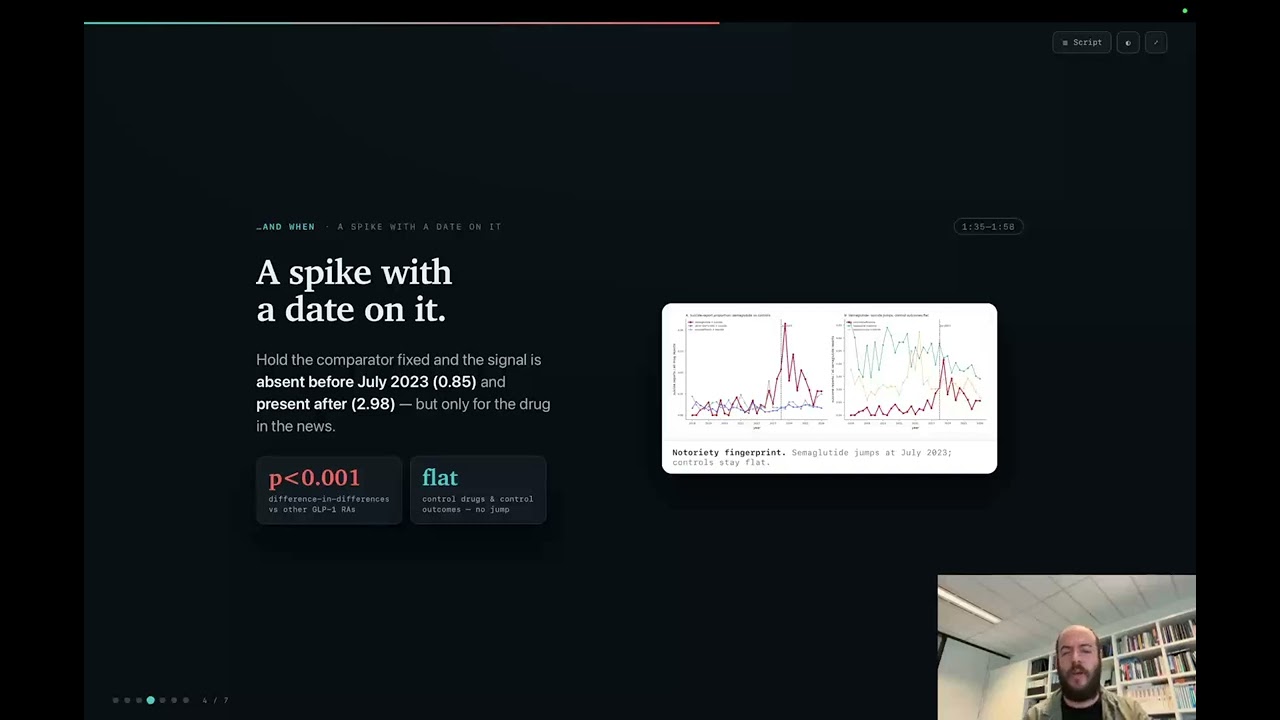
GLP-1 drugs like Ozempic are among the world's most prescribed — and in 2023 regulators opened suicide investigations after adverse-event databases lit up, even though the randomised trials showed no such risk. We reconciled that contradiction by rebuilding the entire evidence base as four strictly-separated streams — designed studies, spontaneous reports, mechanism, and an exploratory benefit arm — with formal risk-of-bias and GRADE certainty on the designed studies, measured error rates throughout, and tooling calibrated against known-answer benchmarks (AUROC 0.76). The result: the spontaneous "alarm" is unstable — its reporting ratio swings from 0.51 to 3.29 depending only on the comparator, and jumps exactly when the drug hit the news. That's the fingerprint of comparator choice and notoriety bias, not a real drug effect. The hopeful twist: reading the same database the same way, the signal points the other way for addiction — toward less drinking, less smoking, less craving across four substance classes (exploratory, but a genuine lead). Every piece — the dual-reviewer risk-of-bias engine, the GRADE harness, and the calibrated openFDA client — is open under Apache 2.0 and runs automatically: a reusable pipeline for evidence synthesis, ongoing drug-safety monitoring, and discovering new indications.