GlycoWorks
Built at Built with Claude: Life Sciences · Jul 7, 2026 · Remote
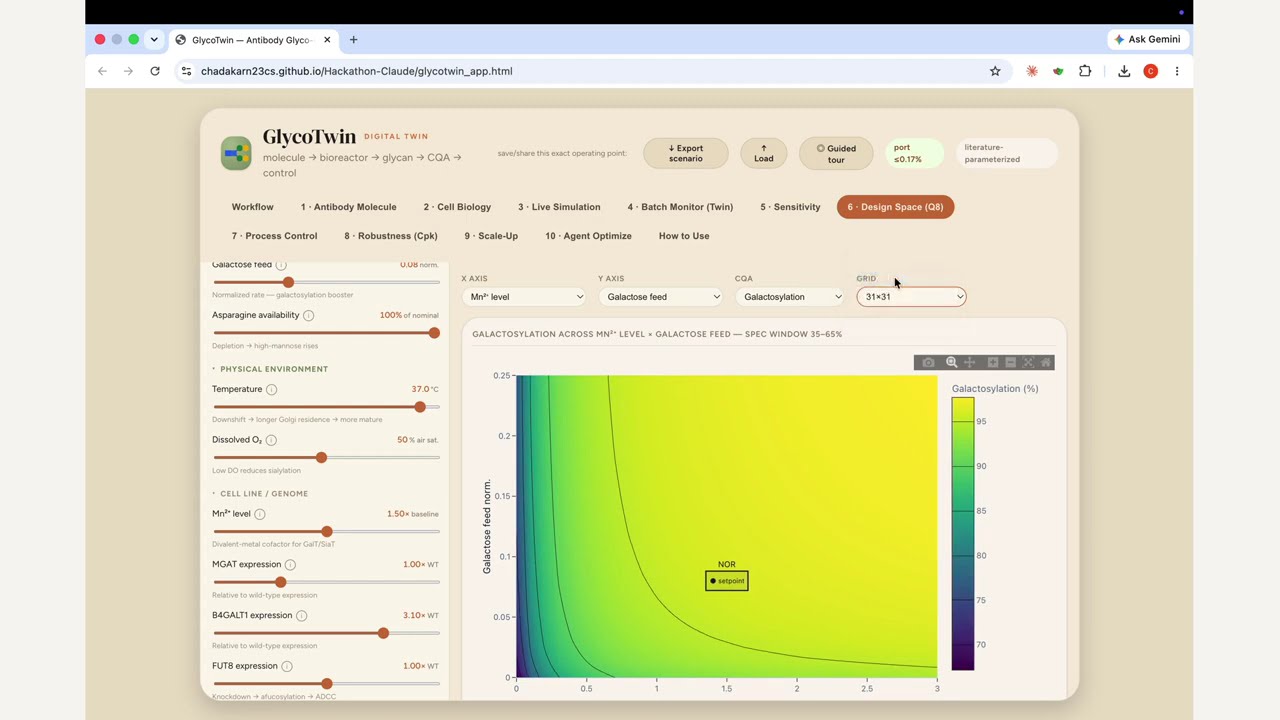
What I built: GlycoTwin, an open mechanistic digital twin connecting a bioreactor knob to the antibody's Fc N-glycan — a quality attribute governing potency, half-life, and immunogenicity. A 9-state CHO fed-batch model feeds an ER→Golgi enzyme train, so any process parameter propagates to galactosylation, afucosylation, sialylation, and high-mannose. Every parameter comes from public literature; nothing is fit to proprietary data. I tested one question: does Fc-galactosylation degrade at scale because CO₂ acidifies the Golgi — and if not, what controls it? What I found: The assumption is wrong. As CO₂ stripping falls from bench to 2000 L and pCO₂ climbs ~60→74 mmHg, galactosylation barely moves (~52→53%), because the CO₂ swing shifts Golgi-lumen pH only 6.43→6.38 — straddling the galactosyltransferase optimum (~6.4) on the flat top of its activity curve. Oxygen has zero effect. The real lever is the clone: overexpressing B4GALT1 recovers ~35 points; galactose feed and Mn²⁺ ~10 each; CO₂ stripping ~0. The model also reproduces the sub-5% sensitivity ceiling from a 2026 meta-analysis it never saw during calibration. Why it matters: Engineer the clone and media, not the CO₂ — productivity, not glycan quality, is the scale-up risk. Being mechanistic, the twin gives a bench-testable reason, not a black-box fit, and spans the CMC workflow: batch monitor, ICH-Q8 design space, Monte-Carlo capability, live control, and a governed agent loop. Fully open, reproducible from one script.
