Cancer crusher
Built at Built with Claude: Life Sciences · Jul 7, 2026 · Remote
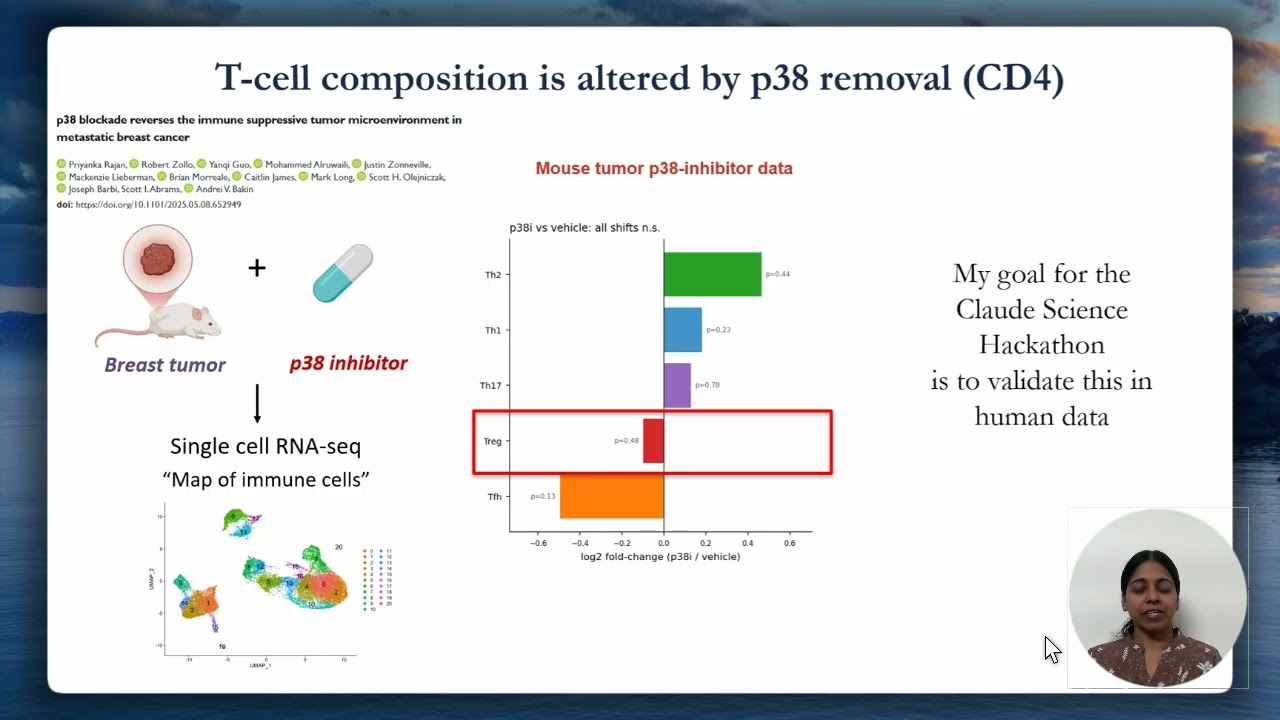
What I investigated My PhD work showed that inhibiting the p38 kinase in mouse models of breast cancer sensitizes tumors to immune checkpoint therapy, and that it shifts the CD4+ T cell compartment away from immunosuppressive regulatory T cells (Tregs) and toward effector cells. Why p38 blockade does this was unknown. I set out to find the mechanism in human data by asking, in a genome-scale CRISPRi Perturb-seq screen of primary human CD4+ T cells, which downstream factors carry the p38 signal into the Treg program. The screen provides genome-wide differential-expression readouts for thousands of individual gene knockdowns across three activation states, which let me treat "loss of p38" as one perturbation among a genome-wide null and ask which other perturbations reproduce its effect. What I found Knocking down p38 (MAPK14) in the human screen reproduced the mouse phenotype: it shifted CD4+ composition away from Treg and toward Th1, and its genome-wide signature was concordant with the mouse p38-inhibition signature. The shift tracked a Treg-associated program and the checkpoint molecule CTLA4, not an exhaustion program. Using two independent human Treg signatures as a readout, p38 knockdown lowered the Treg program more strongly than about 95-97% of all gene knockdowns in the screen. To find the transcription factors responsible, I scored every established p38-substrate transcription factor by whether its own knockdown moved the Treg signature the same way p38 loss did. NR4A3 was the leading mediator, ranking first among the substrate factors in both Treg datasets and among the very strongest of all knockdowns in the tumor-derived signature; ELK1 and C/EBP-beta were consistent secondary candidates. Notably, NR4A3's own transcript barely changed, consistent with p38 controlling it through activity rather than abundance. No single factor reproduced the full p38 effect, indicating that p38 supports the Treg program through several transcription-factor substrates acting in parallel rather than one dominant mediator. I then asked whether these factors act directly on Treg genes by scanning promoters and enhancers for their binding motifs. The NR4A binding motif was present in Treg-gene promoters but not preferentially at NR4A3's targets, pointing to a largely indirect route for NR4A3. The strongest direct transcription-factor-to-Treg-gene chains converged on two nodes: the master Treg regulator FOXP3 (through NFAT and NR4A family factors, established direct FOXP3 regulators) and the Treg effector and suppressive module (IL10, TGFB1, CD39). CTLA4 itself carried no proximal-promoter motif for its candidate regulators but had strong USF1 sites at its distal enhancers, nominating a p38-to-USF1-to-CTLA4 route. Why it matters No approved therapies target Tregs directly, and Tregs are a major barrier to immunotherapy response in breast cancer. These results provide a human-data-grounded, testable mechanism for why p38 blockade reduces Tregs: p38 sustains the Treg program through a small set of parallel transcription-factor substrates that converge on FOXP3 and Treg effector genes. This nominates specific, druggable nodes -- NR4A3 and the FOXP3-directed NFAT/NR4A axis foremost -- to test as points for blunting Tregs while preserving effector T cell differentiation, with the goal of making tumors more responsive to immunotherapy. Scope and limitations The screen is in CD4+ T cells under acute activation, so these findings read as quiescence-versus-activation biology rather than terminal exhaustion, and CRISPRi transcript knockdown is an approximate stand-in for pharmacological kinase inhibition. The nominated transcription factors and regulatory chains are computationally supported leads based on perturbation effects, regulon databases, and motif presence; measured binding (ChIP-seq) and functional perturbation in Tregs are the next steps to confirm them.