T2 Labs
Built at Built with Claude: Life Sciences · Jul 7, 2026 · Remote
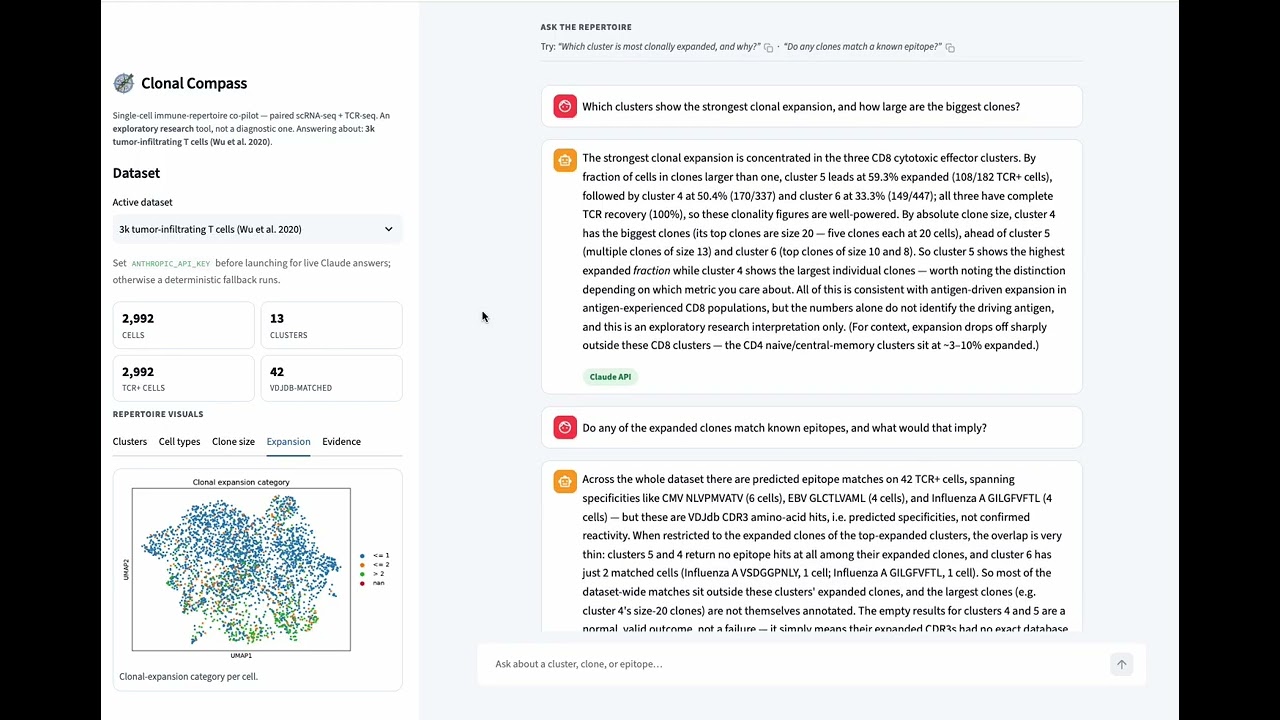
Clonal Compass is a single-cell immune-repertoire co-pilot for paired scRNA-seq + TCR-seq data. I built it for immunologists and computational biologists who already have repertoire-analysis outputs but still need to manually connect several pieces of evidence: which T-cell clones expanded, where those cells sit in the transcriptional landscape, what marker genes support the inferred cell state, and whether any known epitope matches are available. The tool runs a Scanpy/scirpy-based analysis pipeline, computes clone expansion and cluster-level evidence, builds compact evidence bundles, and then uses Claude to generate cautious, reviewable interpretations from those computed results. It also includes a Streamlit chat interface where users can ask grounded questions about the evidence rather than prompting Claude over raw or unstructured biology data. I tested Clonal Compass on two public datasets: a PBMC baseline dataset and a tumor-infiltrating T-cell dataset. The contrast was useful: the PBMC dataset showed low clonal expansion, while the tumor T-cell dataset showed stronger expansion patterns, demonstrating how the same workflow can help summarize different immune-repertoire contexts. This matters because existing repertoire tools are strong at computation but often stop at tables and plots, while general single-cell AI copilots may not be aware of clonotype structure. Clonal Compass sits between those worlds: it makes immune-repertoire analysis more interpretable without asking the LLM to act as an ungrounded biology oracle. Quantitative claims come from computed evidence bundles, and Claude is used as a cautious interpretation layer that hedges uncertainty, cites observed metrics, and avoids diagnostic or patient-level claims.
