Trialign
Built at Built with Claude: Life Sciences · Jul 7, 2026 · Remote
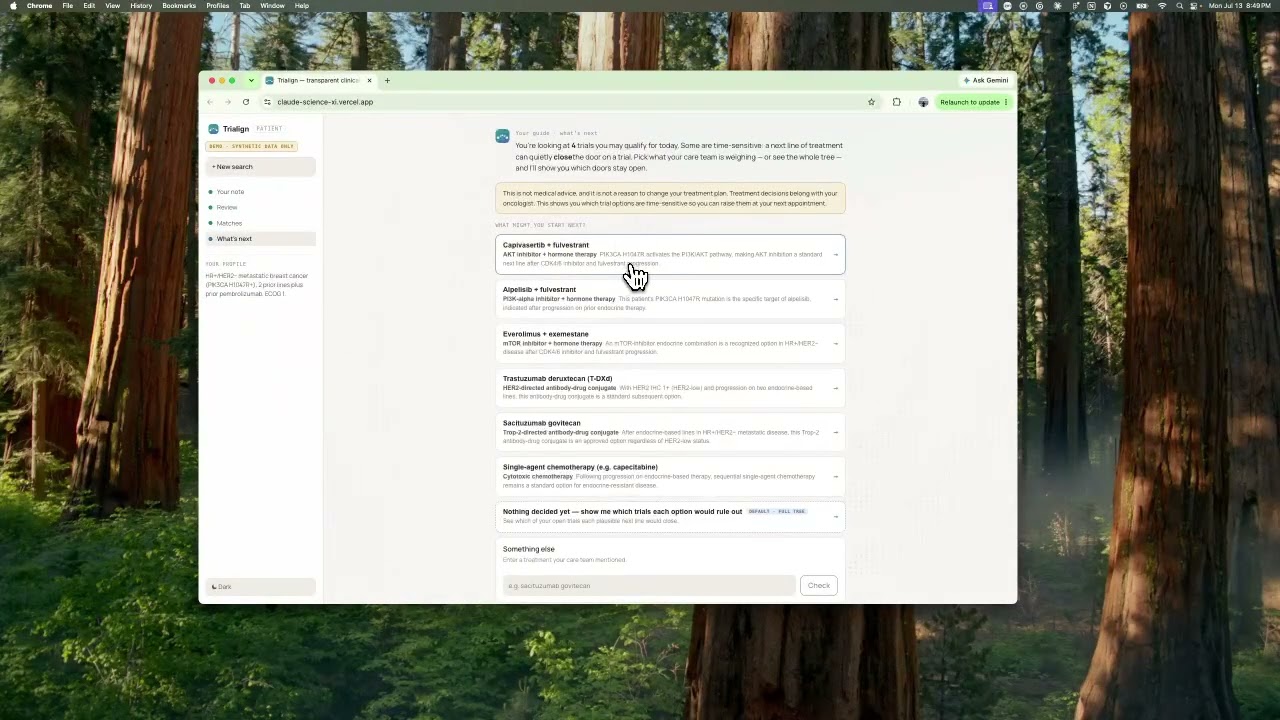
About Trialign is a patient-facing clinical trial matcher for oncology. A patient pastes a clinical note, uploads a record, or connects their EHR via SMART on FHIR. Claude reads it into a structured mCODE profile, asks only the questions that actually change an eligibility call, and screens live against recruiting studies on ClinicalTrials.gov — showing the inclusion and exclusion reasoning behind every match, criterion by criterion. The part that makes it different: after showing what a patient qualifies for today, Trialign asks what treatment their care team has recommended next — and shows which trials that next treatment would disqualify them for. What we found We started building a trial search tool. The research pushed us somewhere else. Finding 1: the biggest hole in the funnel isn't matching — it's timing. In one phase I cohort, roughly 48% of patients who fell out of the trial funnel had already started an off-protocol therapy without ever consenting to a trial. Most trials exclude patients with prior exposure to certain drug classes. So the treatment you begin next month can silently disqualify you from trials you didn’t know existed. Every existing tool — TrialJectory, Antidote, TrialMatch — treats eligibility as a static snapshot. It isn't. It's a window that closes, and nobody shows patients the window. Finding 2: FHIR gives you the documents, not the data. The Cures Act (§170.315(g)(10)) requires every certified EHR to expose a FHIR R4 API that lets a patient authorize a third-party app to pull their own records. But the mandated USCDI data set doesn't carry oncology's decisive variables — receptor status, PIK3CA mutations, ECOG, RECIST measurable disease, date of last dose. Those live in narrative notes and pathology PDFs, which arrive as unstructured DocumentReference blobs. The FHIR R4 API hands you the documents. Claude is what turns them into a matchable profile. Finding 3: the regulatory position is the opposite of what everyone assumes. Because the patient authorizes the disclosure themselves, we never become a HIPAA business associate. We also found that ONC and the NCI have already published USCDI+ Cancer Clinical Trials Matching, a federal data element list built on mCODE for exactly this use case. We conform to it. Why it matters Roughly 76% of patients considered for cancer trials never reach first dose, and 3-month mortality after screen failure is around 30% — patients getting too sick to qualify while they wait. Someone I know got into a trial only because their oncologist happened to be its principal investigator, and paused to discuss the trial before starting a therapy that would have disqualified them. That pause is the only reason they got into the trial. Everyone else deserves the same pause. That's what we built.

