Signal Reversal · T-cell Reversal
Built at Built with Claude: Life Sciences · Jul 7, 2026 · Remote
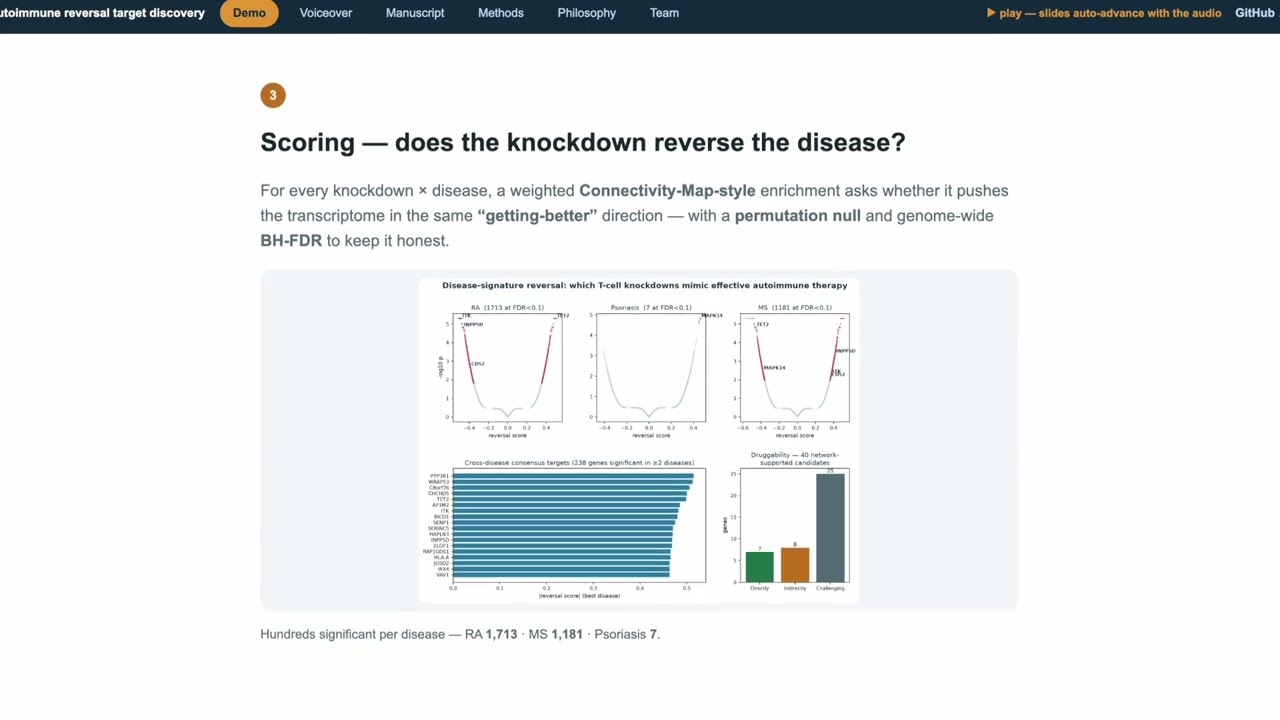
We asked a simple question of a genome-scale CRISPRi Perturb-seq screen of primary human CD4+ T cells (Marson & Pritchard labs): which single-gene knockdown pushes a T cell's transcriptome opposite to active autoimmune disease — i.e. mimics effective therapy — and can itself be drugged? For each of 11,281 knockdowns and three diseases (RA, psoriasis, MS), a Connectivity-Map-style weighted-GSEA score — calibrated with a permutation null and Benjamini–Hochberg FDR — ranks how well the knockdown reverses that disease's published treatment-response signature (RA 1,713 · MS 1,181 · psoriasis 7 significant). Genes significant in ≥2 diseases (238), a six-filter plausibility cascade, and Open Targets tractability leave a 40-gene shortlist — 7 directly targetable, led by ITK (with INPP5D, KAT6A, MAPK14, CD52) — several with approved-drug precedent. Cross-validating the top candidates against four more diseases (seven total) leaves exactly two universal regulators: TET2 and KAT6B. KAT6B is the striking result — a literature-blind screen independently nominated the KAT6A/B pathway in precisely the diseases (MS, IBD) where mouse genetics had already shown the paralog is causal, and a dual KAT6A/B inhibitor is already in clinical trials. A separate Th1/Th2 cell-state method converges on overlapping targets and validates the approach (AUROC 0.92/0.86; independent human-genetics enrichment p = 4.2×10⁻¹¹). Everything is FDR-controlled, deterministic (reproduced at Pearson r = 1.0000), and honestly caveated — all candidates are computational hypotheses for experimental validation, not confirmed drug targets. Data/security: the deliverable is analysis code plus one self-contained, offline HTML report — no server, no telemetry, no credentials or personal data; it uses only the public S3 Perturb-seq bucket, public GEO series, and the public Open Targets / STRING APIs.

