Arya
Built at Built with Claude: Life Sciences · Jul 7, 2026 · Remote
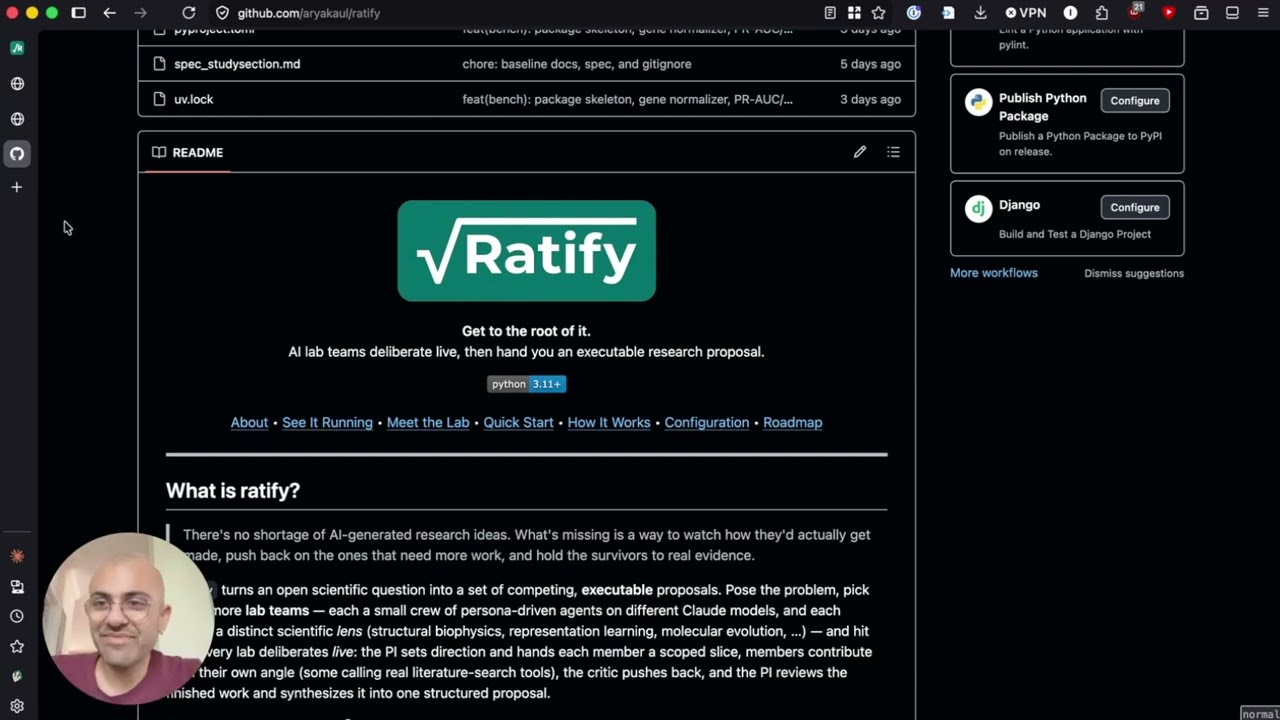
What I built: Ratify convenes diverse AI "labs" (each a small crew of persona-driven agents (a PI, members, and a critic)) running on different Claude models and seeded with a distinct scientific worldview to attack one open research problem, deliberate live, and produce competing executable method specs. It turns each spec into running code and scores it against held-out real data. I used it to ask: if you seed different scientific lenses, do you get different methods and do any of them beat a strong biological baseline when held to real evidence? The data came from the Krogan lab's cross-species coronavirus interactome and tried to predict from sequence alone, which host proteins a held-out viral protein binds, using their real SARS-CoV-2 / RaTG13 AP-MS data. What I found: Two things. First, seeding distinct worldviews produces measurably diverse methods: the labs' predictions were truly independent. Second, a simple baseline of "assume a virus grabs the same host proteins as its close relative" gets you most of the way there and is hard to beat. On the first pass, none of my labs beat it. Only after I handed each lab its own held-out scores and asked it to try again did one method (reasoning from molecular evolution) come out ahead. The tool surfaced an approach an ML-only scientist would have skipped. Why it matters: As more of science is handed to autonomous agents, the risk isn't too few ideas: it's confident, wrong ones. Ratify's answer is structural: nothing counts until it's executable and scored against evidence it never saw. That allows an idea generator to also become an idea filter. It also doubles as a way to test multi-agent setups against a real scientific yardstick, and every run leaves behind a chain of verified scientific reasoning. For a working scientist, it's a room of diverse, evidence-held collaborators on demand for you to interact with.