Finerium
Built at Built with Opus 4.7: a Claude Code hackathon · Apr 21, 2026 · Remote
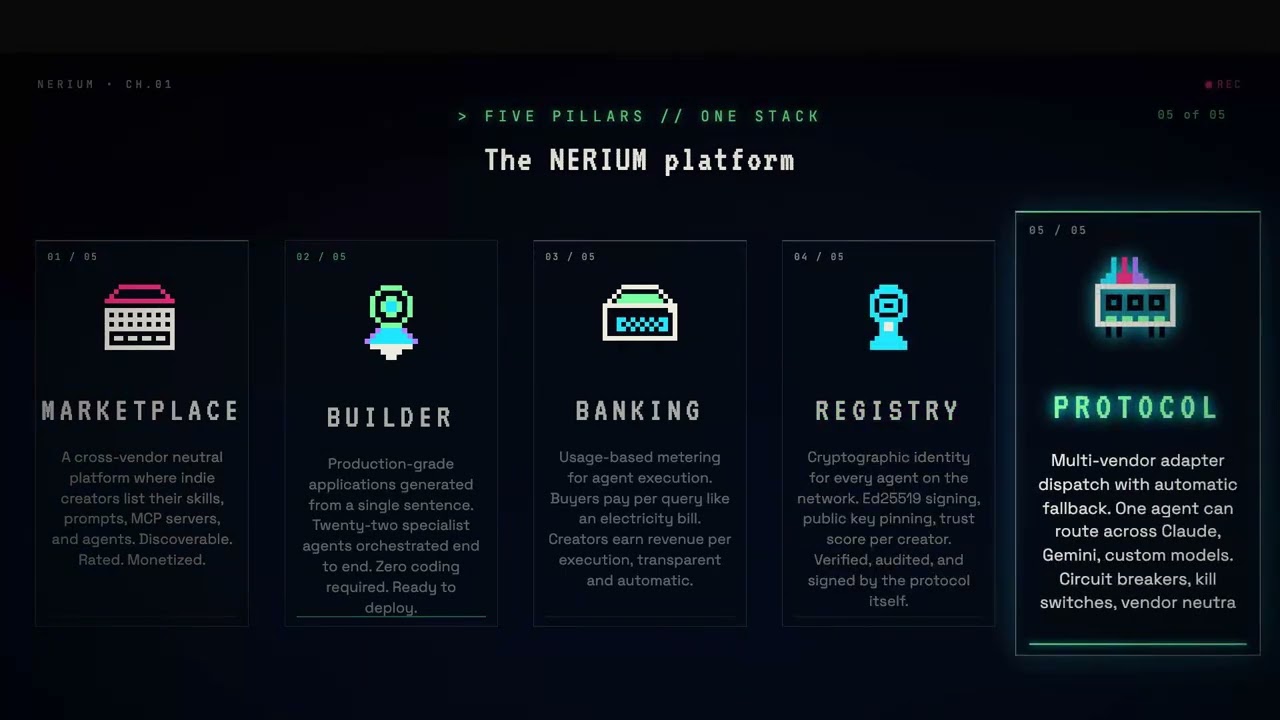
NERIUM is infrastructure for the AI agent economy. Five integrated pillars: Marketplace, Builder, Banking, Registry, Protocol. Packaged as a playable JRPG world to make agent infrastructure accessible to non-technical founders. The Builder pillar is a gamified prompting editor. A user types one sentence describing their project. Sekuri, the agent structure architect, classifies project complexity (small=4 agents, medium=8, large=14) and proposes a multi-vendor agent roster. Eight vendors are presented in the model selection interface: Anthropic Opus 4.7, Google Gemini Pro, OpenAI Codex, Higgsfield, Seedance, Meta Llama 3.1, Mistral Mixtral, and Auto. The agents spawn in parallel terminals and execute the build end to end. The Marketplace pillar solves the indie creator monetization gap. Today, AI skills sit forgotten on Twitter feeds, MCP servers buried in GitHub repos, brilliant prompts traded in Discord and lost by Monday. NERIUM Marketplace gives every creator a permanent home and every buyer a real search engine. Discoverable, rated, sortable by trust score, monetized from day one. The Banking pillar treats AI agents the way utilities treat electricity. Every query metered. Every execution billed transparently. Buyers pay only for what they use. Creators earn revenue per execution, automatically. Stripe Connect Express integration with usage-based metering. The Registry pillar provides cryptographic identity for every agent on the network. Verified, audited, and signed by the protocol itself. Ed25519 signing with weekly key rotation. Astraea Bayesian trust score with Wilson confidence interval recomputed nightly. The Protocol pillar provides multi-vendor adapter dispatch with automatic fallback. One agent can route across Claude, Gemini, custom models. Vendor neutrality built in. Circuit breaker and kill switch architecture for graceful failure. This submission was constructed by 54 specialist Claude Code agents on Opus 4.7, orchestrated via formal multi-version handoff documents (V1 through V7 in _meta/orchestration_log/). Each agent has a defined role, dependency contract, ferry discipline, and self-check verification. The recursive automation thesis: NERIUM was built by managing 54 Claude agents through manual orchestration, and NERIUM's Builder pillar gives that capability to its users. Honest claims: Stripe in test mode at submission, Stripe Atlas activation pending. Builder live runtime is theatrical at submission with bring-your-own-key pattern available for judges with their own Anthropic API key. Multi-vendor model selection UI is showcased; live runtime invocation at submission is Anthropic-only via Max plan workflow, multi-vendor live runtime activates per-vendor billing setup post-launch. Voiceover generated via Gemini 2.5 with bundled cyberpunk synthwave background music for consistency, demonstrates further multi-vendor AI usage acceptable per hackathon rules. Built by Ghaisan Khoirul Badruzaman, first-year Politeknik Negeri Bandung Teknik Informatika student in Indonesia.