Crosswalk
Built at Built with Opus 4.7: a Claude Code hackathon · Apr 21, 2026 · Remote
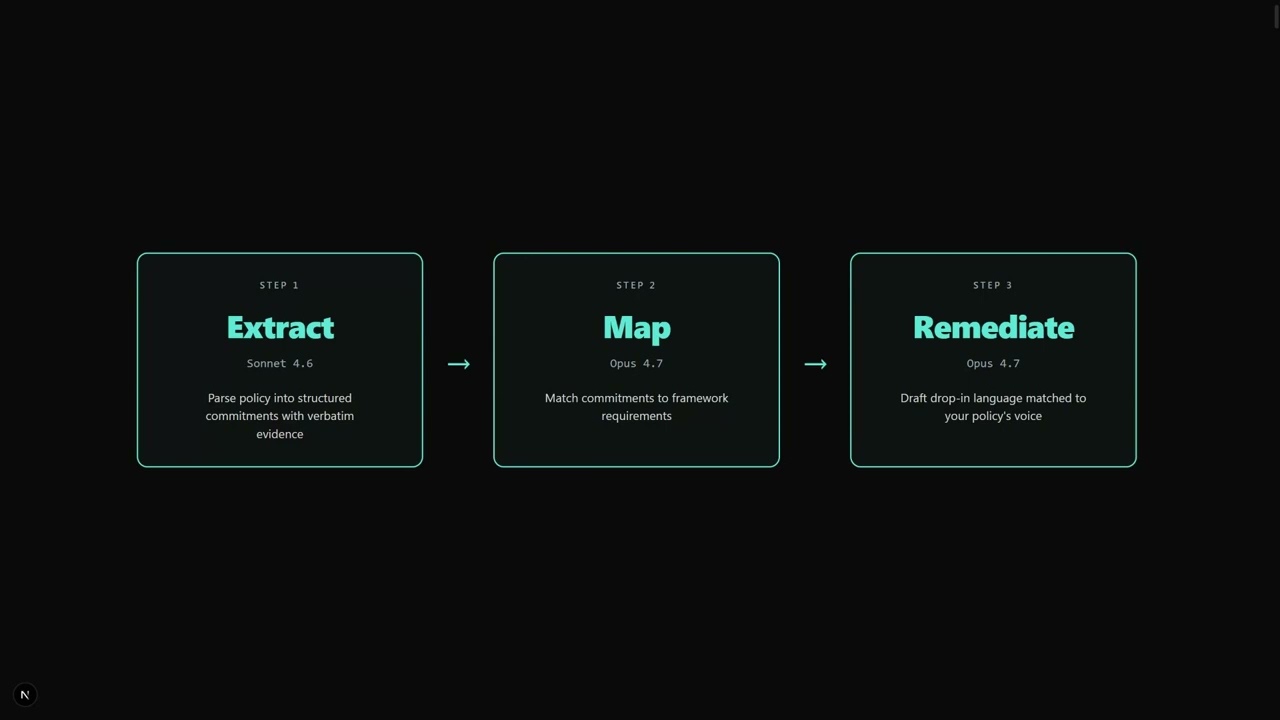
Crosswalk reads your AI governance policy and validates it against EU AI Act, NIST AI RMF, FDA AI/ML SaMD, and ISO 42001 in one pass. You get drop-in policy language for every gap, not a remediation roadmap. The pipeline is a 3-step prompt chain. Sonnet 4.6 extracts every concrete commitment from the policy as structured data. Opus 4.7 maps each commitment to framework requirements with verbatim evidence citations — every covered finding cites a specific commitment ID and a substring of that commitment's evidence quote, so you can audit Crosswalk's reasoning by hovering, not by trusting. Opus 4.7 then drafts remediation language matched to the policy's voice — preserving modal verbs, structure, and register. Microsoft RAI gets dense legalistic prose with numbered RS4.X structure. A flatter corporate policy gets institutional voice. I empirically verified by running the same Article 55 gap through both and comparing. Two features I'm proud of: Industry-aware applicability gate. Tell Crosswalk your industry and role, and it marks structurally out-of-scope requirements as not-applicable. Run a tech company through FDA SaMD and clinical-device requirements get skipped with a written rationale per item, not surfaced as false-positive gaps. The skipped section is the difference between a tool and a checklist. Tier C cross-framework merging. Equivalent requirements across regulators (e.g., EU Article 9 risk management ≡ ISO 42001 Clause 6.1) collapse into single proposals via union-find clustering, so accepting one fix counts toward both regulators' coverage. Soft-conflict detection (Jaccard similarity on token sets) flags when regulators want different things on the same topic. Word .docx export ships with a cover page, framework citations, severity badges, change-list table, and full audit trail. Per-step prompt caching keyed on policy_hash + framework_id makes re-runs near-instant and deterministic. Schema robustness via permissive parse + post-hoc hydration handles model drift without failing.