Yabloko Labs
Built at Meta Global AI Developer Hackathon · Oct 26, 2026 · Remote
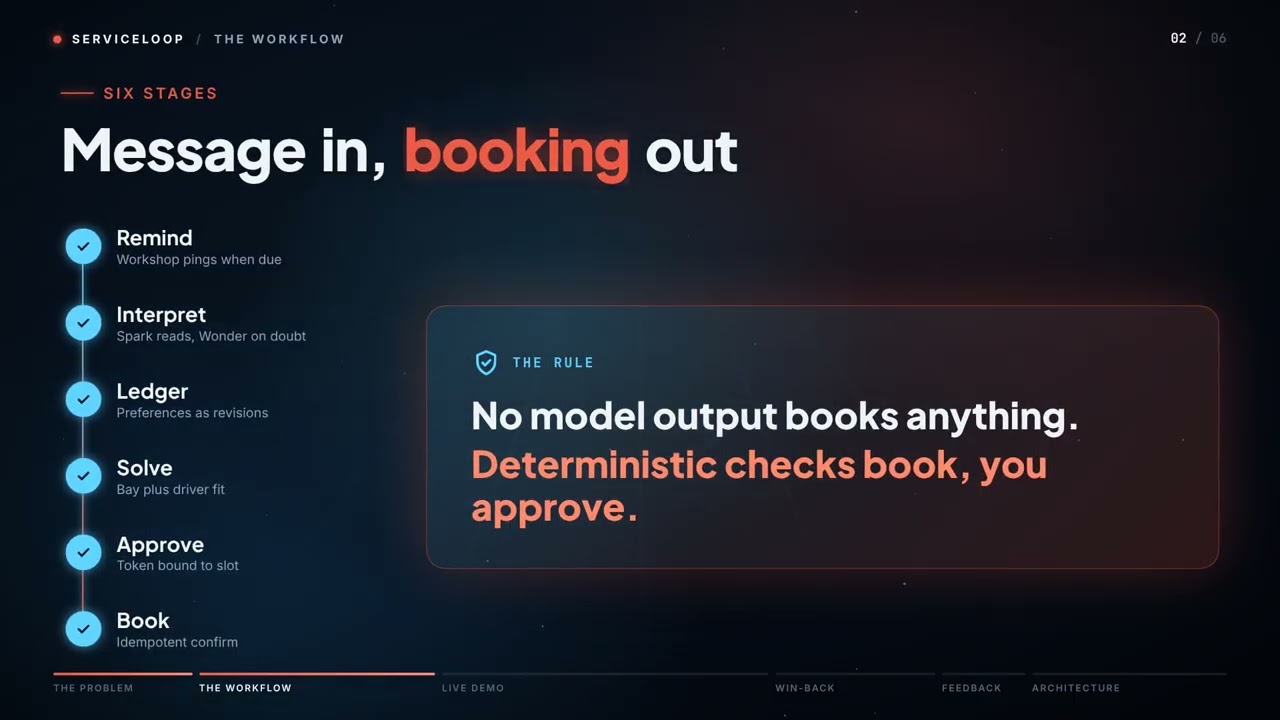
So my Toyota car was due for a service, but finding the time to sort it was a proper pain. The workshop would ring whilst I was busy, and I’d still be left wondering: what slots have they got, can they collect the car, and will any of it fit around my day? I already knew the car needed a service. It was all the back-and-forth to get it booked that was doing my head in. That experience inspired **ServiceLoop**. I wanted to reply, “Saturday morning, only if pickup is available,” and have a system check the options, clarify anything unclear, and bring me a proposal to approve. I see it as a win-win. Customers get a simpler way to arrange a service around their lives. Workshops could spend less time chasing people, understand why customers haven’t booked, and turn more reminders into appointments. A lot of startups focus on winning new customers, but I think there’s a real opportunity to make life easier for the customers businesses already have. ServiceLoop addresses **Build for Your World** by bringing Meta’s models into a problem I experience firsthand. **What it does** ServiceLoop turns service reminders into a conversation. Customers can introduce new constraints, change their preferences, and ask questions without restarting the booking process. - It maintains a **revisioned constraint ledger**, distinguishes pickup time from service time, and asks about ambiguous requests such as “before ten.” - It checks service-bay and pickup-driver availability before proposing an appointment. - Confirmation requires **explicit customer approval** bound to the exact proposal and final price. Changed terms require fresh approval. - The win-back flow explores why a customer has not booked, whether because of price, timing, pickup, or a poor previous experience. - Discount offers follow configured workshop policies with eligibility rules, caps, and expiry dates. The model cannot invent discounts or authorize exceptions. **How it works** The core design rule is: **models interpret; deterministic code decides.** - **Muse Spark** interprets customer messages as structured constraint updates. - **Muse Wonder** provides a bounded second opinion for ambiguous or invalid interpretations. - **Application code** validates the updates, checks resources, and controls booking. The application uses **TypeScript, React, and SQLite**. Muse Code supported implementation and testing. Meta-direct is the default inference provider, with additional Muse Spark Open adapters through Baseten and Modal. **What we demonstrated** Our recorded clean frozen evaluation achieved **40/40 candidate successes, 40/40 booking successes, and zero booking violations** within that test suite. We also compared Meta-direct and Baseten on held-out interpretation cases. The submitted demo runs in browser text chat with clearly labeled simulated workshop data. **WhatsApp is not connected.** Voice transcription passed a separate API contract test but is not wired into the browser flow. The next step is a consented workshop pilot to measure whether negotiated reminders lead to completed appointments and fewer unwanted follow-ups.